

 Travel Essentials
 Travel Essentials

Learn how to get started with hurling, understand its rules, history, and cultural significance in Ireland.
 Travel Essentials
Ireland’s contribution to global sports extends far beyond football and rugby. Nestled within the Emerald Isle lies one of the world’s oldest and most exhilarating field games: hurling. This ancient sport captivates millions of players and spectators across Ireland and increasingly throughout the world. For visitors seeking an authentic cultural experience or individuals curious about Irish heritage, understanding hurling opens a window into the soul of Irish identity and community life.
The story of hurling stretches back through millennia of Irish history, making it one of the planet’s most enduring athletic pursuits. Hurling has been played for over 3,000 years in Ireland, with the first literary references appearing around 1272 BC. The sport’s antiquity is so profound that it predates recorded Irish history itself, suggesting it may have existed before Christianity’s arrival on the island.
Archaeological investigations reveal that hurley sticks and balls date back to at least the twelfth century, providing tangible evidence of the sport’s medieval practice. Early Irish law documents known as the Brehon Laws contain explicit references to hurling, indicating that by the fifth century, the sport was sufficiently established to warrant legal documentation. References appear throughout ancient Irish mythology, poetry, and historical chronicles, underscoring hurling’s profound cultural significance across centuries.
The sport’s evolution reflects broader patterns in Irish society. During periods of conflict and colonization, hurling was weaponized as a cultural identifier. The 1366 Statute of Kilkenny explicitly prohibited Gaelic Irish cultural practices, including hurling, within English-controlled territories, demonstrating how the sport became intertwined with Irish resistance and identity. Centuries later, following the Act of Union in 1798, British authorities banned large public gatherings of men and suppressed hurling as a precaution against potential insurrection. Combined with the devastating Great Famine, this period nearly extinguished the sport entirely.
The late nineteenth century marked a transformative moment for hurling. Michael Cusack championed the sport’s revival, publishing articles about hurling’s historical importance in newspapers beginning in 1882. His efforts culminated in a pivotal development: the founding of the Gaelic Athletic Association (GAA) in 1884 in Thurles, County Tipperary.
The GAA’s establishment represented far more than administrative reorganization. Before formal standardization, hurling clubs across Ireland operated under varying rule sets, resulting in chaotic and inconsistent competition. The GAA’s primary contribution was formalizing the sport around a unified written rule system. This standardization extended to equipment; prior to the GAA’s intervention, players wielded hurleys of diverse designs, each reflecting personal preference and regional tradition. The organization designated the bossed hurley as the official standard, introducing consistency to equipment specifications.
The first All-Ireland Hurling Championship took place in 1891, with Kerry capturing the inaugural title. The following year, Tipperary’s Thurles Blues defeated Meelick of Galway to claim the 1888 championship, establishing the competitive framework that endures today. These early championships transformed hurling from a dispersed folk practice into a formalized national competition, galvanizing public interest and participation.
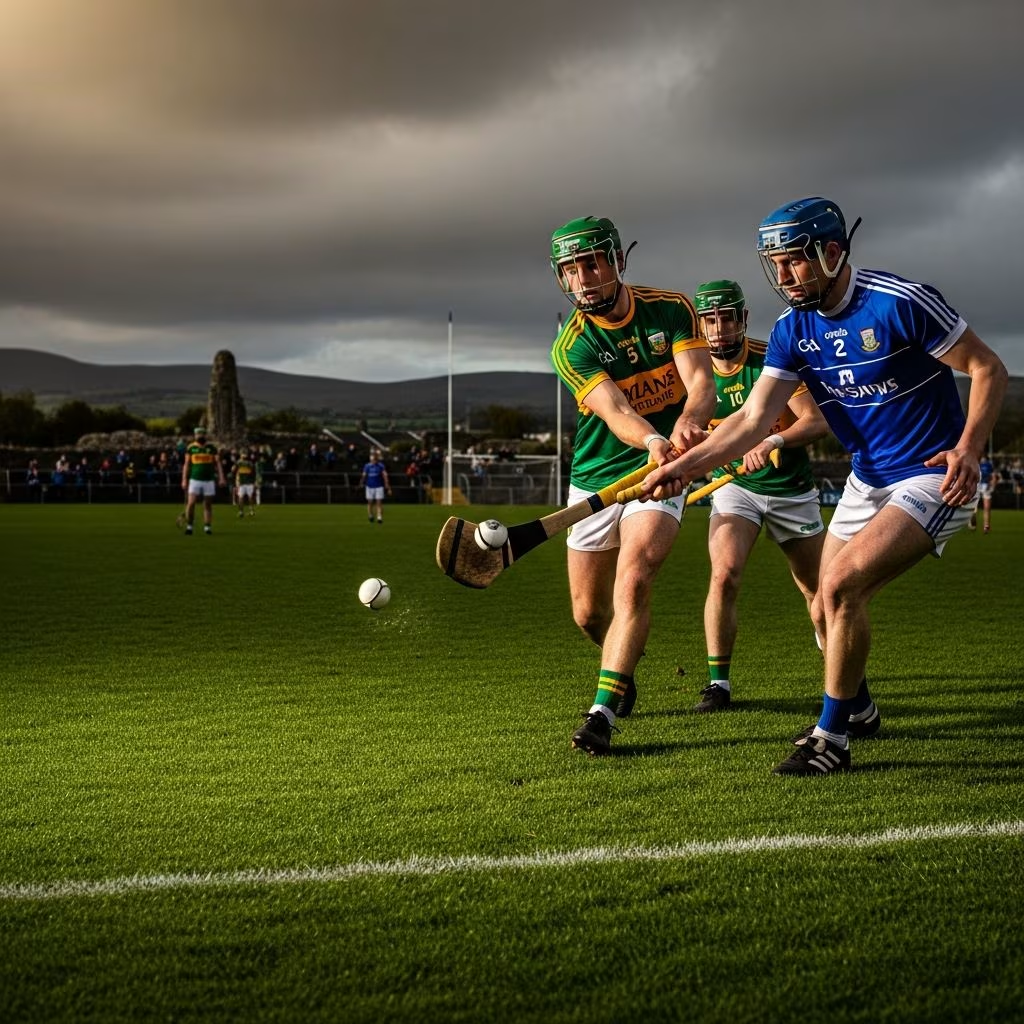
For newcomers, hurling initially appears bewilderingly complex, but its core principles follow a logical structure. The sport involves two teams attempting to propel a small ball—called a sliotar—across an opponent’s goal line using wooden sticks known as hurleys.
Basic gameplay elements include:
The sport combines the precision of golf, the physicality of rugby, the teamwork of basketball, and the hand-eye coordination demands of baseball. This unique blend creates an extraordinarily demanding yet exhilarating athletic experience.
Hurling imposes extraordinary physical requirements on participants. Players must simultaneously develop hand-eye coordination of elite caliber, explosive leg power, upper-body strength, and cardiovascular endurance. The sport demands constant directional changes, rapid acceleration and deceleration, and sustained intensity across competition.
Beyond physical attributes, hurling requires sophisticated tactical intelligence. Players must anticipate ball trajectories, read opposing formations, execute precise passes under pressure, and adapt strategies in real-time. The sport’s fluidity means that play continuously transitions between offense and defense, requiring players to maintain spatial awareness while executing technical skills.
The psychological component proves equally demanding. Hurling players must manage pressure during high-consequence moments, maintain focus across fluctuating momentum shifts, and coordinate seamlessly with teammates in compressed timeframes.
Contrary to perceptions that hurling belongs exclusively to Irish natives or the athletically elite, the sport welcomes newcomers of diverse backgrounds and ability levels. Most Irish communities maintain hurling clubs offering structured pathways for entry.
Practical starting points include:
Many clubs provide equipment for beginners, eliminating financial barriers to participation. As players develop competence, they can invest in personal hurleys customized to their playing style and physical dimensions.
Hurling requires minimal equipment compared to many sports, though quality construction matters significantly.
| Equipment | Description | Key Considerations |
|---|---|---|
| Hurley | Wooden stick typically thirty to thirty-seven inches long with a flattened blade | Crafted from ash wood; weight, balance, and blade size vary by manufacturer and player preference |
| Sliotar | Cork-centered ball covered with leather or synthetic material, slightly smaller than baseball | Official specifications ensure consistency across competitive matches |
| Protective Helmet | Essential safety equipment with face guard and protective padding | Mandatory in organized competitions; protects against ball impact and collisions |
| Mouthguard | Custom or standard protective device for dental protection | Reduces risk of dental injury during contact situations |
| Jersey and Shorts | Standardized club attire in team colors | Usually provided by clubs; allows team identification |
For those not yet ready to play, attending hurling matches provides unparalleled entertainment and cultural immersion. The All-Ireland Senior Hurling Championship represents the sport’s apex, showcasing athletes performing at extraordinary technical and physical levels. Matches between traditional powerhouses like Kilkenny, Limerick, Tipperary, and Wexford draw massive crowds and generate intense regional pride.
Attending a hurling match offers multiple layers of experience. The atmospheric intensity surrounding championship matches creates electric environments filled with passionate supporters. The sport’s fast-paced action keeps spectators constantly engaged, with momentum shifts occurring within seconds. The technical brilliance displayed by elite players—impossible catches, explosive strikes, and creative field vision—rivals any professional sport globally.
Regional festivals and community club matches offer more intimate experiences. These events showcase hurling’s grassroots character while providing more relaxed social atmospheres ideal for learning the sport’s nuances without competitive intensity.
Beyond athletic competition, hurling functions as a cornerstone of Irish cultural life. GAA clubs serve as community hubs where players, families, and supporters converge around shared passion and local pride. These institutions organize not only sports competitions but also social events, fundraisers, and cultural celebrations throughout the year.
For many Irish individuals, hurling club membership constitutes a lifelong commitment spanning childhood through adulthood. The sport provides structured pathways for youth development, mentorship across generations, and social bonding. In rural communities particularly, GAA clubs anchor social structures and collective identity.
The sport’s cultural significance extends internationally, with Irish diaspora communities establishing hurling clubs across North America, Australia, and Europe. These organizations preserve Irish heritage while introducing hurling to increasingly diverse populations.
Travelers exploring Ireland can integrate hurling experiences into their itineraries through multiple approaches. Attending matches provides immediate exposure to the sport’s excitement and cultural significance. Many tourist information centers provide championship schedules and venue directions. The GAA’s official website offers comprehensive competition information, fixture schedules, and ticket information.
Some communities offer hurling experiences specifically designed for tourists, combining instruction with cultural context. These programs typically operate during peak tourism seasons and provide equipment, foundational coaching, and social engagement with local players.
Visiting historic GAA stadiums offers insight into the sport’s infrastructure and heritage. Croke Park in Dublin, one of the world’s largest stadiums, hosts major championships and museum exhibits documenting hurling’s evolution and champions.
