

 Travel Essentials
 Travel Essentials

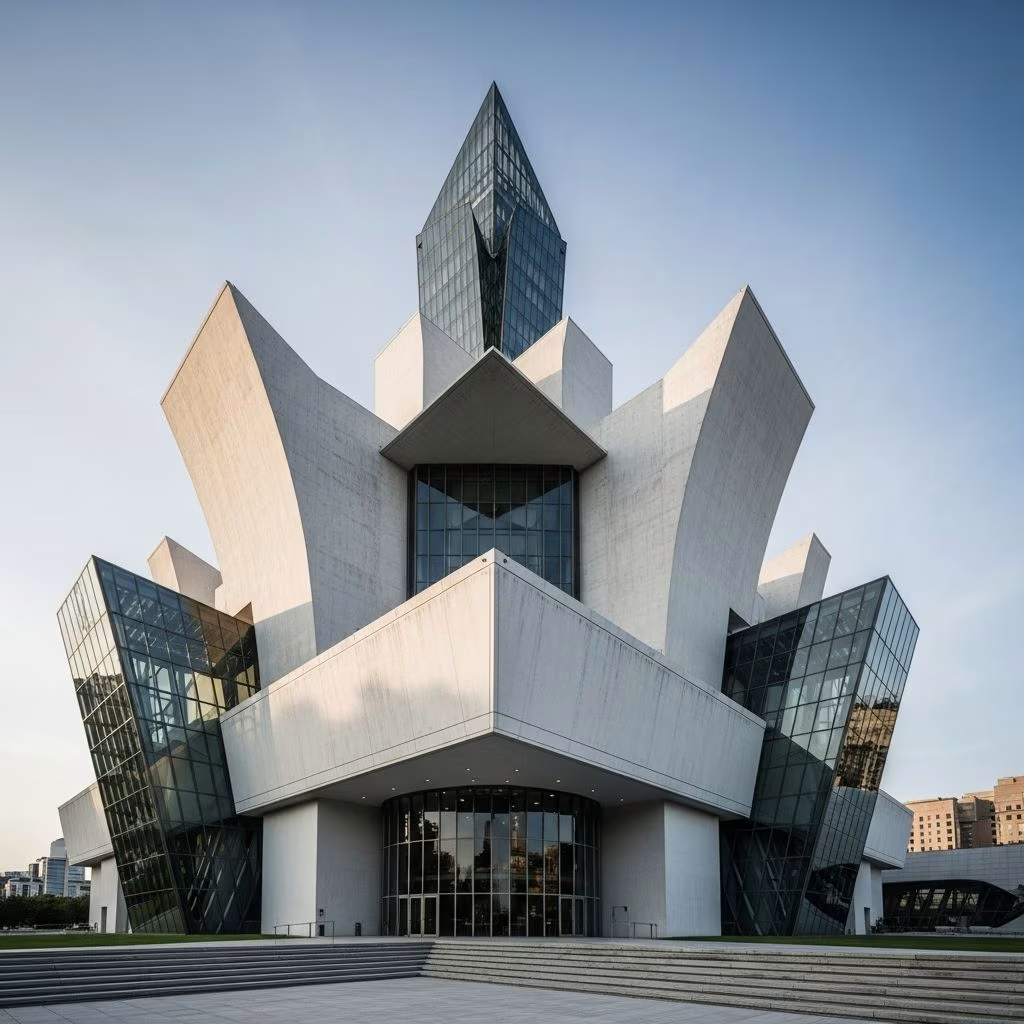
Explore the life and iconic works of architect I.M. Pei, including the Louvre Pyramid, Bank of China Tower, and National Gallery East Building, blending tradition with innovation.
 Travel Essentials
I.M. Pei, a pioneering architect born in China in 1917 and passing in 2019, transformed skylines and cultural institutions worldwide with his precise geometric forms and seamless integration of modern materials like glass and steel. His portfolio spans museums, towers, and civic spaces, often sparking initial controversy before achieving timeless acclaim.
Born Ieoh Ming Pei in Guangzhou, China, Pei moved to the United States in 1935 to study at MIT and Harvard, where he absorbed modernist principles from masters like Walter Gropius. His early career at Webb & Knapp involved urban redevelopment, but it was his independent firm, I.M. Pei & Associates (later Pei Cobb Freed & Partners), that launched him to stardom. Pei’s philosophy emphasized harmony between structure, site, and culture, evident in his use of triangles, pyramids, and sharp angles to evoke stability and light.
Pei’s designs evolved from bold urban towers in the 1960s to intricate cultural complexes, always prioritizing natural light and spatial flow. He received the Pritzker Prize in 1983, cementing his status as a 20th-century giant.
Pei’s museum projects redefined how art interacts with architecture, using innovative entrances and layouts to enhance visitor experience.
The glass Louvre Pyramid, completed in 1989, serves as the museum’s grand entrance amid historic wings. Spanning 24 meters tall with 673 diamond-shaped panes, it floods underground galleries with daylight while preserving classical facades. Initially criticized as an ‘eyesore’ by locals, it now symbolizes Paris, welcoming 10 million visitors yearly. Pei drew inspiration from the museum’s courtyard and ancient Egyptian motifs, creating a subtle nod to the site’s archaeological roots.
Opened in 1978, this trapezoidal marble masterpiece expands the National Gallery with sharp angles and a central waterfall. Its 180,000 square feet house modern art in flexible galleries, with a grand triangular atrium showcasing Pei’s mastery of light and stone. The building’s limestone facade echoes nearby neoclassical structures, bridging old and new.
Unveiled in 1995, this glassy pyramid rises from Lake Erie, its 165-foot tower piercing the sky. Pei incorporated ramps and a surreal entrance hall to mirror music’s energy, blending steel, glass, and concrete in dynamic forms.
Pei’s towers stand as engineering feats, challenging traditional silhouettes with angular profiles inspired by nature and origami.
This 1990 supertall at 367 meters features four triangular prisms forming a cruciform shape, symbolizing growth and bamboo stalks—key in Chinese culture. Its exposed steel skeleton withstands typhoons, pioneering curtain-wall technology. The design reflects Pei’s heritage while embracing modernism.
| Feature | Details |
|---|---|
| Height | 367 meters (70 floors) |
| Materials | Glass, aluminum, steel |
| Unique Aspect | Triangular sections reduce wind load |
Completed in 1979, this stark white cube perches on a waterfront hill, its glass pavilion overlooking Boston Harbor. Pei called it his most significant project, designing intimate spaces for exhibits on Kennedy’s life amid a monumental exterior.
Beyond Western landmarks, Pei crafted spaces celebrating science and heritage in Asia and beyond.
This 23,000-square-meter facility, opened recently, gleams with aluminum cladding on Macao’s waterfront. Its spherical and cubic forms house interactive exhibits, fostering education opposite Hong Kong.
In Qatar, Pei’s 2008 limestone fortress evokes traditional dhow boats, rising from the bay with intricate mashrabiya screens. The central dome illuminates Quran manuscripts and artifacts.
Pei’s early works reshaped American cities with mixed-use complexes.
In Denver, the Mile High Center (1956) integrated offices, retail, and plazas, pioneering pedestrian-friendly design. The William L. Slayton House in D.C. (1960) exemplifies his modernist residences with open plans and site-specific features. Later, 131 Ponce de Leon in Atlanta (1949) showed his initial forays into adaptive reuse.
At 102, Pei left over 50 major projects, influencing generations with his insistence on context-driven design. His structures endure debates, like the Louvre Pyramid’s shift from scorn to icon, proving architecture’s power to evolve public perception. Pei’s fusion of Eastern philosophy—balance, simplicity—with Western tech created timeless beacons.
Today, his buildings host millions, inspiring architects to prioritize light, form, and narrative. From Paris to Hong Kong, Pei’s vision reminds us architecture bridges past and future.
Pei blended sharp geometries, glass/steel materials, and cultural motifs, emphasizing natural light and site harmony.
The Louvre Pyramid faced backlash for clashing with historic surroundings but is now beloved.
Dozens of icons, from museums to towers, listed extensively in architectural archives.
Bank of China Tower (Hong Kong), Macao Science Center, and Doha’s Islamic Art Museum.
Yes, including the 1983 Pritzker Architecture Prize.
