

 Travel Essentials
 Travel Essentials

Explore the vibrant cultures, traditions, and heritage of India's Indigenous communities across different regions and their profound connection to nature.
 Travel Essentials
India’s landscape is woven with the stories, traditions, and cultural practices of its Indigenous communities, often referred to as the original inhabitants of the subcontinent. These diverse groups represent a significant portion of India’s population, maintaining distinct languages, belief systems, and ways of life that have persisted for thousands of years. Understanding these communities requires moving beyond stereotypes to appreciate the complexity, resilience, and richness of their cultural heritage.
The term used to describe India’s Indigenous peoples encompasses over 200 distinct communities, each with its own linguistic, cultural, and social characteristics. These communities constitute approximately 8.6% of India’s total population, representing around 104 million individuals according to census data. This substantial demographic presence underscores the importance of Indigenous cultures in shaping India’s national identity and contemporary society.
What is particularly significant is the linguistic and cultural diversity within this broad categorization. With more than 100 languages spoken across different Indigenous communities, and variations in social structures and belief systems, it would be inaccurate to treat these groups as a homogeneous entity. Instead, recognizing each community’s unique characteristics while acknowledging shared experiences becomes essential for meaningful engagement with Indigenous cultures.
Among the largest and most prominent communities are the Bhil, Munda, and Santhal peoples, each with distinct territorial bases and cultural practices. Their geographical distribution spans from the northeastern frontier states to the southern highlands, from mineral-rich plateaus to coastal regions.
Indigenous communities are not uniformly distributed across India but rather concentrate in specific geographical regions, each with distinct ecological and cultural features:
Indigenous spiritual systems in India reflect a profound connection to natural elements and ancestral wisdom. Rather than adopting external religious frameworks, many communities maintain indigenous belief systems passed down through oral traditions over generations.
In Central and Eastern India, the Sarna religion, also known as the “religion of the holy woods,” forms the spiritual foundation for communities including the Munda, Ho, Santhal, and Oraon peoples. This system emphasizes worship of village deities, celestial bodies, and sacred groves, with religious knowledge transmitted through oral narratives rather than written scriptures. The concept of sacred groves reflects an understanding of forests as spiritually significant spaces deserving protection and reverence.
Across Indigenous communities, animistic worldviews—recognizing spiritual essence in natural phenomena—are prevalent. This perspective shapes daily practices, agricultural calendars, and seasonal celebrations, creating a seamless integration between spiritual belief and material existence.
Indigenous artistic traditions represent centuries of accumulated skill, aesthetic innovation, and cultural meaning-making. These crafts serve not merely as economic activities but as expressions of community identity and repositories of cultural knowledge.
Kondagaon in Bastar has achieved recognition for its distinctive bell-metal and wrought-iron craftsmanship, with artisans creating functional objects that double as artistic expressions. Similarly, the Toda communities of the Nilgiris produce intricate embroidered shawls featuring geometric patterns in striking red, black, and white combinations that carry cosmological significance.
Beyond these regionally celebrated crafts, Indigenous communities throughout India produce textiles, basketry, jewelry, and pottery that reflect local materials, cultural aesthetics, and technical expertise. These handicrafts often become economic lifelines for communities while simultaneously serving as cultural preservation mechanisms.
Indigenous communities have developed governance structures emphasizing collective decision-making, resource sharing, and leadership based on respect and consensus rather than hierarchical authority. Traditional systems such as gram sabhas demonstrate grassroots democratic participation that predates modern constitutional frameworks.
Social organization typically centers on clan-based structures with defined responsibilities and social roles. Elders occupy positions of particular significance, serving as repositories of traditional knowledge, conflict mediators, and guides for younger generations. This intergenerational knowledge transfer ensures cultural continuity while allowing adaptation to changing circumstances.
The emphasis on collective welfare over individual accumulation shapes resource distribution, dispute resolution, and responses to community challenges. This communal orientation reflects values fundamentally different from competitive, individualistic social models.
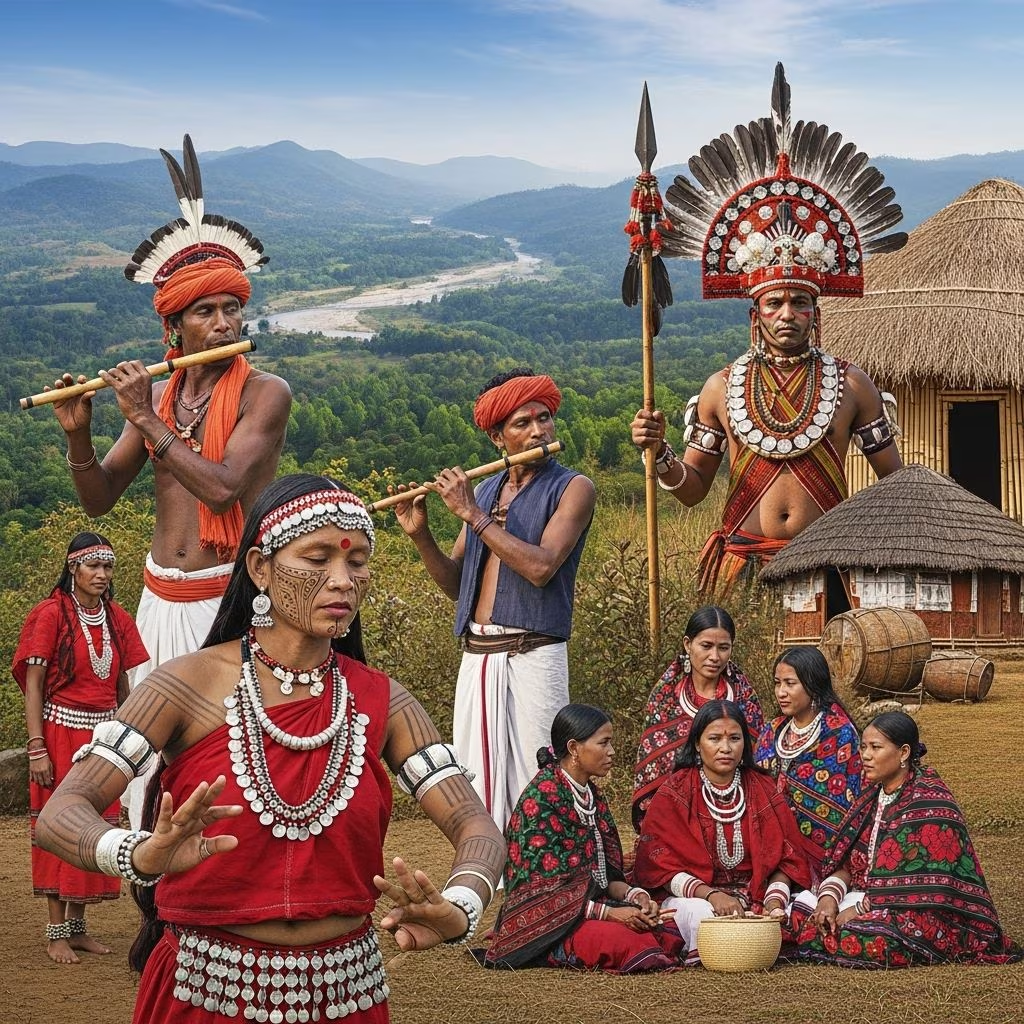
Indigenous communities mark the passage of seasons and commemorate ancestral connections through festivals characterized by music, dance, and communal participation. These celebrations serve multiple functions simultaneously: reinforcing community bonds, transmitting cultural values, honoring natural cycles, and expressing joy and gratitude.
Traditional music forms an integral component of these celebrations, with communities employing percussion instruments like drums and wind instruments such as flutes to create rhythmic accompaniments for dancing. Different regions have developed distinctive dance forms that encode cultural narratives and aesthetic principles—movements often reflect relationships with the environment, historical experiences, or spiritual concepts.
Traditional clothing worn during these occasions incorporates vibrant patterns and natural dyes, with each community developing distinctive aesthetic preferences that signal identity and cultural affiliation.
Indigenous communities have sustained themselves through diversified livelihood strategies combining agriculture, forest resource collection, and increasingly, craft production. These practices reflect sophisticated ecological knowledge accumulated over countless generations.
Agricultural techniques including shifting cultivation represent adaptations to local environmental conditions that, when practiced sustainably, maintain forest biodiversity. The collection of forest produce—fruits, nuts, medicinal plants, and fibers—supplements agricultural income while providing communities with resources for medicinal and cultural purposes.
This integration of agriculture, gathering, and craftsmanship demonstrates a holistic approach to resource utilization that avoids overdependence on single income sources while maintaining ecological balance. Such sustainable practices offer lessons for contemporary environmental management.
The linguistic landscape of Indigenous India encompasses remarkable diversity, with communities speaking languages belonging to different language families including Dravidian, Austroasiatic, and Tibeto-Burman groups. This linguistic variety reflects different ancestral migrations and cultural developments across the Indian subcontinent.
Oral traditions serve as primary mechanisms for preserving and transmitting knowledge, with storytelling, song, and ritual discourse conveying historical narratives, ethical teachings, and practical information. These oral systems are not inferior substitutes for written traditions but rather sophisticated knowledge management systems adapted to specific cultural contexts.
The colonial period fundamentally disrupted Indigenous communities through policies that criminalized traditional practices and alienated people from ancestral lands. The Forest Act of 1865 represented a watershed moment, transforming forests from communal resources into state property and declaring activities essential to Indigenous survival—hunting, gathering, and shifting cultivation—as illegal.
Contemporary challenges include severe economic marginalization, with nearly 46% of Indigenous peoples living below the poverty line nationally, and over 72% in mineral-rich Odisha. This paradox—whereby communities inhabit resource-rich regions yet experience extreme poverty—reflects systematic exclusion from economic benefits of resource extraction.
Despite these obstacles, communities continue resisting threats to their lands and cultures, with movements like the Dongria Kondh resistance to mining projects demonstrating how shared cultural identity mobilizes collective action.
Indigenous cultural practices function as more than historical artifacts; they actively generate community cohesion, transmit values, and provide frameworks for understanding the world. Rituals, languages, artistic practices, and indigenous knowledge systems collectively strengthen social bonds and reinforce shared identity.
The persistence of these traditions despite centuries of pressure reflects the adaptive capacity and cultural vitality of Indigenous communities. Rather than remaining static, these cultures continue evolving while maintaining core characteristics that distinguish them from dominant Indian society.
Indigenous communities function as custodians of India’s most ecologically significant regions—densely forested areas, biodiverse ecosystems, and watersheds critical for national water security. Their sustainable livelihood practices and spiritual reverence for natural elements have historically supported ecological preservation.
The recognition of Indigenous ecological knowledge offers contemporary society valuable perspectives on sustainable resource management, biodiversity conservation, and living in harmony with natural systems.
In India, Indigenous peoples are recognized as the original inhabitants of specific regions, maintaining distinct cultures, languages, and governance systems that predate mainstream Indian society. They constitute approximately 8.6% of India’s population.
There are over 200 distinct Indigenous communities in India, speaking more than 100 languages and varying significantly in ethnicity, culture, and social practices.
Approximately 75% of India’s Indigenous population lives in the eastern belt centered on the Chhota Nagpur Plateau in Jharkhand and adjacent areas, though they also inhabit northeastern states and southern highlands.
Indigenous communities traditionally rely on agriculture, forest resource collection, handicraft production, and in many cases, small-scale trading. These practices are often combined to create diversified income sources.
Traditional governance emphasizes collective decision-making through systems like gram sabhas, with elders playing significant roles in mediating disputes and guiding community choices.
India’s Indigenous communities represent living embodiments of cultural diversity, ecological wisdom, and social resilience. Their traditions, languages, artistic practices, and spiritual worldviews contribute substantially to India’s cultural richness while offering contemporary society valuable lessons about sustainable living, democratic participation, and human connection to natural systems.
Engaging meaningfully with Indigenous cultures requires moving beyond tourist perspectives to recognize these communities as dynamic societies actively shaping their futures while maintaining cultural continuity. Supporting Indigenous cultural preservation, territorial rights, and economic equity becomes essential not only for justice but for preserving knowledge systems and practices vital for addressing contemporary global challenges.
