

 Travel Essentials
 Travel Essentials

Discover India’s stepwells: ancient underground water reservoirs with stunning carvings, rich history, and unforgettable architecture.
 Travel Essentials
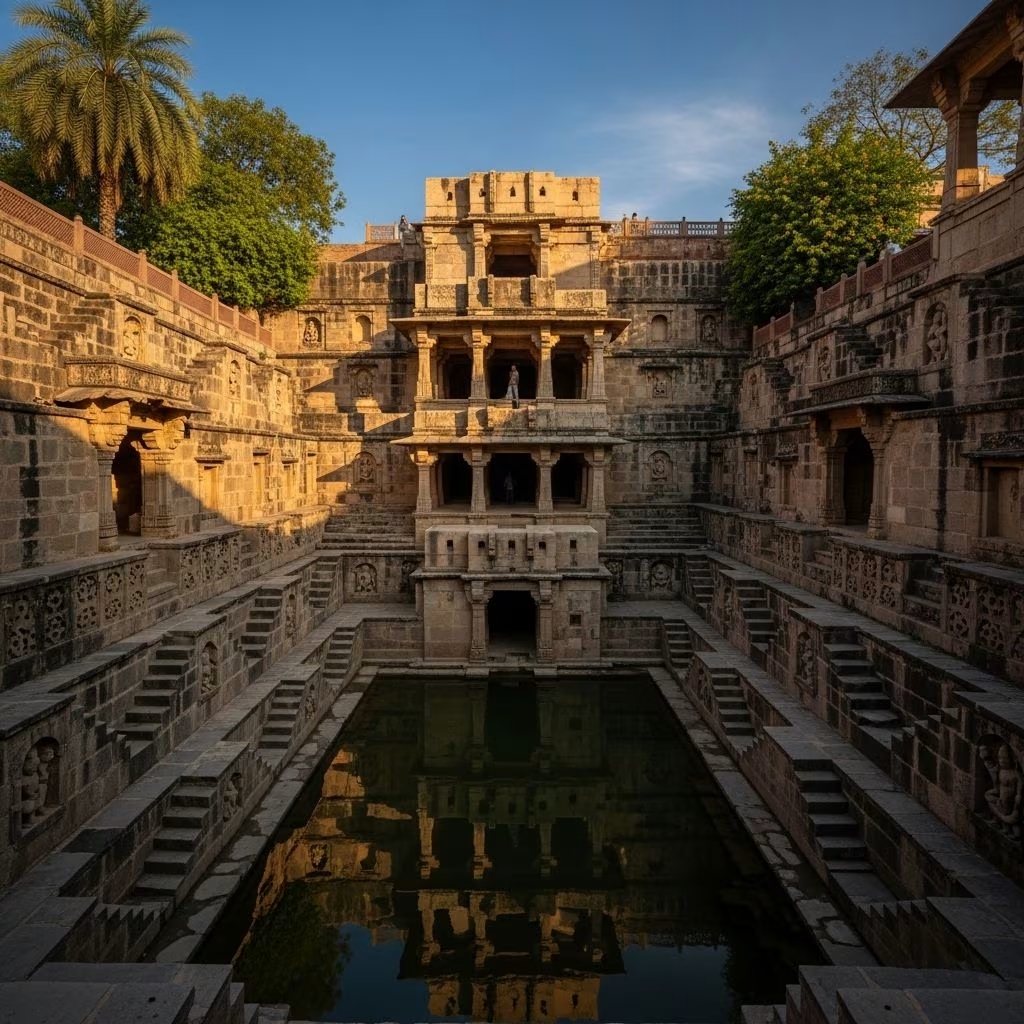
Deep beneath the arid landscapes of western India lie extraordinary subterranean structures known as stepwells, or baolis and vavs. These ingenious creations served as vital water reservoirs in regions plagued by drought, allowing communities to access groundwater through cascading flights of steps. Beyond their practical purpose, stepwells stand as testaments to medieval engineering prowess, adorned with intricate carvings that depict mythology, flora, fauna, and daily life. Predominantly found in Rajasthan and Gujarat, they originated as early as the 7th century and flourished under Hindu, Jain, and Islamic patronage. Today, these sites draw adventurers seeking offbeat historical experiences, blending architectural splendor with cultural immersion.
Stepwells represent a unique response to India’s harsh climate. Unlike surface wells, they feature tiered staircases that descend to fluctuating water levels, ensuring year-round access even in the dry season. The earliest examples date back to 550-625 AD in Gujarat’s Rajkot district, evolving into sophisticated multi-level complexes by the 11th century. During Muslim rule from the 11th to 16th centuries, designs incorporated arches, domes, and pavilions, transforming them into shaded social hubs for rituals, festivals, and respite from the heat.
Architecturally, a typical stepwell comprises a central shaft surrounded by symmetrical steps, platforms, and galleries supported by ornate pillars. Carvings often illustrate Vishnu avatars, elephants symbolizing prosperity, and floral motifs evoking paradise. Many were commissioned by queens and nobles as acts of piety, embedding religious iconography that reflects the era’s spiritual ethos. Their revival in recent years, through conservation efforts by bodies like the Archaeological Survey of India, has turned neglected ruins into vibrant tourist attractions.
Rajasthan, with its desert terrain, boasts some of the most dramatic stepwells. These structures were crucial for caravans along ancient trade routes, doubling as communal gathering spots.
Nestled in the village of Abhaneri, about 95 km from Jaipur, Chand Baori is among the world’s deepest and largest stepwells, plunging 30 meters over 13 levels with 3,500 precisely arranged steps in a hypnotic geometric pattern. Built between 800-900 CE by King Chanda of the Nikumbh dynasty, it functioned as both a water source and social center. Its sheer scale and symmetry have captivated filmmakers, appearing in Hollywood productions. Visitors descend the east side for the full visual impact, while a nearby Harshat Mata Temple adds spiritual context. Entry is free; best visited at dawn to avoid crowds and heat.
In the blue city’s heart, Toorji ka Jhalra, constructed around 1740 by Queen Gulab Rai, has been meticulously restored, revealing lime-plastered steps and carved elephants. Spanning multiple tiers, it once hosted religious ceremonies. Recent cleanups have made it a local hangout and photogenic spot amid bustling markets. Approach from the old clock tower for the grand reveal; photography thrives here during golden hour.
In Bundi, Raniji ki Baori (built 1699) exemplifies Rajput artistry with 46 double-story pavilions cascading down to crystal-clear water. Commissioned by Rani Nathavati, its walls gleam with floral reliefs and deity figures. Less crowded than larger sites, it’s ideal for quiet contemplation. Combine with nearby Taragarh Fort for a full-day heritage trail.
Gujarat hosts the finest preserved stepwells, thanks to silt burial that protected them from weathering. This state’s vavs are UNESCO-recognized for their sculptural excellence.
Patan’s Rani-ki-Vav, erected in 1063 by Queen Udayamati for her husband Bhimdev I, is India’s grandest, a UNESCO World Heritage Site since 2014. Buried by floods and rediscovered in the 1940s, its seven terraced levels brim with over 1,000 Vishnu sculptures, nagas, and apsaras in exquisite detail. The east-west alignment enhances light play on carvings. Open daily; audio guides enhance the experience.
Near Gandhinagar, the 1498 Adalaj Ni Vav honors Queen Rudabai, blending Hindu and Islamic motifs across five stories: floral screens, playful elephants, and chain-link carvings. Its octagonal base and columned corridors create a cool, echoing gallery. Legends of its builder’s sacrifice add mystique. Just 5 km from Gandhi’s ashram, it’s perfect for history buffs.
Beyond the west, stepwells dot other regions, offering urban surprises and hidden gems.
Tucked near Connaught Place, this 15th-century, 60-meter-deep baoli features 104 mossy steps and arched pavilions, protected by the Archaeological Survey of India. Myth links it to Maharaja Agrasen; it’s a serene escape from Delhi’s chaos. Evening visits reveal atmospheric lighting.
In Hampi, Pushkarani (16th century) serves as a ceremonial tank with steep, fringed steps amid Vijayanagara ruins. Karnataka’s pushkaranis, often temple-adjacent, hosted baths and festivals. Nearby, Sevasi Vav in Vadodara descends seven levels with 500-year-old finesse.
To visit safely, note these essentials:
| Stepwell | Location | Access | Best Time | Entry Fee |
|---|---|---|---|---|
| Chand Baori | Abhaneri, RJ | Bus from Jaipur (2 hrs) | Dawn/Dusk | Free/INR 50 foreigners |
| Rani-ki-Vav | Patan, GJ | Train from Ahmedabad | Daylight | INR 40 |
| Adalaj Ni Vav | Adalaj, GJ | Auto from Gandhinagar | Morning | Free |
| Agrasen Ki Baoli | Delhi | Metro to Barakhamba | Evening | INR 20 |
Wear sturdy shoes for uneven steps; avoid monsoons due to slippery conditions. Photography is permitted; drones often restricted. Hydrate and use sunscreen—depths amplify heat.
Many stepwells faced silting and misuse, but initiatives like Jodhpur’s restoration and Hyderabad’s repurposing signal hope. They embody sustainable hydrology, inspiring modern rainwater harvesting. Culturally, they hosted dances, weddings, and tales, preserving folklore in stone.
A stepwell is a multi-tiered groundwater access structure with steps leading to water, common in arid India for storage and community use.
Chand Baori in Abhaneri, Rajasthan, at 30 meters deep with 3,500 steps.
Many are; check railings and water levels. Guides recommended for deeper ones.
No, they’re historical sites; water may be stagnant or sacred.
Thousands historically; around 3,000 survive, concentrated in Gujarat and Rajasthan.
