

 Travel Essentials
 Travel Essentials

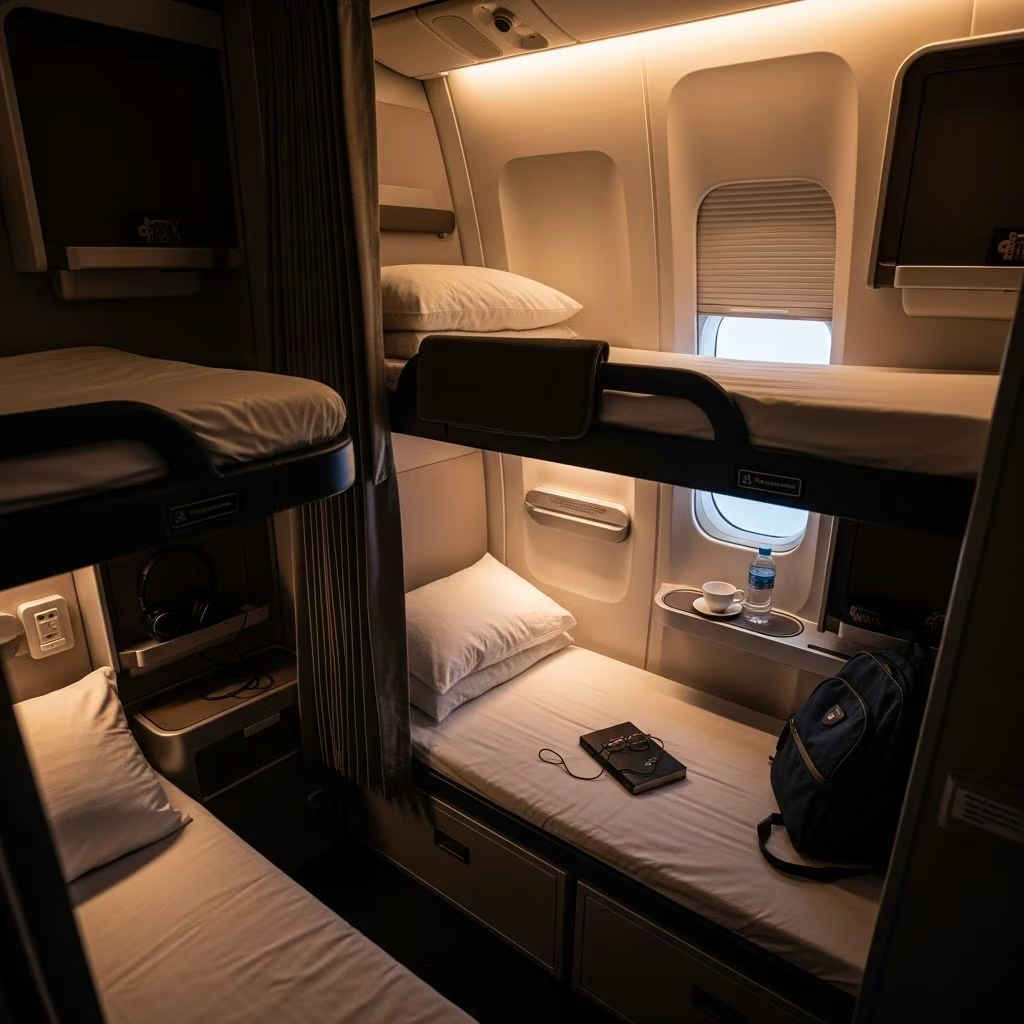
Explore the concealed rest compartments on widebody aircraft where cabin crew sleep on long-haul journeys, featuring stairs, bunks, and strict protocols for optimal rest.
 Travel Essentials
On extended journeys spanning continents, flight attendants play a crucial role in passenger safety and comfort. Yet, these professionals also need adequate rest to perform effectively. Modern widebody aircraft feature discreet compartments designed specifically for crew recuperation, tucked away from passenger view. These areas ensure compliance with international rest regulations while maintaining operational efficiency.
Flight duty periods often exceed 14 hours on routes like New York to Singapore or London to Sydney. Regulations mandate minimum rest: three hours when duties surpass 14 hours, escalating to 4.5 hours for periods over 18 hours. Crew members rotate shifts, with some resting post-meal services when fatigue peaks. This structured approach prevents exhaustion, safeguarding everyone on board.
These rules stem from aviation authorities emphasizing fatigue management. Without proper sleep zones, crew performance could decline, increasing error risks. Hidden rest areas address this by providing quiet, secure environments amid the aircraft’s hustle.
Entry points mimic everyday features to blend seamlessly. On certain models, a door resembling a lavatory leads to steep stairs or ladders. Boeing 777-300ER uses full stairs, while Airbus A350 employs ladder-style access with sliding panels. These narrow passages, often at the cabin’s rear, open to windowless bunk zones.
Once inside, crew navigate dim lighting to minimize disturbance, climbing to upper decks above economy sections.
Bunk configurations vary by aircraft. Boeing 777-300ER offers eight lie-flat bunks in two rows of four, separated by curtains and partitions for privacy. Airbus A350-1000 arranges them adjacently, optimizing limited space. Each bunk includes safety features like seatbelts for turbulence, oxygen masks, protective breathing equipment, flashlights, and interphones for emergencies.
| Aircraft Model | Bunk Count | Layout | Access Type |
|---|---|---|---|
| Boeing 777-300ER | 8 | 2 rows of 4 with aisle | Stairs |
| Airbus A350-1000 | Variable (up to 8) | Adjacent bunks | Ladders/Sliding door |
| Boeing 787 Dreamliner | 4-6 | Compact upper deck | Narrow staircase |
These spaces prioritize function over luxury: narrow beds with cushions, duvets, and bedding stored discreetly. Noise discipline is paramount; even unwrapping sheets requires caution to avoid waking others.
Rest schedules are pre-planned at briefings, with rotations ensuring constant coverage. First-group crew rest after initial services; second-group follows later, benefiting from accumulated fatigue for deeper sleep. Phones on vibrate serve as alarms, creating a chain reaction where one person’s movement cues others.
Pilots have analogous areas, often forward above first class, with similar interphone wake-ups. Acknowledgment buttons confirm readiness, linking rest periods to operational needs. Turbulence, jet lag, and flight phase influence rest quality, but designed features mitigate disruptions.
Beyond seatbelts, compartments include emergency lighting, PBE units, and direct cockpit communication. Located strategically—above rear cabins or below floors—they remain stable during maneuvers. Windowless designs reduce distractions, fostering rapid sleep onset.
Placement adapts to fuselage design. On Boeing 787s, rear upper compartments house flight attendant bunks; pilots rest forward. Some older jets position them below cabin floors. Virgin Atlantic and others camouflage doors at economy’s end, accessible via anonymous panels.
Ultra-long-haul flights (19+ hours) demand enhanced facilities. Lie-flat bunks with belts ensure safety, allowing crew to recharge fully between services.
Despite optimizations, challenges persist. Proximity means one stir awakens all; vibrations from engines or turbulence interrupt sleep. Crew adapt by preferring later slots and employing quick routines. No clocks or audible alarms maintain silence—vibrations and interphones suffice.
Aviation bodies like FAA and EASA enforce duty limits. Crew ‘sign-on’ to engines-off defines periods, mandating bunk time proportionally. Airlines like Cathay Pacific exemplify compliance, integrating rest into service cycles.
For 19-hour flights, rotations include multiple cycles, with bunks accommodating shifts seamlessly.
Functional rather than plush, with lie-flat bunks, padding, and safety gear prioritizing rest efficiency over luxury.
No—locked doors and high placements ensure exclusivity for crew only.
Typically 4-8, depending on aircraft and crew count, with rotations covering all.
No; separate forward compartments for flight deck crew.
Seatbelts secure occupants; designs minimize movement risks.
Imagine boarding a Boeing 777 for a 16-hour flight. Post-takeoff service, four attendants ascend discreet stairs. They settle into curtained bunks, phones vibrating softly after three hours. Emerging refreshed, they seamlessly resume duties, unnoticed by passengers below. This invisible system underpins flawless long-haul experiences.
Advancements continue: newer jets like A350s refine layouts for better airflow and noise reduction. As routes lengthen—think Perth to London—innovative rest solutions evolve, blending engineering with human needs.
