

 Travel Essentials
 Travel Essentials

Discover Ireland's most significant historical landmarks spanning five millennia, from ancient burial sites to medieval castles across the eastern region.
 Travel Essentials
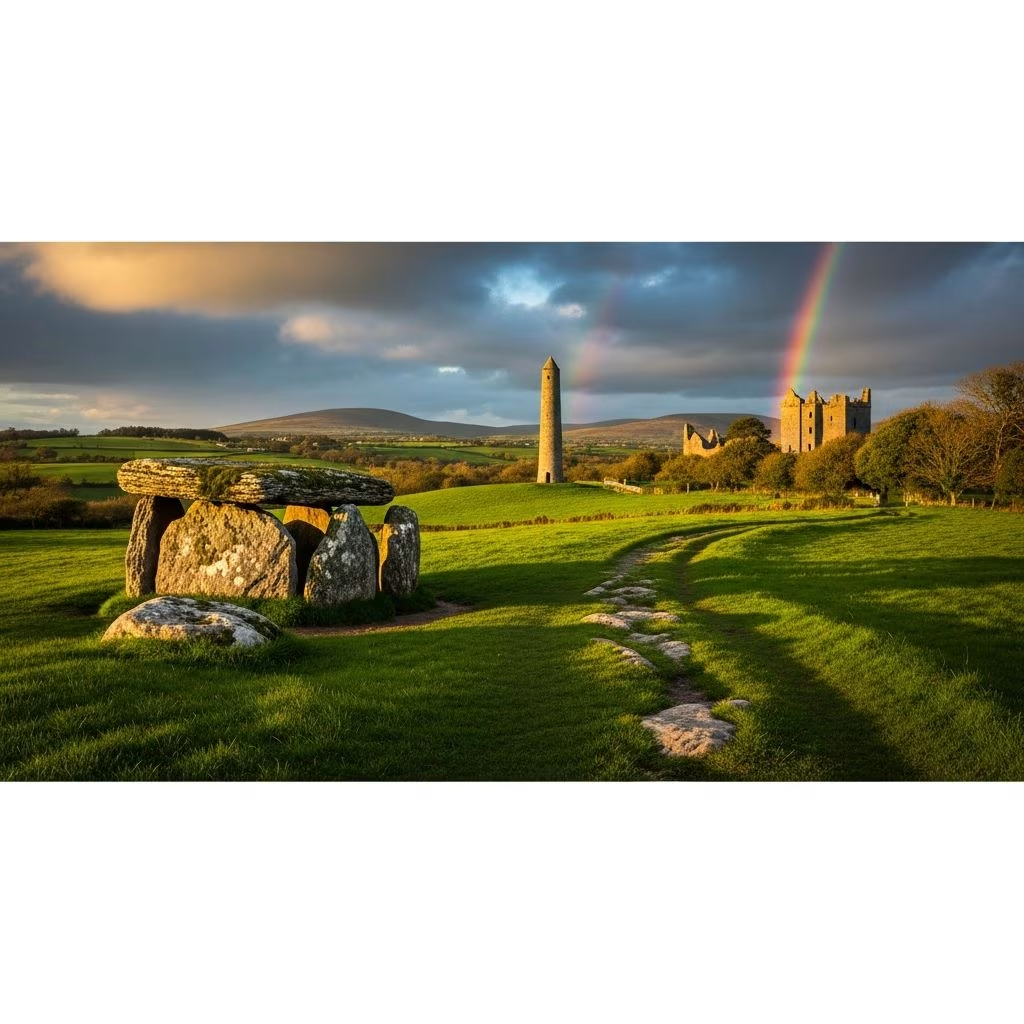
Eastern Ireland contains one of Europe’s most compelling historical landscapes, where visitors can traverse approximately 560 kilometers while moving through five thousand years of human settlement and civilization. This remarkable region, stretching from the megalithic achievements in the north through the midlands and extending southward to coastal cities, represents a journey through multiple epochs of cultural transformation. The pathway connects seventeen counties, each holding distinct archaeological significance and cultural narratives that reveal how successive waves of inhabitants shaped the land and left permanent marks on its geography and identity.
The eastern corridor of Ireland functions as an open-air museum where geological formations and constructed monuments serve as tangible evidence of continuous human habitation. Traversing this region means encountering physical remnants from the Stone Age alongside structures erected during the medieval period, with layers of religious significance interspersed throughout. The landscape itself becomes a teaching tool, with valleys and hilltops chosen by ancient peoples for both practical and spiritual reasons remaining visually prominent today.
Archaeological investigations reveal that eastern Ireland attracted successive populations who recognized the fertile plains and strategic positions as ideal for settlement. These inhabitants—ranging from prehistoric hunter-gatherers to organized Christian monastic communities and Viking traders—each contributed architectural styles, religious practices, and cultural artifacts that accumulated over millennia to create the region’s distinctive character.
The journey through eastern Ireland logically begins with its most ancient attractions, where megalithic structures predate Europe’s other famous prehistoric monuments. Newgrange, located in County Meath’s Boyne Valley approximately 50 kilometers north of Dublin, represents the archetypal example of Neolithic achievement. Constructed approximately 5,200 years ago around 3200 BC, this massive passage tomb predates Stonehenge by roughly one thousand years and surpasses the Great Pyramids of Egypt by approximately six centuries. The monument’s sophisticated architectural design demonstrates that Neolithic peoples possessed advanced understanding of astronomical alignment and stone construction techniques.
Beyond Newgrange, the Boyne Valley contains numerous complementary prehistoric sites that collectively represent the largest concentration of Neolithic ceremonial architecture in Western Europe. These sites reflect Stone Age communities’ complex cosmological beliefs and their commitment to constructing elaborate burial and ceremonial spaces. The archaeological significance of this concentration attracted UNESCO recognition, acknowledging the sites’ global importance to understanding human prehistory.
Additional megalithic attractions include Brownshill Dolmen in County Carlow and the Loughcrew Cairns, structures that showcase regional variations in Stone Age construction techniques. The Loughcrew site contains particularly significant carved artwork representing some of the largest concentrations of Stone Age artistic expression in Western Europe. These monuments collectively demonstrate that eastern Ireland was not peripheral to prehistoric European development but rather a center of cultural sophistication during the Neolithic period.
Beyond their archaeological importance, several eastern Irish locations hold profound spiritual and legendary significance within Celtic mythology and Christian tradition. The Hill of Tara, positioned 24 kilometers south of the Boyne Valley, functioned as the political and spiritual center of ancient Ireland for numerous centuries. Once home to Celtic druids and subsequently to Ireland’s high kings, Tara represented the seat of power for leaders who governed the Irish territories and commanded regional authority. The site’s association with the mythical Tuatha Dé Danann—the god-like race featured prominently in Celtic mythology—elevated its sacred status beyond its function as a political center. Visiting the grounds remains accessible at no cost, allowing contemporary travelers to contemplate the location’s historical weight within Irish consciousness.
The Hill of Slane, located near Tara, carries equally significant religious narratives. According to Irish Christian tradition, Saint Patrick lit a paschal fire on this hill in 433 AD in direct defiance of the ruling Irish high king’s authority. The hill subsequently witnessed Patrick’s explanation of Christian theology to the king through the symbolic metaphor of a shamrock, illustrating how the shamrock’s three leaves represented the paradox of Father, Son, and Holy Spirit existing as unified divinity. This moment marked Christianity’s ignition in Ireland, transforming the religious landscape and establishing the foundation for the monastic culture that would flourish throughout the early medieval period.
The transition from pre-Christian to Christian Ireland created unique hybrid religious landscapes where earlier sacred sites sometimes incorporated Christian meaning while entirely new monastic settlements emerged to support the expanding faith. Eastern Ireland contains multiple early Christian centers that functioned as intellectual and spiritual powerhouses during the medieval period, attracting scholars from across Europe and preserving crucial manuscripts during centuries when continental Europe experienced political fragmentation.
Clonmacnoise, established in the 6th century, became a renowned center of religious learning where monks meticulously copied manuscripts and developed theological scholarship. Glendalough, meaning “valley of two lakes,” served as another monastic retreat where Saint Kevin founded a monastic community that attracted pilgrims and students seeking spiritual development and educational advancement. These monastic settlements were not merely religious institutions but functioning schools where literacy, artistic techniques, and theological knowledge were transmitted to successive generations.
Mellifont Abbey and Jerpoint Abbey represent later monastic developments within the medieval period, showcasing architectural evolution as Romanesque and Gothic styles replaced earlier Romanesque approaches. These abbeys functioned as repositories of agricultural innovation, implementing advanced farming techniques while maintaining their spiritual missions. Monastic scriptoriums produced important historical documents, with Clonmacnoise monks writing the 11th-century Annals of Tighernach and contributing to the 12th-century Book of the Dun Cow—crucial texts for understanding medieval Irish history and mythology.
Irish monasteries maintained crucial roles during Europe’s early medieval period, preserving classical texts and Christian learning when political instability threatened intellectual continuity elsewhere. Monastic scribes copied valuable manuscripts, ensuring that ancient Greek and Roman knowledge survived through the early medieval centuries. This preservation function elevated Irish monasticism to continental significance, attracting students and scholars who recognized Irish monastic centers as intellectual refuges where learning could flourish despite regional political upheaval.
As the medieval period progressed, political authority increasingly expressed itself through castle construction and fortification development. The Rock of Cashel exemplifies this transition, functioning as a seat of power for both regional kings and clergy throughout more than one thousand years of continuous occupation. The site presents an extraordinary collection of fortifications enclosed by lime mortar walls, creating an imposing hilltop stronghold that commanded the surrounding landscape. Visitors enter through the 15th-century Hall of the Vicars Choral and encounter the 13th-century cathedral where its choristers sang liturgical music, alongside the approximately 11th-century round tower that punctuates the skyline. Cormac’s Chapel, built in 1127, represents Ireland’s first Romanesque chapel, showcasing architectural innovations emerging during the medieval period.
Medieval lords throughout eastern Ireland constructed castles and fortified residences that physically represented aristocratic power and territorial control. These structures evolved architecturally over centuries, with Norman innovations in stone construction and defensive design replacing earlier earthwork fortifications. Castle settlements frequently became focal points for emerging towns, with merchants establishing trading communities beneath castle walls for protection and commercial advantage.
Waterford holds the distinction of being Ireland’s oldest city, established as a Viking trading port in 914 AD by Norse merchants who recognized the harbor’s strategic advantages for maritime commerce. The Viking Triangle, comprising Waterford’s cultural quarter, contains over one thousand years of urban development compressed within several blocks, creating a geographically compact but chronologically expansive historical zone. Three museums within this area tell the city’s narrative progression from Viking raids through Georgian prosperity, allowing visitors to understand how Viking settlement transformed into established urban centers that survived subsequent invasions and political transitions.
Waterford’s most significant structure, Reginald’s Tower, dates to the 13th century and represents Ireland’s oldest complete building still standing. The tower exhibits displays chronicling Viking settlement patterns and subsequent medieval development, providing material evidence of how Norse traders established permanent settlements that evolved into politically important urban centers. The presence of Viking artifacts throughout Waterford demonstrates sustained Norse influence on Irish cultural and commercial development during the medieval period.
Before embarking on the physical journey through eastern Ireland’s monuments, the National Museum of Ireland – Archaeology in Dublin provides essential contextual framework for understanding the region’s historical progression. Established in 1877, the museum houses the world’s most complete collection of medieval Celtic metalwork, showcasing the artistic sophistication achieved by Celtic craftspeople during the pre-Christian period. The museum’s preserved Iron Age bog bodies, with intact features including fingernails, provide extraordinary insights into pre-Christian funeral practices and the preservation conditions within Irish peatlands.
Exhibition galleries devoted to Viking Ireland and Medieval Ireland display excavated materials from Dublin’s Wood Quay, revealing how medieval Dublin functioned as a significant urban center during periods when European cities were considerably smaller. These artifacts contextualize the sites visitors subsequently encounter throughout eastern Ireland, transforming ruins and standing monuments into understandable components of broader civilizational narratives.
The comprehensive journey from Dublin through eastern Ireland’s primary historical attractions extends approximately 560 to 850 kilometers depending on which secondary sites travelers choose to visit. A five-day itinerary allows approximately four to five hours of daily driving combined with site visits, creating a sustainable pace that balances travel time with thorough site exploration. Starting from Dublin and concluding in Waterford follows logical geographical progression while encountering historical sites in approximate chronological sequence, beginning with the most ancient monuments and progressing toward medieval and early modern attractions.
The region contains the highest concentration of prehistoric monuments in Western Europe, alongside early Christian monastic centers that preserved European intellectual heritage during the medieval period. The sites collectively span five thousand years of continuous human settlement, offering unparalleled opportunities to understand how successive civilizations shaped landscape and culture.
Five days allows visits to primary attractions with moderate exploration of each site. Travelers seeking deeper engagement with specific sites or desiring to visit secondary locations may require seven to ten days. Daily driving distances of 100-170 kilometers maintain sustainable paces that balance travel time with meaningful site visits.
Many sites offer outdoor exploration accessible to visitors of varying ages and physical abilities. The National Museum in Dublin contains interactive exhibits engaging to younger visitors, while outdoor monuments encourage physical exploration and imaginative engagement with historical narratives.
May through September offers optimal weather conditions with extended daylight hours facilitating longer exploration periods. April and October provide pleasant conditions with fewer crowds. Winter months bring shorter daylight hours and increased precipitation, potentially limiting outdoor exploration opportunities.
Traversing eastern Ireland’s historical landscape creates visceral connection to civilizations separated by millennia yet unified through their modifications of the same geography. Standing at Newgrange, visitors contemplate how ancient peoples engineered structures that continue functioning exactly as originally designed five thousand years later. Monastic ruins reveal how subsequent generations transformed spiritual understanding while constructing lasting physical expressions of religious devotion. Medieval castles demonstrate how political authority materialized through architecture and fortification strategies that controlled territory and commanded respect through intimidating presence.
This journey transcends passive tourism, transforming travelers into participants in ongoing conversations between contemporary societies and their ancestral past. The monuments standing in eastern Ireland’s landscape represent genuine human achievement—expressions of cosmological understanding, spiritual conviction, and political ambition—rather than merely ancient curiosities. By walking through these spaces, visitors participate in the continuity of human civilization, connecting personal experience to collective historical memory spanning five millennia.
