

 Travel Essentials
 Travel Essentials

Embark on a 5-day adventure through Ireland's Ancient East, exploring Neolithic sites, high crosses, royal hills, and historic cities packed with 5000 years of stories.
 Travel Essentials
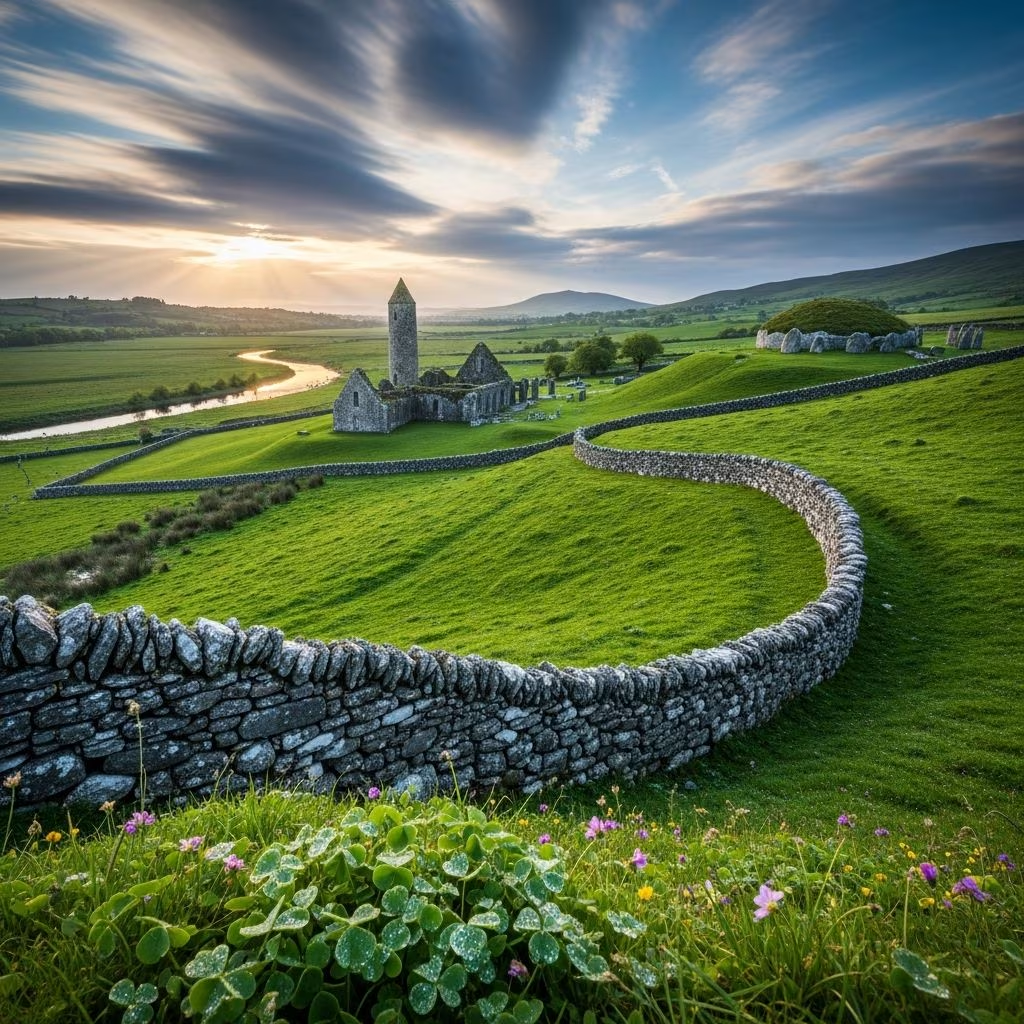
Immerse yourself in over five millennia of human achievement on a carefully crafted five-day road trip across Ireland’s Ancient East. Starting in bustling Dublin and winding through lush valleys, ancient hills, and medieval strongholds to the Viking-rooted city of Waterford, this 560-kilometer journey reveals layers of Neolithic ingenuity, Celtic spirituality, Christian conversion, Viking raids, and Norman conquests. Expect rolling green landscapes dotted with megalithic tombs, intricately carved high crosses, imposing castles, and atmospheric monastic sites that bring Ireland’s storied past vividly to life.
This region stands out for its density of preserved historical landmarks, offering a chronological narrative of Ireland’s evolution in a compact area accessible from Dublin. Unlike the dramatic cliffs of the Wild Atlantic Way, here the focus is on inland heritage trails where prehistoric farmers, druidic priests, saintly missionaries, Norse invaders, and feudal lords left indelible marks. The itinerary balances driving with exploration, covering about 100-120 kilometers daily on well-maintained roads, allowing ample time for guided tours, hikes, and quiet reflection at sites like the UNESCO-listed Brú na Bóinne and the majestic Rock of Cashel.
Begin your adventure in Ireland’s vibrant capital, where world-class museums provide a foundational understanding of the island’s archaeological riches. Dedicate your morning to the National Museum of Ireland – Archaeology, established in 1877. This treasure trove houses the globe’s most comprehensive collection of medieval Celtic metalwork, including ornate brooches and chalices that showcase the artistry of early Irish craftsmen. Marvel at the preserved Iron Age ‘bog bodies,’ remarkably intact with features like skin, hair, and fingernails, offering poignant glimpses into ancient rituals and daily life.
Exhibits on Medieval Ireland and Viking Ireland feature artifacts from Dublin’s Wood Quay excavations, such as weapons, jewelry, and tools that narrate the Norse impact on urban development. After lunch in the museum café, stroll through nearby Trinity College to see the Long Room library, though your focus remains historical. In the afternoon, rent your car and head north on the M1 motorway toward County Meath, arriving at your first ancient wonder by evening. Overnight in a cozy guesthouse near Drogheda, savoring traditional Irish fare like lamb stew.
Day two plunges you into the Neolithic era at Brú na Bóinne, a UNESCO World Heritage site dating to around 3200 BC. This vast necropolis, predating Stonehenge by 1,000 years and Egypt’s Great Pyramids by 600, sprawls across fertile farmland with standing stones. The star is Newgrange, a 80-meter-wide passage tomb topped with white quartzite and grass, aligned precisely for the winter solstice sunrise to illuminate its inner chamber. Nearby, Knowth boasts exceptional passage-grave art with swirling spirals and chevrons, while Dowth offers sheep-grazed solitude.
Book a guided tour in advance to enter these restricted interiors. Drive 20 kilometers south to the Hill of Slane, legendary site where St. Patrick defied High King Logaire in 433 AD by lighting an Easter fire. Here, Patrick used a shamrock to explain the Holy Trinity, igniting Ireland’s Christian flame atop this strategic hill overlooking the Boyne Valley. Continue 24 kilometers to the Hill of Tara, ancient seat of high kings and druids. This ceremonial complex features burial mounds, a Stone Age passage tomb, and folklore ties to mythical Tuatha Dé Danann. Free to roam its windswept fields, feel the weight of 5,000 years underfoot. End in Trim for dinner and lodging, exploring its castle-lit riverside.
| Site | Era | Key Feature | Distance from Previous |
|---|---|---|---|
| Brú na Bóinne | Neolithic (3200 BC) | Solstice-aligned tombs | 50km from Dublin |
| Hill of Slane | 5th Century AD | St. Patrick’s fire site | 20km |
| Hill of Tara | Prehistoric | High kings’ seat | 24km |
Venture into County Wicklow and Carlow for early Christian heritage. En route to Glendalough, detour 50 kilometers west to the Moone High Cross, an 8th- or 9th-century granite masterpiece amid ruins. Its panels depict biblical tales like Adam and Eve, David and Goliath, and the Passion, serving as ‘books in stone’ for illiterate congregations. Twenty kilometers south, confront Browne’s Hill Dolmen, a 5,000-year-old portal tomb crowned by Europe’s largest capstone—over 100 tonnes of granite balanced impossibly.
Near Kilkenny, zip 10 kilometers north to Dunmore Cave, a limestone cavern glittering with stalactites and stalagmites. Viking history darkens its tale: in 928 AD, raiders massacred 1,000 at nearby ring forts; survivors hid here but perished when smoked out. 1973 digs revealed bones and coins, now displayed. Afternoon brings you to Glendalough’s glacial valley, home to a 6th-century monastic city founded by St. Kevin. Wander round towers, stone churches, and lakeside paths evoking eremitic life. Overnight in Kilkenny, a medieval gem with narrow lanes and craft pubs.
The itinerary peaks at the Rock of Cashel, a limestone outcrop dominating Tipperary plains. For over 1,000 years, it was a nexus of Munster kings and clergy. Enter through the 15th-century Hall of the Vicars Choral, explore the ruined 13th-century cathedral, climb the 11th-century round tower, and admire Cormac’s Chapel (1127), Ireland’s inaugural Romanesque structure with vivid corbel paintings. The site’s lime-mortared walls enclose a timeline of power shifts from Celtic chieftains to Anglo-Norman lords.
Twenty kilometers south, Cahir Castle (1142) impresses with its moat, turrets, dungeons, and intact great hall—one of Ireland’s largest medieval fortresses. Nearby, the Swiss Cottage offers a whimsical contrast: a thatched Regency villa (1810) amid gardens, embodying Romantic-era escapism. Hike local trails or enjoy castle ghost stories. Lodge in Cahir or nearby, dining on fresh seafood.
Conclude in Waterford, Ireland’s oldest city, founded as a Viking port in 914 AD. The Viking Triangle compacts 1,000 years into three museums. Start at Reginald’s Tower (13th century), the nation’s oldest intact building, with Viking artifacts and tales of minting, imprisonment, and defense. The Medieval Museum showcases Europe’s only complete medieval vestments set in two original chambers. The Bishop’s Palace, a Georgian mansion, traces Waterford from 1700 to 1970 with fine arts and silver.
Stroll quayside, visit the famous crystal factory, or boat on the Suir River. This finale ties Neolithic beginnings to modern Ireland, proving the region’s enduring narrative thread.
Yes, interactive sites like Newgrange and caves engage kids, though some walks involve hills.
1-2 hours, prioritizing exploration over mileage.
Abundant B&Bs, hotels from budget to luxury in Drogheda, Trim, Kilkenny, Cahir, Waterford.
Add days for Kilkenny Castle, Monasterboice crosses, or Loughcrew Cairns.
Limited; self-drive recommended for flexibility.
