

 Travel Essentials
 Travel Essentials

Explore Ireland's most captivating mythological sites and discover the legendary figures whose stories shaped the nation's cultural heritage.
 Travel Essentials
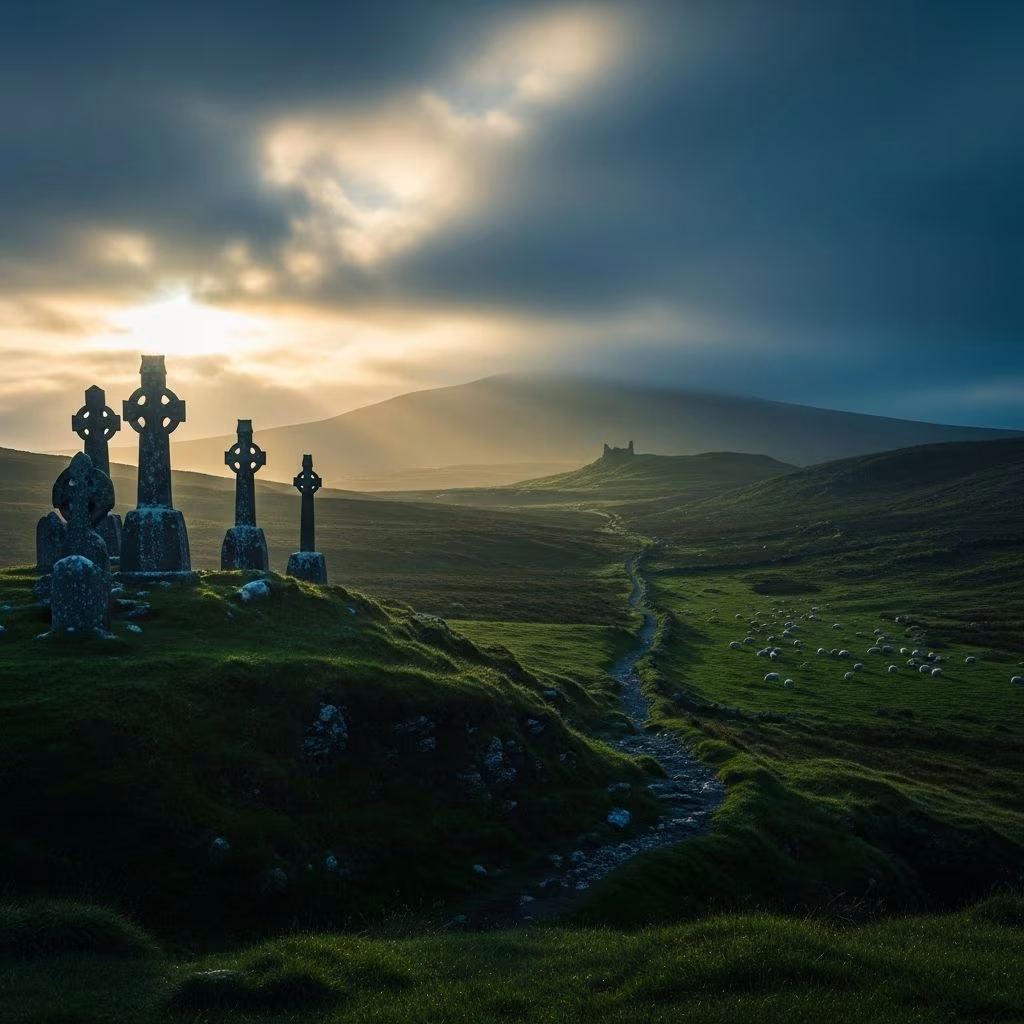
Ireland’s landscape is far more than rolling green hills and rugged coastlines—it is a living repository of ancient stories, where mythology intertwines with geography in profound ways. The island’s rich tapestry of legends has been woven into its very terrain, creating a unique destination where travelers can literally walk in the footsteps of legendary heroes and divine beings. From windswept clifftops to mysterious mountain peaks, Ireland’s most iconic locations carry within them the echoes of epic narratives that have captivated audiences for millennia.
Among Ireland’s most prominent legendary figures stands Fionn mac Cumhaill, a warrior of superhuman abilities whose exploits form a central thread in Irish folklore. Known in anglicized form as Finn McCool, this hero represents the archetypal Irish warrior—strong, cunning, and deeply connected to the land itself. According to tradition, Fionn undertook remarkable feats including monster hunting and the creation of entire islands, all while leading the Fianna, a legendary band of warriors who traveled throughout Ireland engaged in various adventures and conflicts.
The most enduring tale associated with Fionn involves the Giant’s Causeway, a UNESCO World Heritage Site located along County Antrim’s rugged northern coast. This extraordinary natural formation consists of more than 40,000 hexagonal basalt columns, created through ancient volcanic processes. Yet Irish folklore provides an alternative explanation: these distinctive pillars represent the remnants of a causeway constructed by Fionn to reach Scotland and confront his rival, the giant Benandonner. Whether one interprets this site through the lens of geology or mythology, the Giant’s Causeway remains a testament to how landscape and legend become inseparable in the Irish imagination.
The Tuatha Dé Danann occupy a central place in Ireland’s mythological hierarchy. Described as a mythical race of god-like beings, these divine rulers are said to have arrived in Ireland from the north, descending upon the mountain of Sliabh an Iarainn in County Leitrim. These supernatural entities brought with them four treasures of immense power and significance: the Stone of Fal, capable of recognizing rightful rulers; the Sword of Light, an unconquerable weapon; the Spear of Lugh, which guaranteed victory to those who wielded it; and the Cauldron of Daghda, an endless source of sustenance.
The Stone of Fal, also known as the Lia Fáil or Stone of Destiny, holds particular prominence in Ireland’s mythological narrative. This sacred stone was believed to possess the ability to emit a loud cry when the rightful king of Ireland touched it—a living validation of legitimate rule. Located at the Hill of Tara in County Meath, this site served as the seat of Ireland’s High Kings and represents one of the most spiritually significant locations on the island. Standing atop this ancient hill, one can nearly sense the ceremonial grandeur that once characterized this place, where matters of kingship and divine legitimacy were determined.
Newgrange, situated in the Boyne Valley of County Meath, represents one of humanity’s most remarkable achievements in ancient engineering and astronomical knowledge. Built more than 5,000 years ago, this Neolithic passage tomb predates both the Egyptian pyramids and Stonehenge, making it among the world’s oldest monumental structures. The true marvel of Newgrange, however, lies not merely in its age but in its sophisticated understanding of celestial mechanics.
During the winter solstice—the year’s darkest day—a phenomenon occurs that continues to astound visitors and researchers alike. As the sun rises, its light penetrates through the entrance passage with remarkable precision, traveling deep into the monument’s interior and illuminating the central chamber. This celestial choreography suggests that Newgrange’s builders possessed sophisticated astronomical knowledge and possessed the ability to construct monuments aligned with the heavens. Whether interpreted as a temple, a tomb, or an observatory, Newgrange embodies the ancient Irish capacity to merge practical engineering with spiritual significance.
Queen Medb stands among Ireland’s most formidable legendary figures—a warrior queen whose authority and ambition shaped the mythological landscape. Originally ruling from Rathcroghan, Medb’s legend has become particularly associated with County Sligo and the striking limestone formation known as Knocknarea. This dramatic hill, which dominates the skyline overlooking Strandhill, bears upon its summit an enormous cairn that visitors can hike to and explore.
According to Irish tradition, Medb was buried upright at this location, spear in hand and facing toward Ulster—positioned as if eternally ready to defend against her ancient enemies. This image of a warrior queen standing sentinel over the landscape captures something essential about Irish mythology: the integration of human ambition, martial prowess, and territorial identity. From the cairn atop Knocknarea, visitors experience not only spectacular views across the peninsula but also a tangible connection to a female warrior whose legend has endured for centuries.
The Burren in County Clare presents an otherworldly landscape quite unlike anywhere else on the island. This unique limestone terrain covers an extensive area and is characterized by dramatic karst formations, rare flora, and an abundance of ancient monuments. The Burren’s stark beauty combined with its archaeological richness creates an atmosphere laden with mystery and historical depth.
Within the Burren’s boundaries lies the Poulnabrone Dolmen, a Neolithic portal tomb that invites contemplation of the ancient rituals and beliefs of Ireland’s earliest inhabitants. Local folklore attributes the Burren’s mystical character to the presence of fairies and banshees—supernatural beings believed to inhabit the region’s hidden corners and limestone caves. Whether one approaches such legends through the lens of folklore enthusiast or skeptical traveler, the Burren’s combination of geological drama and archaeological significance creates an undeniably enchanting atmosphere.
The Cliffs of Moher, stretching nearly 14 kilometers along County Clare’s western coast and rising more than 200 meters at their highest points, combine natural grandeur with mythological resonance. According to legend, these towering cliffs are home to the Hag’s Head—a location associated with the mythical witch Mal, who fell to her death while pursuing the hero Cú Chulainn. The cliffs’ dramatic setting, with waves crashing far below and Atlantic horizons stretching beyond, creates an environment where ancient legends feel entirely plausible.
Glendalough, nestled within the Wicklow Mountains, represents a unique fusion of spiritual heritage and natural splendor. This monastic site, established in the sixth century by Saint Kevin, has inspired countless legends concerning the saint’s encounters with wild animals and his profound spiritual connection to the natural world. The settlement’s location among serene lakes and lush forests created an environment conducive to both contemplation and the development of spiritual myths.
Visitors to Glendalough can explore the ancient round tower that dominates the site’s landscape, hike through scenic mountain trails, and experience the peaceful atmosphere that has drawn pilgrims and seekers for over 1,400 years. The combination of architectural heritage, natural beauty, and spiritual significance creates an environment where legend and reality seem to merge seamlessly.
Dún Aonghasa, a prehistoric fortress situated on the cliffs of Inishmore—the largest of the Aran Islands—dates back to approximately 1100 BCE. This ancient defensive structure features semicircular walls positioned dramatically on the clifftop, offering breathtaking views of the Atlantic Ocean and providing visitors with tangible connection to Ireland’s distant past. The fort’s strategic location and imposing presence speak to the martial concerns and architectural capabilities of Ireland’s Bronze Age inhabitants.
The Cailleach Bhéara, a figure from Irish mythology, is associated with the shaping of the landscape surrounding Carrowmore. This mysterious figure represents seasonal transformation—appearing as an old woman during winter and emerging renewed in spring. Some traditions suggest that the Cailleach and the goddess Brigid represent the same divine being in different manifestations, speaking to the fluid and multivalent nature of Irish mythological figures.
Loughcrew, also known as the Hills of the Witch (Slieve na Calliagh), carries a legend involving a witch who allegedly formed the prominent cairns by dropping stones from her apron as she jumped from hilltop to hilltop. According to tradition, this supernatural figure eventually fell and died, with her burial site marked at Patrickstown Hill. These narratives reveal how Irish culture attributed landscape formation to the actions of powerful feminine figures, suggesting deep cultural reverence for female power and agency.
Irish mythology functions not as isolated stories but as an interconnected network of narratives, locations, and themes. The Fenian Cycle, which chronicles the exploits of Fionn and his band of warriors, weaves together numerous locations across the island, creating a literary landscape that maps onto the geographic reality. Similarly, the tales of the Tuatha Dé Danann, the exploits of Queen Medb, and the adventures of individual heroes form a complex mythological ecosystem where different narratives intersect, reference one another, and collectively construct a distinctive cultural identity.
Contemporary Ireland has recognized the value of its mythological heritage, both culturally and as a tourist resource. The Myths and Legends Trail offers a curated journey through significant sites including Carrowmore Megalithic Cemetery, Loughcrew Megalithic Cemetery, and the Rathcroghan Visitor Centre. These organized pathways allow visitors to engage with mythology in a structured manner while still maintaining the sense of personal discovery and wonder that makes such journeys transformative.
Summer months (June through August) offer the longest daylight hours and most favorable weather conditions. However, visiting during winter solstice provides the unique opportunity to witness Newgrange’s astronomical alignment phenomenon, making December a particularly significant time for those interested in ancient astronomical knowledge.
Most major sites including the Giant’s Causeway, Cliffs of Moher, and Hill of Tara offer visitor facilities and are generally accessible. However, some locations like Dún Aonghasa involve steep climbs or hiking. It’s advisable to check specific site conditions and accessibility information before planning visits.
Irish mythology blends historical memory, literary invention, and spiritual significance. While some legends reference real locations and possible historical figures, most mythological narratives cannot be verified through archaeological or historical documentation. They are best appreciated as cultural expressions reflecting ancient Irish values and worldviews.
Yes, Newgrange offers special viewing opportunities during the winter solstice period. However, access is limited and requires advance lottery registration due to high demand. Regular guided tours are available throughout the year for those unable to attend the solstice celebration.
