

 Travel Essentials
 Travel Essentials

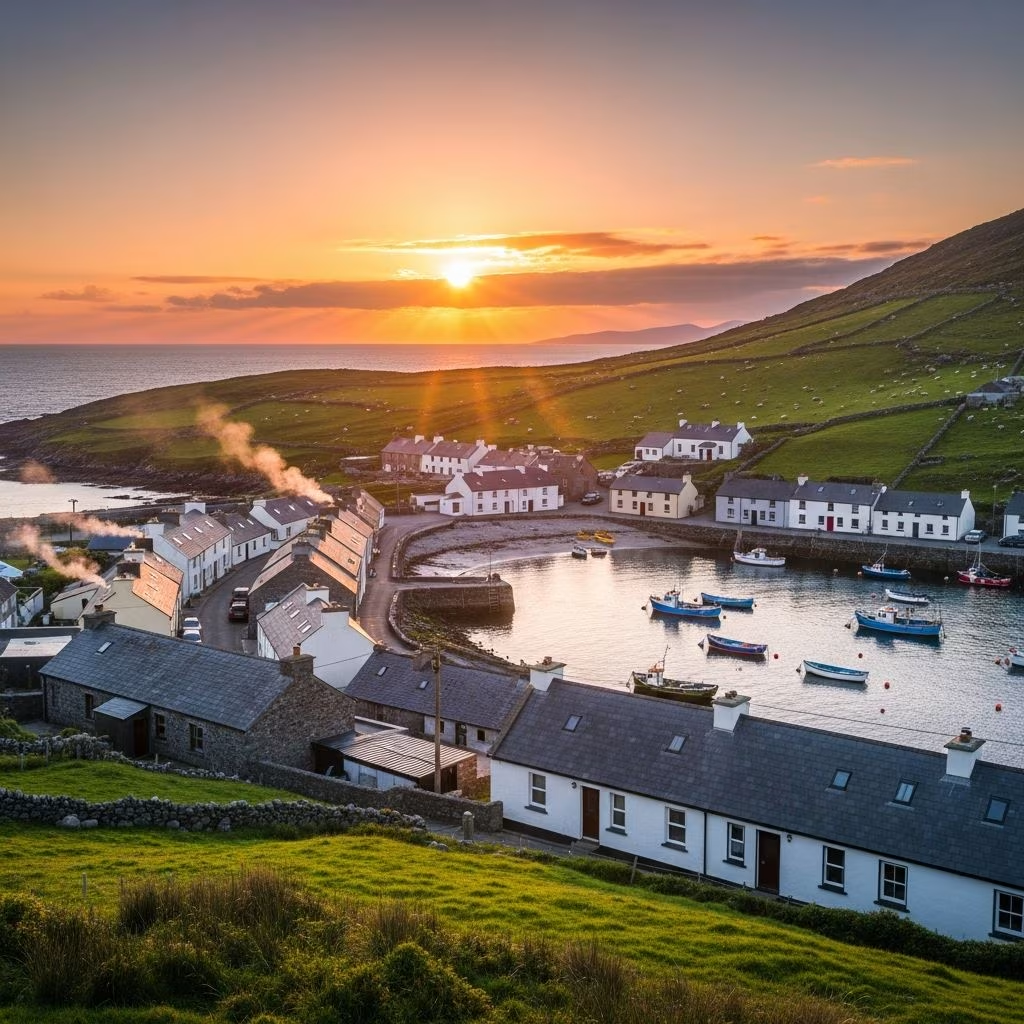
Ireland incentivizes relocation to its remote islands with up to €84,000 grants for renovating derelict properties, tackling depopulation while offering a serene island lifestyle.
 Travel Essentials
Ireland’s government has launched a bold strategy to counteract the declining populations on its offshore islands. Through the Our Living Islands policy, introduced in 2023, eligible residents can access enhanced grants of up to €84,000 (approximately $90,000 USD) to refurbish vacant or derelict properties on designated islands. This initiative not only preserves cultural heritage but also fosters sustainable communities in these picturesque, tide-cut locations.
The Our Living Islands is a comprehensive 10-year national policy published in June 2023 by the Irish Department of Rural and Community Development. It addresses the long-standing challenge of depopulation on approximately 30 offshore islands, many of which are isolated by tides and lack bridges to the mainland. These islands, home to tight-knit communities, have seen residents leave for better opportunities on the mainland, threatening their cultural and economic viability.
The policy takes a whole-of-government approach, coordinating efforts across housing, transport, education, and healthcare to make island life viable long-term. Central to this is the expansion of the Croí Cónaithe (Living Heart) Vacant Property Refurbishment Grant, which provides extra funding for island renovations to offset higher construction costs due to remoteness.
The program’s flagship offering boosts standard refurbishment grants specifically for the islands. Here’s a clear overview:
| Property Type | Standard Grant (Mainland) | Island Grant |
|---|---|---|
| Vacant House | €50,000 | €60,000 |
| Derelict House | €70,000 | €84,000 |
These amounts, equivalent to about $66,000 and $92,000 USD respectively (based on recent exchange rates), cover only renovation works like structural repairs, insulation, and energy upgrades. No funds are provided for purchasing property or moving costs. The home must become the applicant’s primary residence or a long-term rental, not a short-term holiday let.
Not all Irish islands qualify; the program targets around 23-30 specific ones with permanent populations that are naturally isolated. Key criteria include daily tidal cut-off and no mainland bridges. Prominent examples include:
Prospective movers should verify the full government list, as eligibility can evolve.
Eligibility hinges on Irish residency, open to citizens and legal residents, including non-EU nationals who meet immigration criteria such as investor visas or financial independence for retirees. Foreigners of Irish descent (via parent or grandparent) can pursue citizenship to qualify.
Property requirements are strict:
Applicants commit to living there for a minimum period, ensuring genuine community contribution.
Navigating the process requires preparation. Follow these steps:
Grants are competitive; early applications are advised, especially post-2023 launch.
Island life promises unparalleled natural beauty—think turquoise waters, puffin colonies, and star-filled skies—but demands adaptation.
Advantages:
Challenges:
Families benefit from community support, but assess schooling options carefully.
Beyond grants, Our Living Islands invests €10 million+ in infrastructure like ferries, broadband, and jetties. It supports tourism sustainably, Gaelic language preservation, and biodiversity. Early successes show population stabilization, with new families injecting vitality.
This mirrors global efforts like Italy’s 1-euro homes but emphasizes renovation over sale, prioritizing liveability.
Social media buzz has exaggerated the program—no direct ‘move here and get paid’ cash handout. It’s a targeted refurbishment aid for residents, not a free relocation package. Fact-checks confirm: Ireland funds renovations, not relocations.
Yes, if you hold Irish residency through visas like investor or retirement schemes.
No, solely for refurbishment; you must own it first.
At least until renovation completion, with primary residence commitment.
Limited; tourism, fishing, remote work common.
8-12 weeks typically.
No, long-term rental only.
(Word count: 1678)
