

 Travel Essentials
 Travel Essentials

Explore what causes turbulence, its risks to passengers and aircraft, pilot strategies, and essential safety tips for worry-free flying.
 Travel Essentials
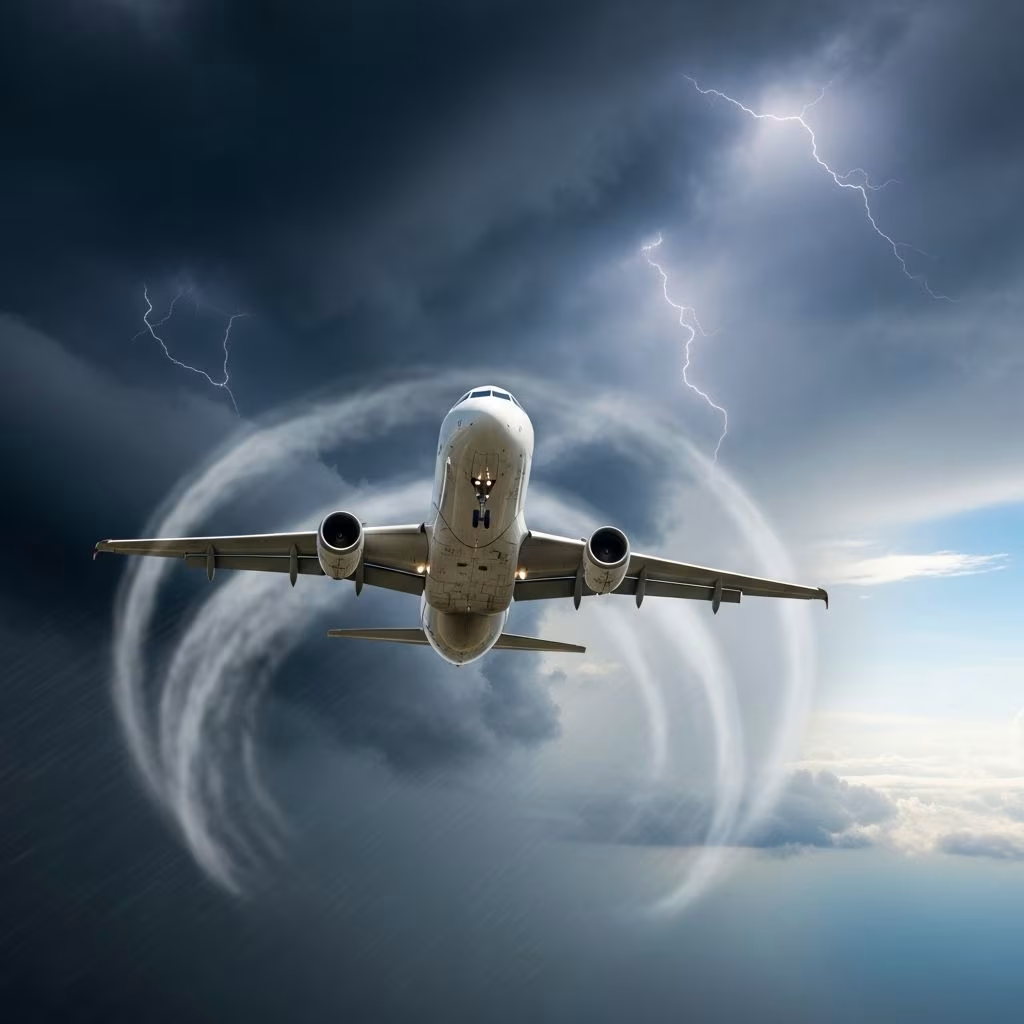
Airplane turbulence stirs anxiety in many travelers, often depicted as a grave threat in movies. In reality, it ranks as a common atmospheric phenomenon that modern aviation handles with engineering precision and pilot expertise. While it can jolt passengers, the risk to aircraft integrity remains negligible, and injuries stem mainly from unbuckled seats rather than structural failure.
Turbulence arises from irregular air movements invisible to the eye, triggered by factors like jet streams, mountain airflow, weather fronts, or thunderstorms. Even clear skies hide clear air turbulence (CAT), the most elusive type, forming where wind speeds shift abruptly at high altitudes.
Pilots classify turbulence by intensity: light causes minor swaying, moderate prompts loose objects to shift, severe demands tight seatbelts, and extreme—though rare—could challenge unsecured passengers. Aircraft designs incorporate damage-tolerant engineering, tested since the 1970s to endure stresses far beyond routine encounters. Wings flex dramatically, up to 90 degrees in tests, without compromising flight.
Modern jets boast robust structures certified for forces exceeding typical turbulence. The Federal Aviation Administration (FAA) notes planes withstand conditions that would toss boats in rough seas. Pilots reduce speed to turbulence penetration speed, safeguarding the airframe while minimizing passenger discomfort.
| Turbulence Intensity | Aircraft Response | Passenger Impact |
|---|---|---|
| Light | Minimal adjustment needed | Slight bumps, no belts required |
| Moderate | Speed reduction, possible reroute | Objects move; belts advised |
| Severe | Altitude change requests | Belts mandatory; stay seated |
| Extreme | Emergency maneuvers if needed | High injury risk if unbelted |
This table outlines responses, drawing from FAA guidelines and pilot protocols. Such measures ensure flights proceed safely even in adverse conditions.
Globally, turbulence injures around 100 people yearly—half flight attendants—necessitating medical care, out of billions of passengers. U.S. data to the National Transportation Safety Board (NTSB) logs only severe cases: deaths within 30 days, hospitalizations over 48 hours, fractures, or organ damage. Most incidents involve unbelted individuals hurled from seats, not plane failure.
Injuries from turbulence surpass those from crashes but pale against everyday risks like car accidents. FAA identifies it as the top nonfatal injury cause for passengers and crew.
Pre-flight briefings include detailed weather reports pinpointing risky zones. In-flight, pilots share Pilot Reports (PIREPs) via radio, prompting climbs, descents, or path deviations. Air traffic control spaces aircraft to dodge wake turbulence—vortices from heavy jets trailing at up to 300 feet per second, strongest near runways.
FAA partners with the National Center for Atmospheric Research (NCAR) for 15-minute turbulence nowcasts, aiding real-time avoidance. Airlines train crews on historical data reviews to refine procedures.
The simplest defense? Buckle up whenever seated. FAA mandates belts during takeoff, landing, taxi, and lit signs—but experts urge constant use.
During bumps, remain calm—planes stabilize via autopilot and crew training. Parents secure children under two on laps with supplemental belts.
Wake arises from wingtip vortices during lift generation, peaking at low speeds like takeoff and landing. Controllers enforce spacing: heavy jets trail small planes by miles. Pilots climb above sinking vortices or exploit winds to dissipate them. Near-airport observers hear whip-cracks as vortices descend.
Beyond U.S. initiatives, aviation bodies promote data sharing. Airbus emphasizes severe turbulence awareness to protect cabins. Airlines invest in training prioritizing crew safety first. Future tech promises refined predictions, further slashing incidents.
Turbulence triggers fight-or-flight responses, amplifying unease. Knowledge dispels myths: no plane has crashed solely from turbulence in modern history. View it like road potholes—unpleasant but manageable. Breathing exercises or distractions like music ease tension.
| Type | Source | Prediction Ease | Avoidance Tactics |
|---|---|---|---|
| Convective | Thunderstorms | High (radar) | Reroute widely |
| Mountain Wave | Mountain winds | Medium | Altitude adjustments |
| Clear Air (CAT) | Jet stream shear | Low | PIREPs, nowcasts |
| Wake | Preceding aircraft | High (ATC) | Spacing, climb |
This breakdown, informed by FAA and pilot insights, highlights varying challenges.
Climate models suggest potential increases from stronger jet streams, but aviation adapts with better forecasting.
Rarely; designs tolerate extremes. Inspections follow severe events.
Yes, but delays cost more than brief discomfort. Pilots mitigate effectively.
Consult doctors; belts low on abdomen protect. Turbulence poses no unique fetal risk.
Seconds to 30 minutes typically; pilots seek smoother air.
Embrace turbulence as routine. Modern aviation’s safety record—safer than driving—relies on engineering, training, and vigilance. Buckle up, trust the pros, and enjoy the journey above the clouds.
