

 Travel Essentials
 Travel Essentials

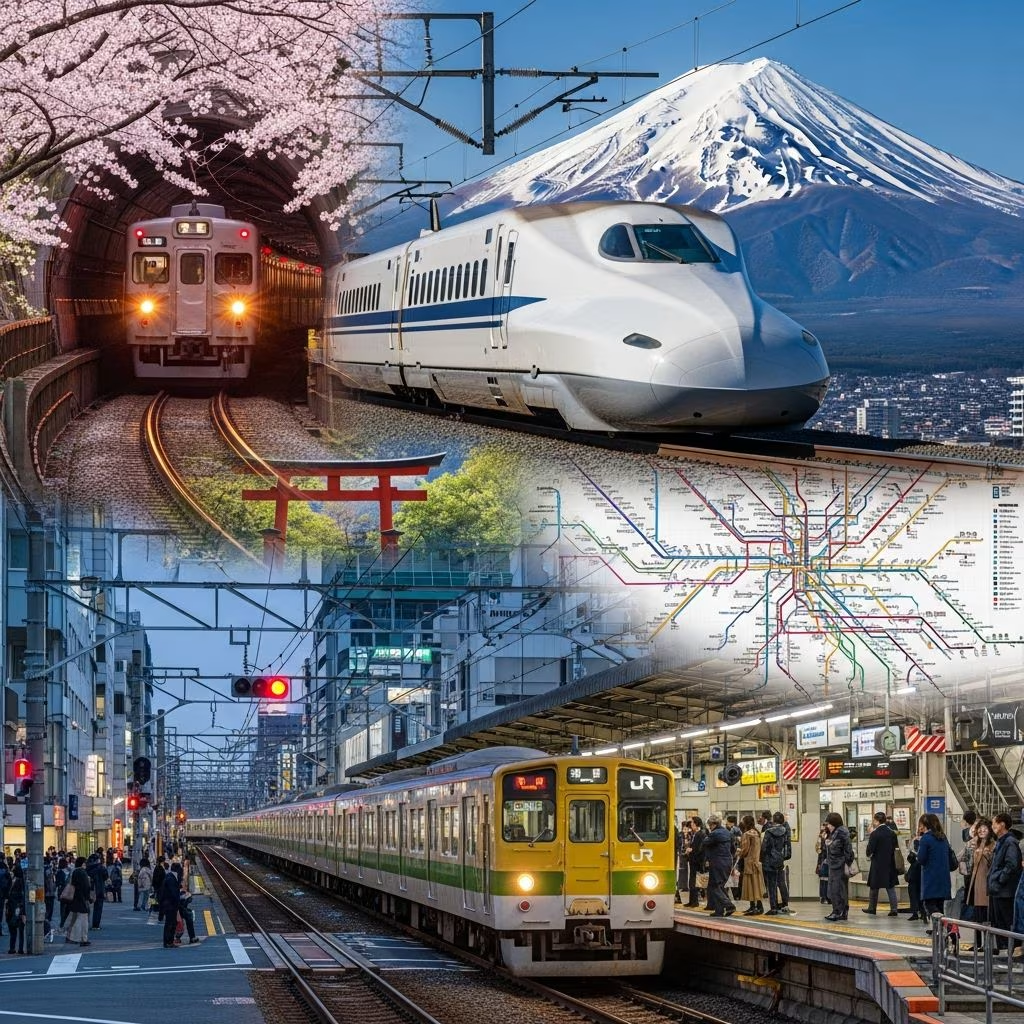
Explore Japan's world-class transportation network including trains, buses, subways, and transit passes for convenient travel throughout the country.
 Travel Essentials
Japan’s transportation infrastructure stands as one of the world’s most sophisticated and reliable systems, seamlessly connecting travelers from bustling metropolitan centers to serene countryside villages. The combination of cutting-edge technology, meticulous scheduling, and extensive coverage makes exploring Japan exceptionally straightforward for visitors of all experience levels. Whether you’re planning to spend a few days in Tokyo or embark on a cross-country journey, understanding the available transit options will enhance your travel experience significantly.
Japan’s transportation network operates on multiple integrated levels, each serving specific purposes and geographic areas. The system has evolved over decades to accommodate both domestic travel needs and international tourism, resulting in a cohesive framework where different modes of transport complement one another rather than compete. This integration means you can transition seamlessly from long-distance rail to local buses without confusion or significant delays.
The backbone of Japan’s transit system consists of railways operated primarily by Japan Railways (JR), a network that blankets the entire nation with incredible density. Beyond JR, numerous private railway companies operate regional routes, while urban centers maintain independent subway systems. Buses fill crucial gaps in coverage, particularly in areas where rail infrastructure wouldn’t be economically viable, making them essential for reaching smaller towns and tourist attractions located away from major stations.
The shinkansen, commonly known as Japan’s bullet train, represents perhaps the most iconic element of the country’s transportation culture. These sleek, high-speed trains connect major cities across Japan with remarkable efficiency, traveling at speeds up to 320 kilometers per hour while maintaining exceptional comfort and punctuality. The shinkansen network consists of six primary routes radiating from Tokyo, each serving distinct regions and travel purposes.
The Tōkaidō-Sanyō line constitutes the busiest shinkansen corridor, originating in Tokyo and extending southward through Nagoya, Kyoto, Osaka, and continuing to Hiroshima before terminating at Hakata Station in Fukuoka. This route captures the essence of Japan’s major cities and cultural landmarks, making it the most frequented path for international visitors. The journey from Tokyo to Kyoto requires approximately two hours, while reaching Osaka adds only a few additional minutes to your travel time.
Northern travelers benefit from the Tōhoku line, which extends from Tokyo through Sendai and concludes at Shin-Aomori in Japan’s northern reaches. For those venturing toward Japan’s west coast, the Jōetsu line tunnels through mountainous terrain to reach Niigata along the Sea of Japan, while the Nagano line branches westward from Takasaki to serve the central highlands. The Kyūshū line, meanwhile, connects the southernmost island’s major cities, linking Kagoshima with Hakata.
Shinkansen services operate across three distinct speed tiers. The Kodama trains stop at every station along the route, providing the most frequent access points but requiring longer journey times. The Hikari service skips intermediate stations and serves only major destinations, significantly reducing travel duration while commanding a modest fare premium. The Nozomi represents the absolute fastest option, available exclusively on the Tōkaidō-Sanyō line, though it carries an additional surcharge and remains unavailable to most Japan Rail Pass holders.
Beyond the prestigious shinkansen, Japan’s regional rail system provides extensive connectivity for both long-distance and intermediate journeys. Limited express trains, known as tokkyū, offer the next tier of speed and efficiency, making fewer stops than standard services while charging a surcharge comparable to or slightly less than shinkansen fares. These services prove particularly valuable for travelers whose destinations fall outside the main shinkansen corridor.
Local trains form the circulatory system of Japan’s transit network, connecting neighborhoods within cities and linking nearby municipalities to regional hubs. Color-coded lines with numbered stations throughout major urban areas simplify navigation, even for first-time visitors unfamiliar with Japanese geography. Trains arrive with such reliability that passengers can literally set their watches by scheduled departure times, a hallmark of Japanese railway culture.
Japan’s major cities operate independent subway systems that provide rapid transit through metropolitan areas, complementing the overground rail network. Tokyo maintains the most complex arrangement with nine metro lines and four subway lines operated by different companies, requiring passengers to occasionally transfer between systems during longer journeys. Despite this complexity, digital navigation tools and color-coded signage make orientation straightforward.
The metro represents the fastest and most convenient method for traveling within cities, with frequent departures and direct access to major attractions, business districts, and residential neighborhoods. Kyoto and Osaka operate more limited metro systems, though they still provide effective coverage of central areas. In cities where metro coverage remains incomplete, buses fill the transportation gaps, accessing destinations that rail infrastructure cannot economically serve.
Peak hour travel on Tokyo trains deserves special mention—the crush of humanity during morning rush hours (typically 8-9 a.m.) and early evening periods (shortly after 5 p.m.) can overwhelm unprepared travelers. Avoiding these windows when possible makes for a considerably more comfortable experience, though the trains operate with military precision regardless of crowding levels.
Japan’s bus network encompasses both urban transit systems and long-distance highway coaches, providing coverage to areas beyond practical rail reach. Within cities, buses offer flexibility in routing and can access tourist destinations that don’t align with train station locations. In Kyoto specifically, buses prove more effective than the limited metro system for reaching temples and cultural sites distributed throughout the city.
Long-distance buses, or chōkyori basu, connect major cities at fares significantly cheaper than comparable shinkansen journeys, though travel times extend accordingly. These buses typically depart from locations adjacent to major train stations, and longer journeys (exceeding two hours) include rest stops to accommodate passengers. Night buses offer cost-effective alternatives for travelers willing to sacrifice sleeping comfort for budget savings, converting overnight travel time into productive journey time.
Bus fare payment systems vary between cities and operators. Some systems accept exact change paid upon boarding, while others utilize ticket dispensers where passengers collect numbered tickets upon entry and pay the corresponding fare displayed on electronic signage upon exit. IC card systems (discussed in detail below) function universally across participating bus operators, eliminating the need to calculate exact change or navigate varying payment procedures.
IC card technology revolutionized Japan’s transit experience, enabling seamless travel across multiple operators and payment methods. SUICA cards, operated by JR East, extend beyond basic train fares to encompass subways, monorails, buses throughout the Kanto region (encompassing Tokyo, Kanagawa, and Chiba), as well as Sendai, Niigata, and Okinawa. The convenience of SUICA extends beyond transportation—participating restaurants, taxis, vending machines, and food stores accept SUICA payments, effectively converting the card into a multipurpose payment instrument.
PASMO cards provide similar functionality with slightly different geographic coverage, while the ICOCA system serves travelers in western Japan. These systems eliminate the friction associated with purchasing individual tickets repeatedly and provide modest savings compared to cash payment alternatives.
The Japan Rail Pass represents the most significant investment option for travelers planning extensive rail journeys. This pass grants unlimited access to most JR trains nationwide, including the shinkansen (with limited exceptions), making it economically advantageous for travelers planning multiple long-distance trips. Foreign passport holders qualify for discounted pass pricing, though the pass must be purchased before arriving in Japan. Strategic calculation of your intended routes determines whether purchasing a Japan Rail Pass makes economic sense for your specific itinerary.
Tokyo’s two major airports—Narita and Haneda—require distinct transit strategies, though both offer efficient public transportation access to central Tokyo and onward destinations. The Narita Express represents the most recommended connection from Narita International Airport, offering fast, comfortable travel with reserved seating at a fixed cost of ¥3,200 for standard passengers, with discounted fares available for foreign passport holders. Japan Rail Pass holders include unlimited Narita Express access within their pass benefits, making airport access essentially free for pass-holding visitors.
Haneda Airport provides multiple transit options, with the Tokyo Monorail offering a scenic elevated journey from the airport to Hamamatsucho Station, where connections to the JR Yamanote Line—Tokyo’s central circular loop—provide onward distribution throughout the city. The Keikyu Line represents another rapid option, providing excellent access to other metro lines and delivering travelers to central Tokyo quickly and affordably, with the added advantage of SUICA card compatibility.
Successfully navigating Japan’s transportation network requires minimal preparation, though a few practical approaches dramatically enhance the experience. Digital navigation applications—particularly Google Maps and the dedicated Navitime App—provide real-time transit routing, schedule information, and platform-specific directions that nearly eliminate navigation confusion. These applications account for the complex interaction between multiple operators, automatically calculating the most efficient route among numerous possibilities.
Having your destination address written in Japanese or at minimum the station name in both English and Japanese characters enables smoother communication with station staff when clarification becomes necessary. The principle of accessing the nearest train or bus station and then using navigation applications to reach your final destination provides a reliable framework for exploring unfamiliar areas.
Onboard announcements in English on major transit routes supplement electronic signage displaying upcoming stations, eliminating the common traveler anxiety about missing departure points. Prepare to approach doors in good time before arrival at your destination station, as the interval between train arrival and departure measures only a few seconds—Japan’s trains depart with remarkable punctuality, waiting for no one.
| Trip Type | Best Transit Option | Estimated Duration | Cost Consideration |
|---|---|---|---|
| Tokyo to Kyoto | Shinkansen | 2 hours | Higher cost, fastest option |
| Tokyo to Osaka | Shinkansen | 2-3 hours | Premium pricing, reliable |
| Tokyo to Hiroshima | Shinkansen | 4 hours | Substantial cost, unmatched speed |
| Intercity budget travel | Highway buses | Variable | Lowest fares, extended duration |
| Urban sightseeing | Metro or bus | Variable | Very economical |
Japan’s regional diversity necessitates flexible transit strategies adapted to local infrastructure patterns. While Tokyo’s extensive rail network makes train travel economically sensible, acquiring a Japan Rail Pass specifically for Tokyo-only trips proves impractical given the reasonable metro fares available. Conversely, Kyoto’s bus-oriented tourism infrastructure makes buses the optimal choice for accessing temples and cultural attractions despite the city’s metro system.
Sapporo, located in Japan’s snowy north, relies more heavily on subway systems than other major cities, with weather-related disruptions to surface transit making underground rail the most dependable option. These regional variations demonstrate the importance of researching your specific destinations before settling on a transportation strategy.
Taxis operate as a supplement rather than primary transportation in Japan, operating extensively in all major cities with spotlessly clean vehicles and trustworthy operators. However, taxi fares substantially exceed train costs for comparable distances, making them economically sensible primarily for situations where timing or luggage considerations override cost concerns. Taxis prove particularly valuable for late-night travel when trains cease operating, typically resuming service in early morning hours.
Effective transportation planning begins with mapping your intended destinations and calculating whether a Japan Rail Pass investment aligns with your itinerary. Consider the balance between convenience (train travel) and cost (bus travel), recognizing that budget-conscious travelers may sacrifice some travel time in exchange for meaningful savings. Urban exploration benefits from IC card acquisition, eliminating repetitive ticket purchases and enabling experimentation with various neighborhoods without financial friction.
Japan’s reputation for punctuality, cleanliness, and service excellence extends throughout the transportation system, making travel planning less stressful than comparable journeys in many other countries. The combination of technological advancement, cultural commitment to reliability, and extensive infrastructure investment has created a transit environment where delays and confusion represent genuine rarities rather than anticipated frustrations.
