

 Travel Essentials
 Travel Essentials

Explore Paris's rich jazz history from WWI to today, featuring iconic venues, festivals, and live performances throughout the city.
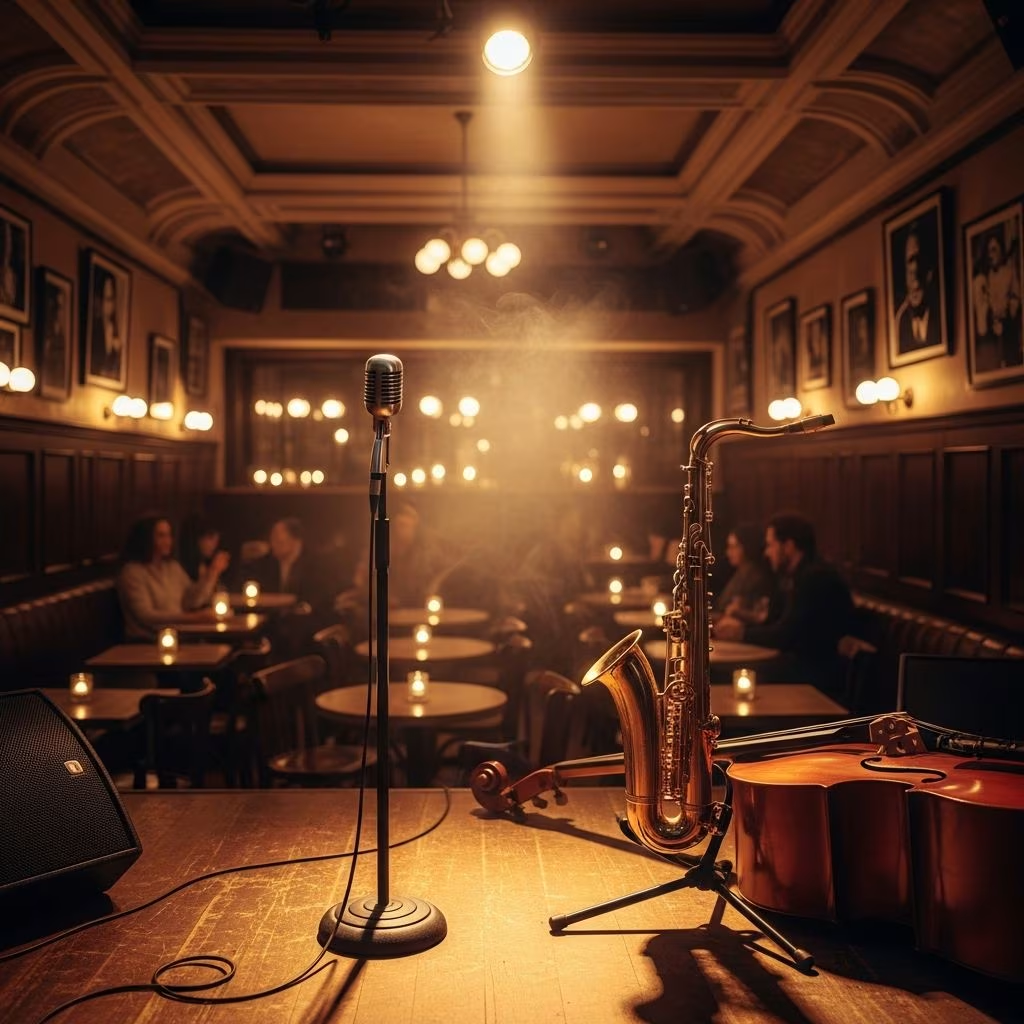 Travel Essentials
Paris stands as one of the world’s most significant capitals of jazz music, hosting a vibrant and continuously evolving scene that attracts musicians and enthusiasts from across the globe. The city’s relationship with jazz extends back more than a century, rooted in the aftermath of World War I when American soldiers introduced the genre to French audiences. Today, this legacy manifests in thriving concert venues, prestigious annual festivals, and spontaneous street performances that define the contemporary cultural landscape.
The introduction of jazz to Paris emerged during an unlikely moment in history. Following the conclusion of World War I, African-American servicemen stationed in France with the United States military brought with them the sounds of ragtime and jazz, performing in the city’s music halls and entertainment districts. This musical importation coincided with a period of profound cultural transformation in France.
The 1920s, known colloquially as les années folles or “the crazy years,” witnessed an unprecedented embrace of jazz by the Parisian populace. Rather than dismissing the genre as a foreign curiosity, French society—particularly the urban elite and younger generations—adopted jazz as emblematic of modernity, artistic freedom, and cultural rebellion. The philosophy accompanying the music resonated deeply with postwar sensibilities, offering an escape from the constraints of traditional society and representing artistic innovation.
This foundational period established Paris as a destination where jazz could flourish beyond its American origins. The city provided a unique cultural context where the genre could be reimagined, celebrated, and integrated into the broader artistic conversation occurring during this transformative decade.
The physical spaces where jazz performances occur in Paris embody the genre’s character—many housed in centuries-old structures with distinctive architectural features. These venues range from intimate underground cellars to sophisticated modern establishments, each contributing distinct atmospheres to the listening experience.
The Latin Quarter remains synonymous with Parisian jazz culture. Caveau de la Huchette operates within a historic cellar, its ancient stone walls providing an atmospheric backdrop for performances. This venue represents the type of underground jazz club that has become emblematic of Left Bank cultural life, where the intimacy of the space enhances the connection between performer and audience.
The Les Halles district concentrates several significant jazz establishments within close proximity. Duc des Lombards presents a more refined aesthetic, emphasizing acoustics and close-proximity seating arrangements that prioritize musical clarity. Le Baiser Salé, whose name translates to “the Salty Kiss,” cultivates a more rustic character while programming diverse acts and hosting energetic jam sessions that extend late into evening hours. Sunset/Sunside operates as a dual-level venue, with basement performances at Sunset providing underground club ambiance and ground-floor Sunside offering alternative configurations.
Le Marais district features Cave du 38 Riv’, an exposed-stone cellar venue programming eclectic musical styles including bossa nova and funk alongside traditional jazz forms. This programmatic diversity reflects how contemporary Paris jazz venues have expanded beyond purist approaches to embrace broader musical conversations. Near Canal St-Martin, New Morning operates with a 500-person capacity and has hosted internationally recognized musicians including Chet Baker and Dizzy Gillespie. In Montmartre, Bab-Ilo maintains exceptional intimacy by limiting capacity to approximately 40 attendees, creating extraordinarily personal performance environments. Within central Paris’s western edge, Jazz Club Étoile operates inside the Le Méridien Étoile hotel and maintains a reputation for rigorous artistic standards, having featured performers such as B.B. King and Lionel Hampton.
Paris’s jazz culture extends significantly beyond individual club performances through an active festival circuit that distributes performances throughout the calendar year.
Beyond formal festival structures, Paris maintains consistent opportunities for jazz engagement. The city supports a substantial community of street musicians and subway performers, many of whom have undergone competitive audition processes to secure coveted performance positions. These distributed performances mean that jazz encounters occur throughout daily urban life—in transit stations, public squares, and street corners—making the genre omnipresent within the city’s acoustic landscape.
Modern Paris jazz culture balances historical preservation with progressive innovation. The scene accommodates traditional bebop and swing alongside contemporary fusion experiments, funk-influenced interpretations, and genre-blending collaborations. This programmatic range reflects how jazz has evolved globally while maintaining strong connections to historical practice.
The frequency of live performances enables visitors and residents to experience jazz performances virtually every evening throughout the year. This consistency distinguishes Paris from many other major cities where jazz performances concentrate in specific districts or operate according to more limited schedules. The distributed nature of performance venues across multiple neighborhoods means that jazz engagement doesn’t require specialized knowledge of particular districts—instead, opportunities arise organically throughout urban exploration.
Yes, Paris offers jazz performances on nearly every evening throughout the year. Multiple venues operate nightly programming, supplemented by street performers and seasonal festivals, ensuring consistent availability regardless of visit timing.
Many Paris venues occupy historically significant structures—medieval cellars, Renaissance buildings, converted warehouses—that create distinctive atmospheric qualities. This architectural heritage contributes to performance experiences that emphasize ambiance alongside musical content, differentiating the Parisian approach from venues prioritizing acoustic specifications alone.
Numerous free performances occur during Fête de la Musique and through street performers. Festival pricing typically emphasizes accessibility through reduced ticket costs and multi-venue programming. While prestigious venues command premium prices, budget-friendly options remain consistently available.
Contemporary Paris venues program diverse styles including bossa nova, funk, blues, R&B, and fusion approaches. This eclecticism reflects how jazz as a categorical framework has expanded to encompass related improvisational and rhythm-based traditions.
Prospective participants in Paris’s jazz culture should recognize several planning considerations. Performances typically begin in evening hours and extend late into night, with some venues maintaining programming until early morning hours. Venue capacity ranges dramatically—from 40-person intimate spaces to 500-capacity halls—affecting both acoustic characteristics and social atmosphere. Advance reservations enhance reliability of seating at popular establishments, particularly during festival periods.
Geographic distribution across Left Bank, Right Bank, Marais, Montmartre, and Canal St-Martin neighborhoods means that jazz exploration naturally integrates with broader city navigation. Rather than treating jazz venues as specialized destinations, visitors might encounter performances as natural extensions of neighborhood exploration.
Paris’s relationship with jazz transcends simple musical appreciation—the genre has become embedded within the city’s identity and cultural self-conception. From early 20th-century adoption through contemporary practice, jazz has remained a significant signifier of Parisian sophistication, artistic openness, and cultural vitality. The consistency of performances, diversity of venues, and institutional support through festivals reflect deep cultural investment in maintaining this legacy.
The architectural context—with performances occurring in cellars dating to medieval periods and stone-walled spaces evoking centuries of history—creates unique resonances. Jazz performances in these environments carry metaphorical weight, suggesting connections between historical continuity and artistic innovation, between preservation and creative transformation.
For musicians, Paris represents a destination where jazz receives recognition as serious artistic practice worthy of prestigious venues and dedicated audiences. For audiences, the city offers jazz engagement as integral to cultural experience rather than specialized entertainment. This integration of jazz into Parisian identity distinguishes the city’s approach from locations where the genre occupies more peripheral cultural positions.
Paris continues evolving as a premier international center for jazz music and culture. The combination of historical venues with contemporary programming, festival celebrations with spontaneous street performances, and international recognition with local community support creates an environment where jazz remains dynamic and central to urban cultural life. Whether through formal concert attendance, intimate cellar club experiences, or chance street performances, Paris offers substantive engagement with jazz traditions and contemporary practices that have defined the city’s artistic character for more than a century.
