

 Travel Essentials
 Travel Essentials

Explore Jordan's top historic and religious sites, from biblical mountains to ancient baptism grounds, offering spiritual depth and archaeological wonders for pilgrims and travelers.
 Travel Essentials
Jordan stands as a living testament to millennia of spiritual and historical significance, hosting sites revered by Christians, Muslims, and Jews alike. These locations, etched into dramatic landscapes from rugged mountains to serene riverbanks, draw visitors seeking connection to biblical narratives, prophetic legacies, and architectural marvels. This guide delves into the most compelling historic and religious destinations, highlighting their stories, accessibility, and unique allure.
Mount Nebo rises prominently in central Jordan, offering sweeping views over the Jordan Valley and the distant Promised Land. According to Old Testament accounts, this is where Moses gazed upon the land he was destined never to enter before his passing. The site’s spiritual weight is amplified by archaeological layers, including a 4th-century church adorned with intricate Byzantine mosaics unearthed in recent excavations.
Today, the Moses Memorial Church anchors the area, blending ancient remnants with modern commemoration. Pilgrims ascend the gentle slopes to the serpentine cross symbolizing Moses’ bronze serpent, contemplating the biblical panorama that unfolds below. The Franciscan Custody of the Holy Land maintains the site, ensuring preservation amid growing visitor numbers. Combine a visit with nearby Madaba, famed for its mosaic map of the Holy Land, for a fuller mosaic of early Christian artistry.
On the eastern banks of the Jordan River lies Al-Maghtas, or Bethany Beyond the Jordan, authenticated by UNESCO as the precise location of Jesus Christ’s baptism by John the Baptist around 29 AD. Referenced in the Gospel of John, this wetland preserves pools where baptisms occurred, surrounded by remnants of six Byzantine churches and baptismal fonts.
Adjacent Elijah’s Hill (Jabar Mar-Elias) marks the prophet’s ascension to heaven after parting the river waters. The site’s raw authenticity—mud-brick chapels rising from marshy grounds—evokes profound tranquility. Annual pilgrimages, including masses led by the Latin Patriarch, underscore its living role in Christian devotion. Excavations continue to reveal Crusader-era structures, layering history upon scripture.
Visitors wade into shallow pools or follow wooden walkways, immersing in the site’s misty aura. Proximity to the Dead Sea enhances multi-day itineraries blending spirituality with natural wonders.
Perched atop a stark hill overlooking the Dead Sea, Machaerus—known today as Mukawir—serves as the grim stage for John the Baptist’s imprisonment and beheading. The Roman-Jewish historian Josephus pinpointed this as Herod Antipas’ fortress-palace, where Salome’s dance sealed the prophet’s doom (Matthew 14:1-12).
Though little remains beyond foundational walls and a cistern, the isolation amplifies the drama. Ascend via a steep path for 360-degree vistas encompassing the Dead Sea’s shimmering expanse and Palestinian hills. The site’s desolation mirrors its tragic lore, making it a poignant stop for those tracing New Testament events. Pair with nearby Lot’s Cave, tied to Genesis 19:30, for deeper Old Testament context.
| Site Feature | Description | Biblical Tie |
|---|---|---|
| Hilltop Palace Ruins | Circular fortress foundations | Herod’s domain (Mark 6:14-27) |
| Cistern | Possible imprisonment site | John’s captivity |
| Views | Dead Sea and West Bank | Strategic overlook |
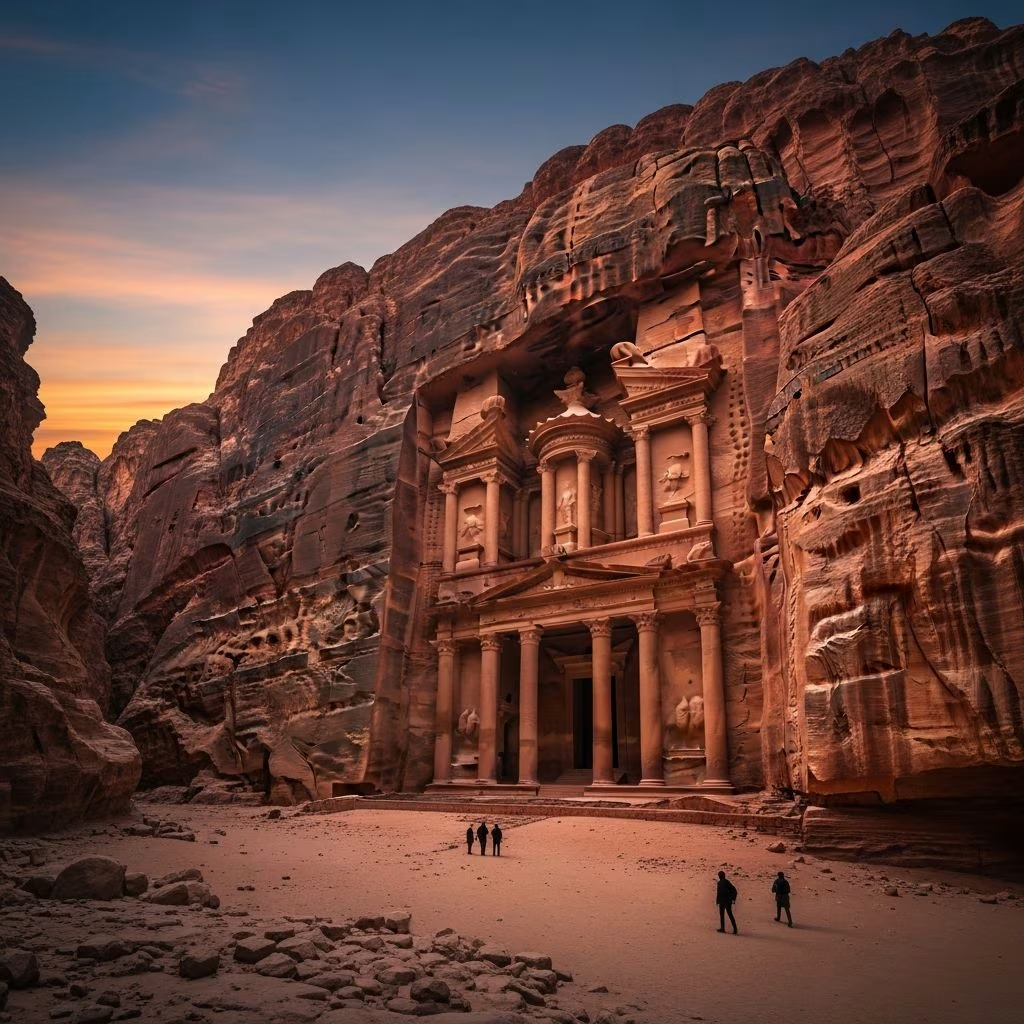
Petra transcends its status as a Nabataean rock-cut city to embody religious resonance. Believed by some traditions as the spot where Moses struck a rock to yield water, its Treasury (Al-Khazneh) and Monastery (Ad Deir) stun with Hellenistic influences amid rose-red cliffs. A UNESCO World Heritage gem, Petra’s High Place of Sacrifice hosted ancient rituals, while Jebel Haroun nearby enshrines Aaron’s tomb atop a Byzantine church and Muslim shrine.
The strenuous hike to Jebel Haroun rewards with vistas and dual-faith veneration—Aaron, Moses’ brother, unites Jewish, Christian, and Islamic narratives. Petra’s Siq canyon entrance sets a dramatic prelude, channeling visitors through 1st-century engineering marvels. Nighttime candlelit tours add mystical depth.
Umm Qais, ancient Gadara, overlooks the Sea of Galilee and commands views of the Yarmouk River and Golan Heights. Here, Jesus reportedly exorcised demons into a swine herd that plunged into the lake (Gadarene Swine miracle). Roman theater ruins and colonnaded streets frame black basalt tombs, evoking the biblical encounter.
The site’s Decapolis context—Hellenistic cities east of the Jordan—highlights cultural crossroads. Modern excavations, including a temple at nearby Pella, enrich the Greco-Roman biblical backdrop. Ideal for sunset visits, blending panoramic beauty with scriptural reflection.
Jordan’s landscape cradles multiple prophetic sites. Jebel Haroun’s summit shrine honors Aaron, demanding a rewarding climb past Nabataean steps. The Cave of the Seven Sleepers near Amman recounts youths divinely preserved from persecution, revered in Christian and Islamic lore. Mutah’s Tomb of Jafar bin Abi Talib commemorates the Prophet Muhammad’s cousin, a martyrdom site drawing Muslim pilgrims.
Anjara’s Our Lady of the Mountain Church marks a rest stop for Jesus, Mary, and disciples en route to Jerusalem, designated a 2000 Jubilee pilgrimage site. Ajloun’s Mar Elias shrine celebrates Elijah, hosting annual festivities. These lesser-trod gems offer intimate spiritual encounters.
Navigating Jordan’s sacred circuit requires planning. Amman serves as a hub; rent a car or join guided tours for remote sites. Most charge modest fees (3-10 JOD), with combo tickets optimizing value. Respect customs: modest dress at shrines, no photos in sensitive worship areas.
Spring (March-May) or fall (September-November) avoids summer heat. Jordan’s tourism board promotes interfaith harmony, with sites open to all faiths.
Yes, Jordan maintains stability and welcomes pilgrims with efficient security at major sites.
Key moments include Moses’ vista from Nebo, Jesus’ baptism, John’s beheading, and Elijah’s ascension.
Absolutely; many hold multi-faith significance, emphasizing Jordan’s tolerant heritage.
Petra’s proximity to Jebel Haroun integrates seamlessly; overnight in Wadi Musa.
Yes, operators like Visit Jordan offer tailored Christian, Muslim, or interfaith packages.
