

 Travel Essentials
 Travel Essentials

Explore July 2025's celestial highlights: Mercury's peak visibility, Delta Aquariid meteors, Cygnus nebulae, planetary parades, and moon phases for stargazers worldwide.
 Travel Essentials
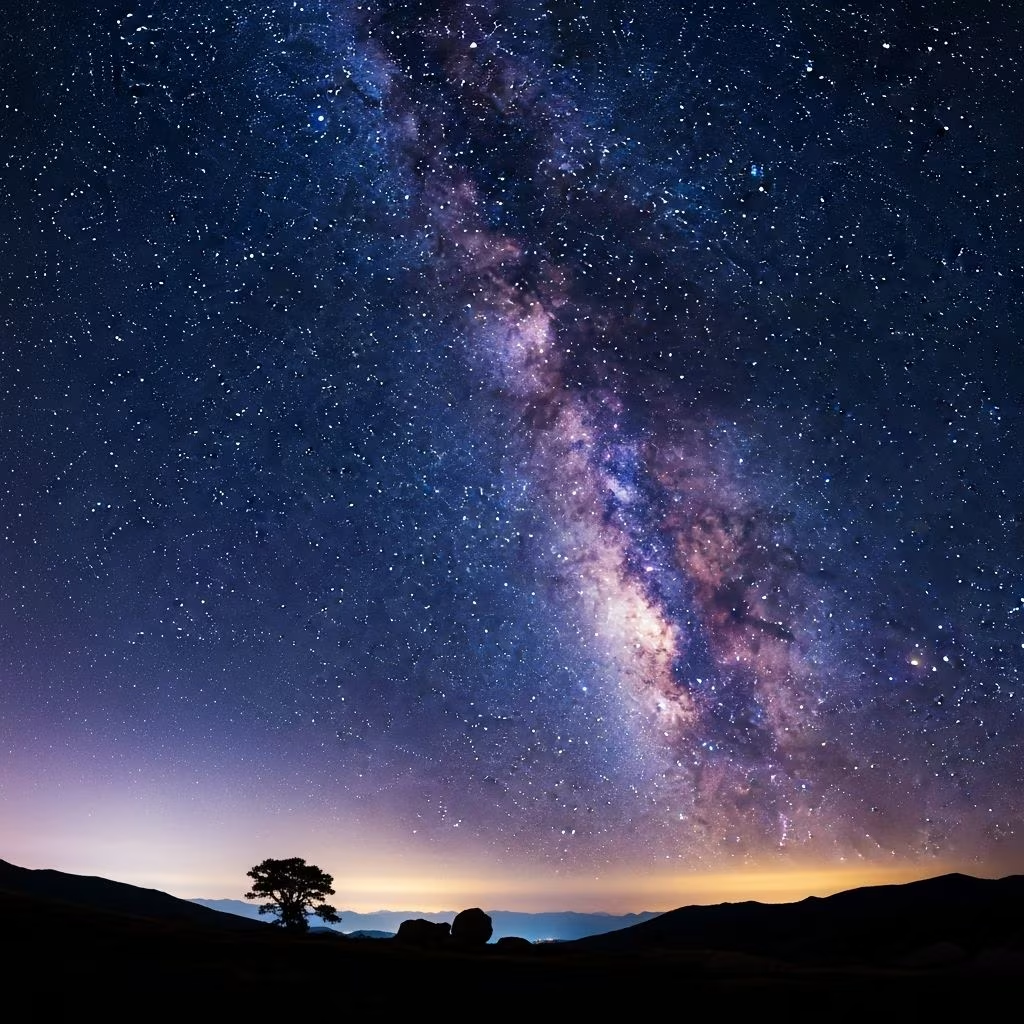
July 2025 promises a rich tapestry of celestial events, making it an ideal month for stargazers in both hemispheres. From fleeting planetary appearances to prolific meteor showers and intricate deep-sky treasures, the summer skies offer endless opportunities for observation. This guide breaks down the key highlights, optimal viewing times, and practical tips to maximize your experience under clear night skies.
Planets dominate the July evenings and mornings, providing bright beacons amid the starry backdrop. Venus, Mars, Mercury, Jupiter, and Saturn each play starring roles, with conjunctions adding drama to the displays.
Uranus and Neptune add challenges for binocular users. Uranus (mag 5.8) lurks 2.4° north of Venus on July 4 in Taurus, showing a bluish disk in telescopes. Neptune stays near Saturn all month, two Moon-widths apart, at magnitude 7.8.
The Delta Aquariid meteor shower ramps up from July 12 to August 23, cresting on July 30 with up to 25 meteors per hour under ideal conditions. Originating from Comet 96P/Machholz, these swift fireballs favor Southern Hemisphere viewers due to optimal radiant positioning. Northern observers can still spot 15-20 per hour away from city lights.
Combine with the Alpha Capricornid shower (peaking July 30, fewer but brighter meteors) for a double feature.
July’s early evenings unveil prominent summer asterisms. Aquila the Eagle soars in the east during the first half of the night, anchored by Altair—the southern apex of the Summer Triangle alongside Vega (Lyra) and Deneb (Cygnus).
Cygnus, the Swan, dominates overhead with its Northern Cross shape. This Milky Way hotspot hosts deep-sky gems perfect for binoculars or small scopes:
| Object | Type | Location in Cygnus | Best Views |
|---|---|---|---|
| North America Nebula (NGC 7000) | Emission Nebula | Near Deneb | Binoculars; H-beta filter enhances |
| Pelican Nebula (IC 5070) | Emission Nebula | South of North America | Dark skies; wide-field scopes |
| Albireo | Double Star | Head of the Swan | Small telescopes; golden-blue contrast |
Trace the Summer Triangle early evening: Start with Vega high west, drop to Altair south, then arc to Deneb northeast.
The Moon cycles through phases, framing planets beautifully:
Highlights include Moon-Venus-Jupiter trio on July 21-22 mornings and Moon-Mars on July 28 evenings.
Asteroid Vesta arcs through Virgo at magnitude 6.7-7.2, mimicking a double star on July 19. Track its motion against stars July 19-21 and 30-31. Pluto reaches opposition mid-month, visible telescopically in Capricornus at magnitude 14.3— a nod to its dwarf planet status.
Maximize sightings with these strategies:
Hemispheric notes: Southern viewers excel for Delta Aquariids and Sagittarius Milky Way; Northerners prioritize Cygnus overhead.
Small telescopes reveal Saturn’s rings (tilted favorably), Mars’ gibbous phase in Leo, and Neptune’s disk near Saturn. Pluto hunters need 8-inch+ apertures and charts. Vesta’s path offers motion confirmation over nights.
| Date | Event | Viewing Tips |
|---|---|---|
| July 1-7 | Mercury prime time | West horizon, 30-45 min post-sunset |
| July 2 | Mercury near Beehive | Binoculars in twilight |
| July 4 | Mercury elongation; Uranus-Venus | Low east/west horizons |
| July 10 | Full Moon | Planetary frames |
| July 18 | Last Quarter | Evening deep-sky |
| July 21-22 | Moon-Venus-Jupiter | Pre-dawn east |
| July 24 | New Moon | Darkest nights for meteors/nebulae |
| July 28 | Moon-Mars | Post-sunset west |
| July 30 | Delta Aquariid peak | Midnight south, lie back |
The Delta Aquariid peaks July 30 with 25/hr, best south; Alpha Capricornids add bright ones same night.
Yes—Venus, Mars, Mercury, Jupiter, Saturn are naked-eye bright; use binoculars for details.
Southern Hemisphere gets superior meteor rates and Milky Way; Northern excels in Cygnus nebulae.
No lunar or solar eclipses; focus on lunar phases and conjunctions.
Monitor forecasts; urban dwellers use apps for moonless nights; early Mercury is horizon-dependent.
July 2025’s skies blend accessibility for novices with depths for veterans. Step outside, let eyes adjust, and connect with the cosmos.
