

 Travel Essentials
 Travel Essentials

Kansas City’s fare-free transit experiment boosted ridership, especially among vehicle-less residents, while revealing the funding challenge of lasting equity.
 Travel Essentials
In the fall of 2019, Kansas City, Missouri became a watershed moment in American urban transportation policy. The city council voted unanimously to eliminate fares across its bus system, making Kansas City the nation’s first large metropolitan area to offer citywide fare-free public transit. This decision was not merely symbolic—it represented a fundamental rethinking of how cities should provide mobility services to their residents and a recognition that financial barriers could exclude entire populations from economic opportunity, employment, and essential services.
What began as an ambitious policy experiment has since generated critical data about who benefits most from removing the cost of transit and what communities have been historically underserved by traditional fare-based systems. The results from nearly five years of implementation offer valuable lessons for cities grappling with transit equity and affordability.
The Kansas City Area Transit Authority (KCATA), which operates service across a bistate, seven-county region, implemented the Zero-Fare policy in 2020, applying the elimination to routes that originated or terminated within city limits. This geographic distinction meant that while comprehensive coverage was limited to specific corridors, the policy still represented one of the most ambitious transit equity initiatives in North America.
The implementation was deliberate and data-driven. Rather than launching without planning, transit officials monitored ridership patterns, collected feedback from users, and tracked demographic shifts in the traveling public. This approach enabled researchers and policymakers to develop a nuanced understanding of how fare elimination affected different population segments.
Research from the University of Kansas revealed that the policy successfully attracted new riders across multiple demographic categories. Seventeen percent of survey respondents stated they began using bus service specifically because it became free. However, adoption rates were not uniform across all populations, revealing important patterns about transit access disparities.
Younger people and women emerged as particularly responsive to the fare elimination, with these groups showing higher propensities to become new transit users. White residents proved more than twice as likely to become new bus users compared to residents of color, a counterintuitive finding that may reflect broader factors such as employment location, residential patterns, and prior awareness of transit options.
One of the most significant findings concerned vehicle access. New users without access to a working vehicle made substantially more trips per week—4.88 trips compared to those with vehicle access—suggesting that the fare-free policy had its greatest impact on the most transit-dependent populations. This outcome directly supports one of the central arguments for eliminating transit fares: that they disproportionately burden those with the fewest transportation alternatives.
The policy did not only attract new riders; it changed travel behavior among those already using transit. Almost 40 percent of preexisting bus users reported increasing their trip frequency after fares were eliminated. This finding suggests that even for habitual transit users, fare elimination removes a psychological and financial barrier that was previously constraining their mobility.
Notably, a majority of preexisting users did not increase their usage, indicating that other factors beyond cost—such as route availability, schedule alignment with work or school, and transportation alternatives—continue to influence transit decisions.
Overall bus use increased across varying personal characteristics including age, race, income level, and vehicle access. However, the policy’s most profound impact emerged among the populations historically marginalized by transportation systems. Transit officials noted that fare-free service has the potential to enhance mobility and quality of life, particularly for people from historically marginalized communities.
The concentration of benefits among vehicle-less populations underscores a critical reality: those without personal transportation options experience transit not as one choice among many, but as a necessity. For them, fare elimination represents a material change in economic well-being, as transit expenses no longer compete with food, housing, and healthcare for limited household budgets.
The expansion of the ridership base carries consequences beyond mobility statistics. Research suggests that policy changes generating greater political support for fare-free transit can potentially lead to increased government funding and wider public backing for such policies. When transit becomes accessible to populations previously priced out of the system, political coalitions supporting transit investment expand accordingly.
This dynamic represents a fundamental shift in how communities perceive public transportation. Rather than viewing transit as a service for low-income populations, fare-free systems position transit as infrastructure—similar to roads or sidewalks—that serves the entire city.
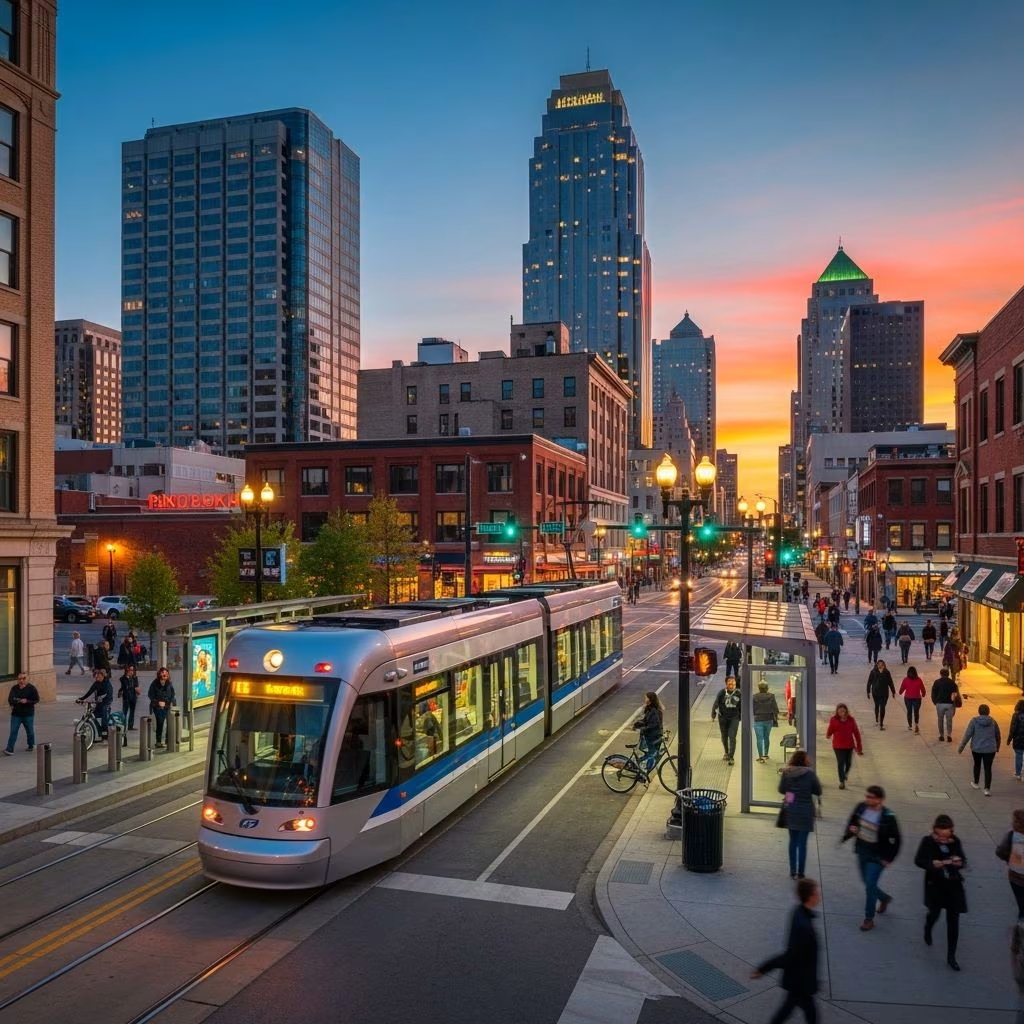
Alongside bus service, Kansas City operates the KC Streetcar, an electric, fixed-rail public transportation vehicle using a steel-tracked fixed path that runs 5.7 miles through the heart of the city from UMKC to the River Market. The KC Streetcar is permanently fare-free, with service running daily and streetcars arriving every 10-15 minutes during peak weekday periods.
The streetcar operates under extended hours, running Monday through Thursday from 5:00 a.m. to midnight, with extended Friday and Saturday service until 1:00 a.m., and regular Sunday hours. Unlike buses designed for longer commute trips, streetcars serve shorter local journeys, creating an integrated fare-free network that encourages intra-city movement for employment, shopping, and entertainment.
In spring 2025, KCATA announced that fares would be reinstated on bus routes, though with continued exploration of long-term feasibility for maintaining fare-free service. As of June 1, 2026, standard fares returned to RideKC bus routes, with a single ride costing $2 and a day pass priced at $4. However, the KC Streetcar will remain permanently fare-free.
This transition reflects the financial pressures facing transit agencies nationwide. While the zero-fare policy demonstrated clear ridership and equity benefits, sustaining the program required securing dedicated funding sources. The reintroduction of fares represents an attempt to balance operational sustainability with the equity gains achieved during the fare-free period.
The new program framework aims to achieve multiple objectives: maintain reliable transit service, provide flexible ways to pay, and make fares predictable and easy to understand. By preserving fare-free streetcar service while reintroducing bus fares, the system maintains some equity benefits while generating revenue for expanded service.
The Kansas City experience demonstrates both the promise and challenges of fare-free transit policy. The elimination of fares successfully attracted new riders, particularly among populations historically excluded from transit access due to cost barriers. The data clearly shows that fare removal unlocks mobility for those without vehicle alternatives.
However, the reinstatement of fares signals that fare-free policies alone, without complementary funding mechanisms, face sustainability challenges. Cities pursuing fare-free or reduced-fare transit must simultaneously develop robust funding strategies—potentially through dedicated tax revenues, congestion pricing, or development fees—to avoid cycles of policy implementation followed by rollback.
The continued free status of the KC Streetcar suggests that Kansas City remains committed to maintaining at least some component of fare-free transit infrastructure, preserving a portion of the equity gains achieved during the full zero-fare period.
Kansas City’s experience provides a natural experiment in fare policy for other American cities. The research findings indicate that fare elimination successfully reduces barriers to mobility for vulnerable populations and demonstrates that pricing structures embedded in transit systems can either expand or restrict access based on policy choices. Cities cannot simultaneously claim to prioritize equity while maintaining fares that exclude low-income residents from job opportunities, healthcare appointments, and social services.
The policy also reveals that transit equity requires attention to complementary infrastructure. Fare elimination matters most for populations with limited transportation alternatives, but those populations also require routes serving employment centers, medical facilities, and essential services. A comprehensive approach to transit equity integrates fare policy, service design, and route planning.
