

 Travel Essentials
 Travel Essentials

See up to 10 million bats fill Zambia’s skies at dawn and dusk in one of nature’s greatest migrations—plus tips for visiting Kasanka.
 Travel Essentials
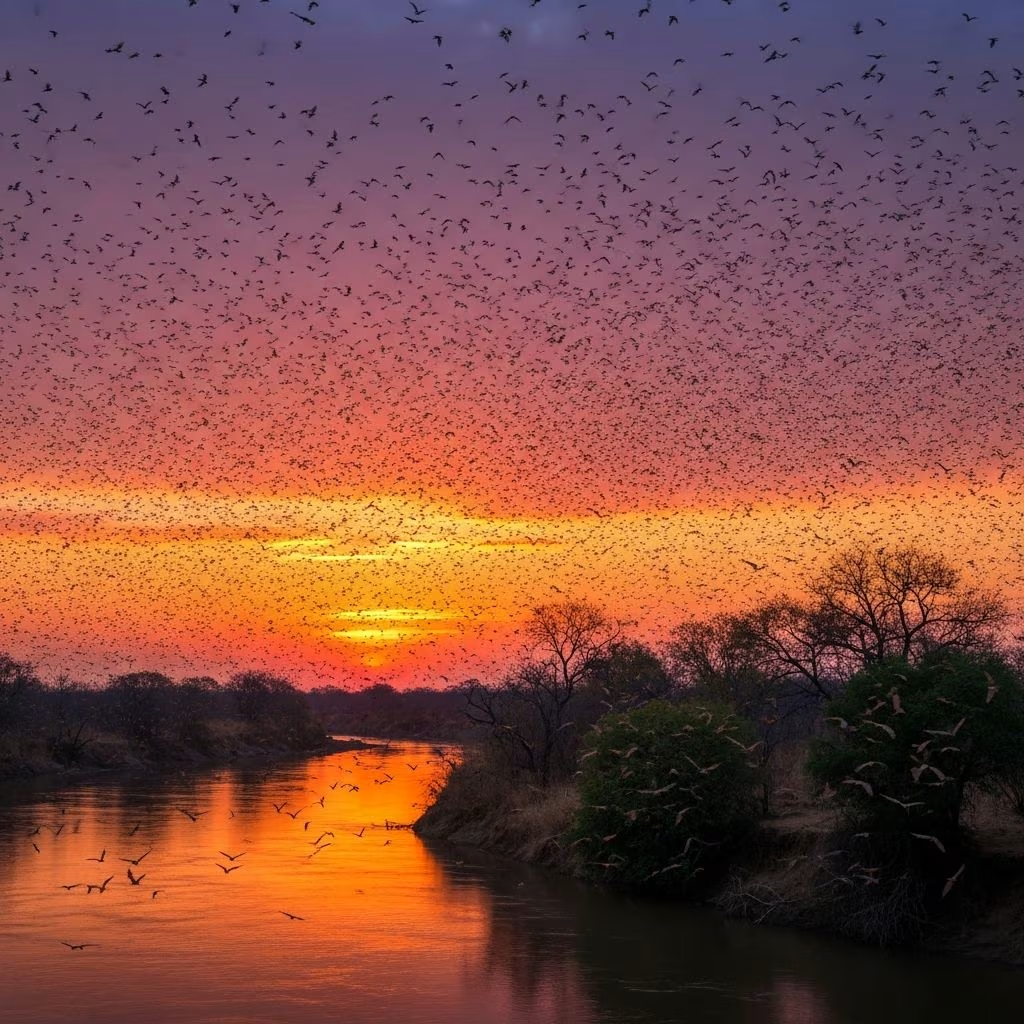
The Kasanka bat migration stands as one of nature’s most awe-inspiring displays, drawing up to 10 million straw-coloured fruit bats to a tiny forest patch in Zambia’s Kasanka National Park each year. This phenomenon, recognized as the planet’s largest mammal migration by biomass, transforms the sky into a living whirlwind at dawn and dusk.
From late October to early December, straw-coloured fruit bats (Eidolon helvum) converge on just 2 hectares of swamp forest within the 390-square-kilometer park. These bats, the second-largest fruit bat species in Africa with wingspans up to one meter and weights reaching 350 grams, travel thousands of kilometers from equatorial Africa, including the Congo Basin.
Unlike the famous wildebeest migration involving about 2 million animals, Kasanka’s event surpasses it in sheer numbers, creating a gothic spectacle of swirling shadows as millions take flight simultaneously. Research indicates peak gatherings of 8-10 million individuals, though exact counts vary due to the challenge of precise enumeration.
Scientists puzzle over why these bats select this specific location. The Mushitu evergreen swamp forest, cooled by a nearby stream creating natural air currents, offers ideal roosting conditions rare amid Zambia’s fire-prone landscapes. Seasonal fruiting of wild loquat, red milkwood, water berries, and masuku provides abundant food, supplemented by nearby agricultural crops like mangoes and bananas.
The bats do not reside year-round; by January, they disperse completely, suggesting a precise migratory strategy tied to fruit availability and weather patterns. Studies show they fly an average of 50-140 km nightly from the roost, consuming up to twice their body weight in fruit—equating to over a billion fruits during their stay. This feasting fuels their long-distance journeys and disperses seeds vital for forest regeneration.
Kasanka’s bats are strictly nocturnal. During the day, they roost densely in the forest canopy, protected from predators like fish eagles, crowned eagles, and crocodiles. As sunset approaches, they erupt in massive clouds, foraging across farmlands and woods before returning just before dawn, their wings casting dramatic shadows.
Prime viewing occurs from tree-top hides, where visitors witness eye-level flights of millions. Dawn and dusk are magical, with the sky darkening under the weight of wings—a sensory overload described as an “animal carnival.”
Avoid post-December, as the forest empties.
Despite its scale, the straw-coloured fruit bat population has declined 30% in the past decade due to deforestation for agriculture and bushmeat hunting. Kasanka serves as a critical sanctuary, protected by the Zambia National Parks and Wildlife Service and partners like Kasanka Trust Ltd (KTL).
Ecotourism generates revenue for local communities through employment and park fees, countering illegal logging threats. Bats’ seed dispersal supports biodiversity, making their protection essential for ecosystem health.
| Threat | Impact | Conservation Action |
|---|---|---|
| Deforestation | Loss of roosting/fruit forests | Protected areas expansion by KTL |
| Bushmeat Hunting | 30% population decline | Community education programs |
| Agricultural Expansion | Habitat fragmentation | Ecotourism revenue incentives |
Kasanka National Park offers more than bats: picturesque landscapes, superb birdlife, and diverse wildlife like elephants, hippos, and leopards. Lodges provide tree hides, guided safaris, and comfortable stays.
Combine with South Luangwa for a full Zambia safari itinerary.
Researchers like those from Kasanka Trust use AI and trigonometry for counts, estimating peaks far higher than initial models suggest—potentially 10-12 million. Long-term studies track migration routes via GPS, revealing the bats’ role in pollination and seed spread across Africa.
Climate change may alter fruiting seasons, prompting adaptive conservation. Visitor experiences contribute via citizen science apps for bat monitoring.
The annual gathering of 8-10 million straw-coloured fruit bats in Kasanka National Park, the world’s largest mammal migration by number.
Mid-October to mid-December, peaking in November. Dawn and dusk offer the most dramatic views.
Yes, with guided tours and lodges ensuring safety amid abundant wildlife.
They consume billions of fruits, dispersing seeds that regenerate forests.
Absolutely—use fast shutters for the swirling masses; hides provide stable platforms.
The Kasanka migration offers a rare chance to see nature’s raw power: a biomass surpassing Africa’s great herds, in an under-the-radar gem. It blends spectacle with purpose—supporting conservation through your visit.
