

 Travel Essentials
 Travel Essentials

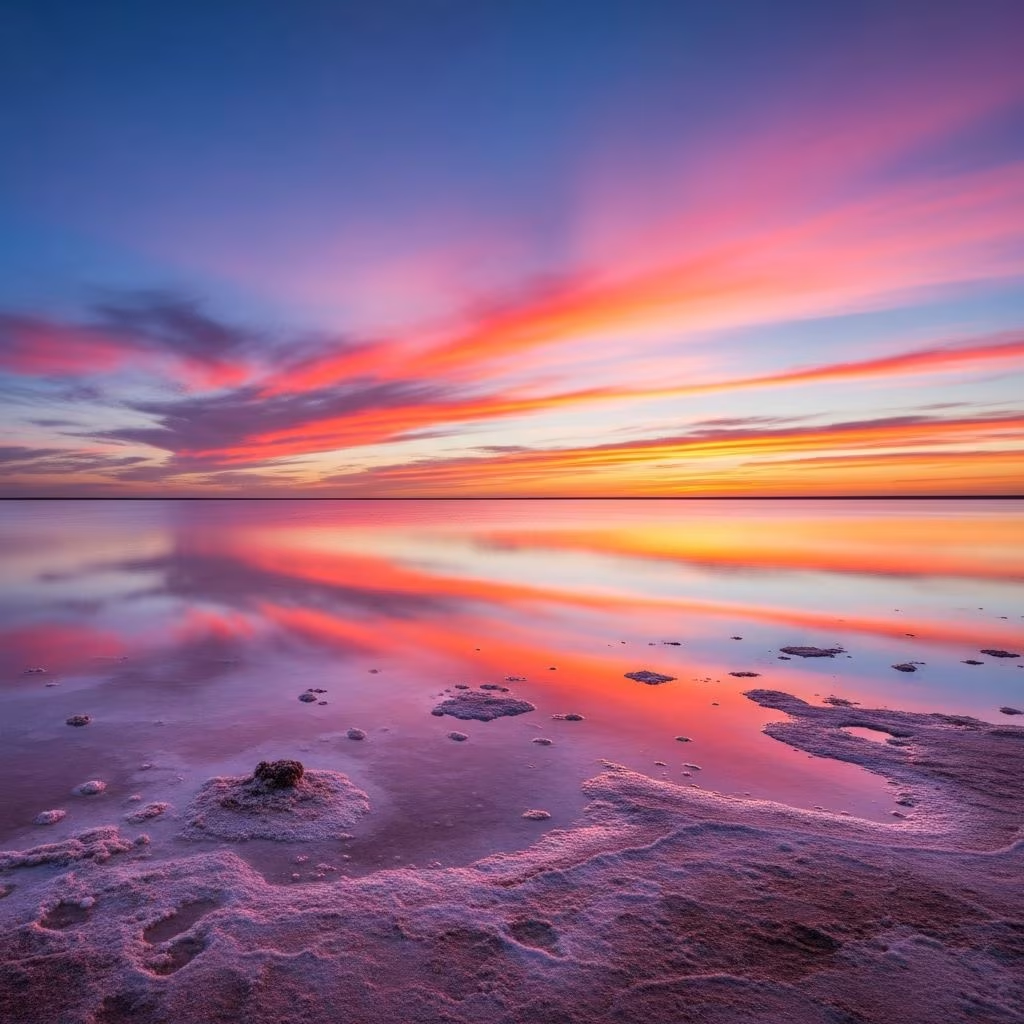
Kati Thanda-Lake Eyre transforms into a vibrant pink-orange spectacle during rare floods. Learn about its geography, the science behind the colors, wildlife boom, and how to visit this outback gem.
 Travel Essentials
Australia’s remote outback hides one of the planet’s most captivating natural displays: Kati Thanda-Lake Eyre, the nation’s largest lake, which sporadically bursts into vivid pink and orange tones. This enormous salt flat, typically a blinding white expanse, only awakens after exceptional rainfall, creating a fleeting masterpiece that draws adventurers and nature enthusiasts from around the globe.
Spanning approximately 89 by 48 miles, Kati Thanda-Lake Eyre occupies South Australia’s lowest point, forming the heart of an endorheic basin—a closed drainage system with no outlet to the sea. Covering up to 9,500 square kilometers when full, it dominates the Lake Eyre Basin, a massive 1.2 million square kilometer catchment stretching across parts of Queensland, South Australia, the Northern Territory, and New South Wales.
Most years, the lake remains a dry, crusted salt pan, reflecting the harsh arid climate where evaporation far outpaces inflow. It fills completely only a handful of times per century, with the most recent major event in May 2025 following record-breaking rains in Queensland. Torrential downpours swelled rivers like the Cooper Creek and Warburton River, channeling unprecedented volumes of water southward over months.
The lake’s signature transformation happens as floodwaters recede. Evaporation concentrates the brine, creating hypersaline conditions ideal for halophilic (salt-loving) microorganisms. These include algae like Dunaliella salina and various bacteria and archaea that produce carotenoids—pigments ranging from pink to deep orange-red for protection against intense sunlight and UV radiation.
Satellite imagery from Japan’s Himawari-9, orbiting 36,000 km above Earth, captured the 2025 event’s scale, with pink expanses visible from space. NASA’s Earth Observatory noted greenish tones in Belt Bay and reddish-orange in Madigan Gulf, evolving as salinity peaked six to seven months post-flood.
| Factor | Effect on Color |
|---|---|
| Initial Flood | Clear to greenish water from sediment and algae blooms. |
| Evaporation | Increasing salinity triggers pigment production. |
| Peak Pigmentation | Vibrant pink-orange across vast areas. |
| Dry Phase | White salt crust returns. |
This phenomenon mirrors other pink lakes globally, like Australia’s Lake MacDonnell or Hillier, but Kati Thanda’s sheer size amplifies its drama.
Beyond aesthetics, floods trigger an ecological explosion. Pelicans, egrets, and other waterbirds migrate thousands of kilometers to breed, forming massive colonies. Fish eggs hatch rapidly, shrimp populations surge, and insects proliferate, sustaining a brief but intense food web.
The 2025 influx marked the fourth major flood in 160 years and the deepest in six, promising sustained life for months. As waters pinken, these microbes form the base of the food chain, tinting the lake while nourishing higher trophic levels. This pulse event underscores the basin’s resilience in one of Earth’s driest regions.
Records trace significant fillings to 1949, 1974, 1984, and now 2025, each tied to La Niña-driven wet periods. The lake’s behavior offers a natural barometer for regional climate patterns, with floods correlating to Queensland’s monsoon strength.
Indigenous Anangu and Yarluyandi peoples have known Kati Thanda for millennia, naming it for the blood-like flows during rare wet times, symbolizing renewal. European explorers like Charles Sturt first mapped it in the 1840s, dubbing it Lake Eyre after overseer Edward John Eyre.
Accessing Kati Thanda demands preparation due to its isolation—over 700 km northeast of Adelaide across unsealed roads passable only in 4WD vehicles during dry spells. The optimal vantage is aerial: scenic flights from William Creek, Marree, or Coober Pedy offer unobstructed views of the colored expanses.
Operators like Wrightsair provide tailored flights, often combining overland camps for immersive stargazing under pristine outback skies.
Pack essentials: ample water (10L/day/person), sun protection, satellite phone, and spare tires. Permits aren’t required for overflights, but respect Indigenous land protocols. Accommodations range from William Creek’s historic pub to glamping at Anna Creek Station, the world’s largest cattle station.
| Lake | Location | Size | Color Cause | Accessibility |
|---|---|---|---|---|
| Kati Thanda-Lake Eyre | South Australia Outback | 9,500 km² | Flood algae blooms | Aerial/4WD tours |
| Lake MacDonnell | Eyre Peninsula, SA | Small | High salt algae | Drive & walk |
| Lake Hillier | Middle Island, WA | ~15 km² | Dunaliella salina | Flight only |
While smaller lakes offer ground access, Kati Thanda’s scale demands sky-high perspectives.
Mining threats and climate variability challenge the basin. Protected within Kati Thanda-Lake Eyre National Park, efforts focus on sustainable tourism. With warming trends potentially altering flood patterns, these events may grow rarer, heightening urgency to visit.
Evaporating floodwaters concentrate salt, thriving halophilic algae and bacteria produce pink-orange carotenoids.
Major floods every 10-20 years; 2025 was the fourth in 160 years.
No—hypersaline waters are inhospitable; admire from afar.
Scenic flights during the evaporation phase, 4-8 months post-flood.
With guides, yes; remote terrain requires preparation for heat and isolation.
