

 Travel Essentials
 Travel Essentials

Explore what to expect at King Charles III's coronation at Westminster Abbey, including ceremony stages, regalia, and weekend festivities.
 Travel Essentials
On Saturday, May 6, 2023, King Charles III made history as the 40th monarch to be crowned at Westminster Abbey, one of the world’s most significant religious and ceremonial venues. This momentous occasion marked a significant transition in British history and attracted global attention. Unlike his mother’s coronation in 1953, King Charles III’s ceremony represented a modernized approach to this ancient tradition, balancing centuries of custom with contemporary sensibilities.
Queen Camilla, King Charles III’s wife, was also crowned during the same ceremony, making this occasion distinct from previous royal coronations. This dual crowning represented a notable shift in how the monarchy honors the consort, reflecting evolving perspectives on the role of the queen consort in modern times.
King Charles III’s coronation was deliberately designed to be more concise and accessible than previous ceremonies. His mother’s coronation in 1953 lasted nearly three hours and accommodated approximately 8,000 guests within Westminster Abbey’s historic walls. In contrast, King Charles III’s ceremony was structured to run slightly longer than one hour, with attendance limited to just over 2,000 guests. This reduction in scale reflected both practical considerations and a desire to make the ceremony feel more connected to contemporary society.
The streamlined nature of the event did not diminish its significance or ceremonial importance. Rather, it allowed organizers to focus on the most meaningful and symbolically important elements of the coronation ritual while maintaining the dignity and solemnity required for such a historic occasion.
The scaled-down approach also resulted in reduced expenses compared to historical coronations. This financial consideration acknowledged modern sensibilities regarding public spending while still ensuring the ceremony maintained its grandeur and ceremonial magnificence. By reducing the number of guests and the overall duration, organizers were able to create a more intimate yet still profoundly significant event.
The coronation service was structured around six key ceremonial stages, each with distinct symbolic meaning and historical precedent. Understanding these phases provides insight into how the monarchy reinforces its authority and connection to both religious tradition and the people it serves.
The ceremony commenced with the recognition stage, during which King Charles III stood beside the Coronation Chair, also known as the King Edward Chair, and was formally presented to the congregation by the Archbishop of Canterbury. This moment held profound significance, as it represented the monarch’s presentation to his subjects and the acknowledgment of his role as their sovereign.
Following this presentation, the Archbishop of Canterbury proclaimed King Charles III as “the undoubted King” and called upon attendees to support him. The congregation responded with “God Save the King,” and trumpets sounded in celebration. This recognition stage echoed traditions dating back centuries, including Queen Elizabeth II’s coronation in 1953, when similar acclamations were offered from the cardinal points of the compass.
The second stage involved the taking of the coronation oath, representing perhaps the most solemn moment of the entire ceremony. King Charles III placed his hand upon the Holy Bible and recited the oath, stating: “The things which I have here before promised, I will perform and keep. So help me God.”
Notably, this represented the only occasion in the entire coronation when a monarch signs a written obligation to his or her people. After reciting the oath verbally, King Charles III affixed his signature to this binding document, pledging to serve his people and govern according to the law. This written commitment carries tremendous symbolic weight, as it establishes a formal, recorded covenant between the sovereign and the nation.
The anointing represented the most spiritually significant moment of the entire coronation ceremony. According to the Archbishop of Canterbury and Westminster Abbey’s official records, this stage was where “the Archbishop of Canterbury makes a cross with holy oil on the royal forehead and elsewhere on the body to show that the monarch has been chosen by God”.
During this deeply solemn moment, King Charles III’s ceremonial robe was temporarily removed, and he sat beneath a specially constructed canopy traditionally made of gold cloth. This canopy has historically been positioned such that it remains invisible to the congregation and public, creating a private sacred space within the public ceremony. The Archbishop anointed the King’s hands, chest, and head with holy oil that had been consecrated in Jerusalem, connecting the British coronation to sacred Christian traditions practiced across the world.
Religious scholars and royal commentators have emphasized that while the crowning represents the visual and ceremonial climax of the event, the anointing holds the deepest spiritual and theological significance within the service.
Following the anointing, King Charles III returned to the Coronation Chair to receive the coronation regalia, a series of symbolically important objects that represent different aspects of royal authority and responsibility. These items were presented in a carefully ordered sequence:
These regalia items collectively constitute the Crown Jewels and are among the most precious and historically significant objects in British heritage. Each piece carries centuries of meaning and has been handled by previous monarchs during their own coronations.
The enthronement represented King Charles III’s ceremonial ascension to the throne. After receiving the regalia and being crowned, the King rose from the Coronation Chair and moved to the throne positioned within Westminster Abbey. This transition symbolically established his position as the reigning sovereign.
The homage stage followed, during which various subjects and nobles knelt before King Charles III and formally pledged their allegiance to him. Traditionally, this homage begins with the Archbishop of Canterbury. While historical accounts indicate that homage traditionally involved kneeling, kissing, and touching the crown, contemporary variations to this ancient practice have been considered for modern relevance.
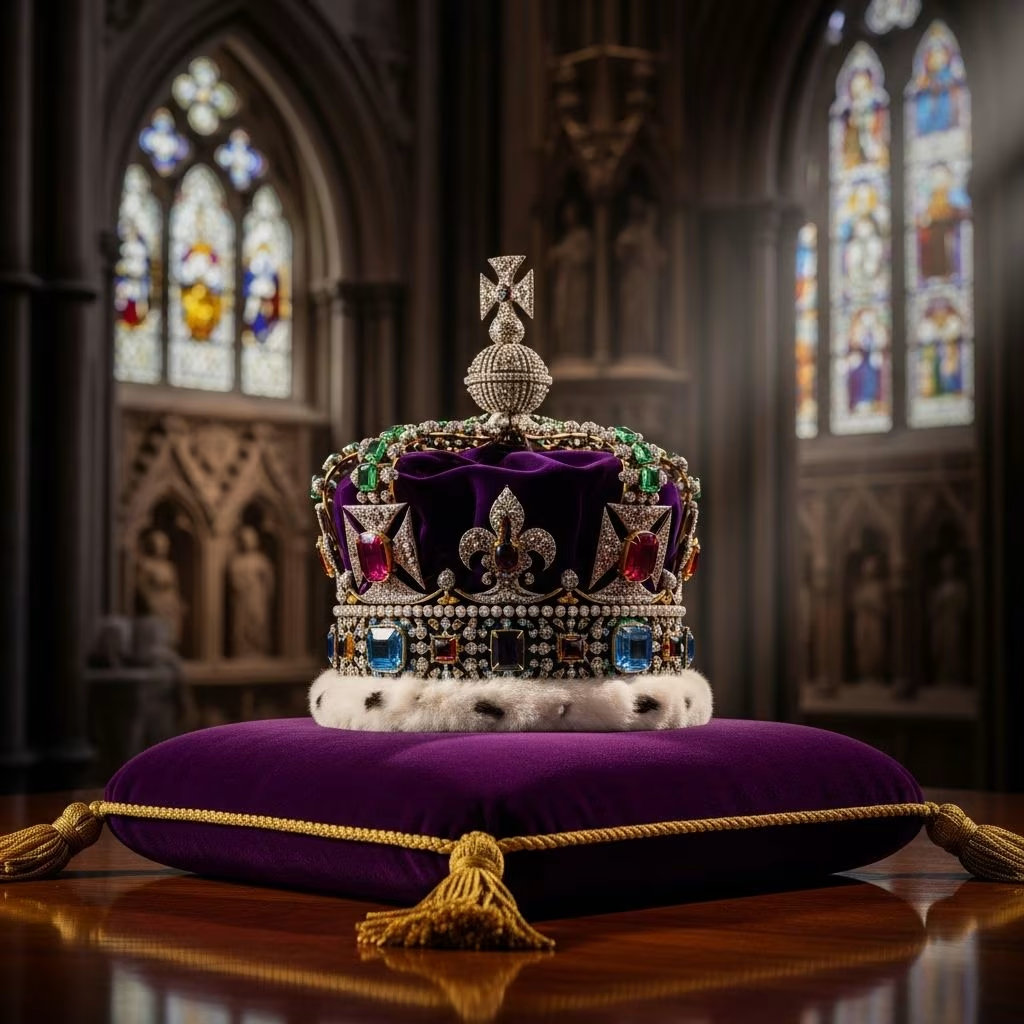
The crowning represented the most visually iconic moment of the entire ceremony. The Archbishop of Canterbury slowly placed the St. Edward’s Crown upon King Charles III’s head, a crown that weighs 4 pounds and 12 ounces and is crafted from solid gold. This particular crown, created in 1661 for King Charles II to replace an earlier medieval crown that had been melted down during the English Civil War, has been used at every coronation since that time.
Significantly, the St. Edward’s Crown is the only crown that King Charles III will wear during his entire reign as monarch. After departing Westminster Abbey, he exchanges it for the Imperial State Crown, which is worn for ceremonial occasions and public appearances.
The Coronation Chair, formally known as King Edward’s Chair, holds extraordinary historical significance. Commissioned by Edward I in the year 1300, this famous piece of furniture was originally designed to encase the Stone of Scone, also referred to as the Stone of Destiny. This sandstone block, used in Scottish coronations for centuries before being taken by English forces in 1296, represents a connection to Scotland’s royal heritage.
For King Charles III’s coronation, the Stone of Scone was positioned beneath the Coronation Chair, and it was subsequently returned to Scotland following the ceremony. This gesture acknowledged Scotland’s distinct royal traditions while maintaining the symbolic unity of the entire British realm.
Two distinct crowns played crucial roles in the coronation ceremony, each serving different ceremonial purposes:
| Crown | Purpose | Characteristics |
|---|---|---|
| St. Edward’s Crown | Coronation ceremony | Solid gold, weighs 4 lbs 12 oz, made in 1661, worn only during coronation |
| Imperial State Crown | Ceremonial occasions | Worn at State Opening of Parliament, royal processions, public appearances |
After the crowning ceremony concluded and King Charles III prepared to depart Westminster Abbey, he exchanged the St. Edward’s Crown for the Imperial State Crown. This crown, which was recently seen resting on the coffin of Queen Elizabeth II, serves as the monarch’s crown for all subsequent ceremonial functions throughout their reign. The Imperial State Crown features precious gems and crosses, making it one of the world’s most recognizable crowns.
The ceremonial aspects of King Charles III’s coronation extended far beyond Westminster Abbey’s interior. On the morning of the coronation, King Charles III and Queen Camilla traveled from Buckingham Palace to Westminster Abbey in the Gold State Coach, an iconic vehicle used for significant state occasions. The processional route was lined by members of the Armed Forces and thousands of celebrating spectators, creating a festive atmosphere throughout central London.
Following the conclusion of the ceremony, the newly crowned King and Queen traveled by a different route to return to Buckingham Palace. This return journey, while not yet publicly detailed at the time of planning, was anticipated to follow established royal routes through London. Upon arriving at Buckingham Palace, King Charles III and Queen Camilla appeared on the palace balcony to greet the assembled crowds, a traditional finale to coronation celebrations.
The coronation regalia extended beyond the symbolic objects presented during the ceremony to include elaborate ceremonial robes. The palace identified four distinct coronation robes, each crafted from crimson or purple velvet and serving specific ceremonial purposes:
These robes, along with the various pieces of regalia, were meticulously selected and explained by Buckingham Palace to emphasize their historical significance and symbolic meanings. Each element of the coronation attire contributed to the overall ceremonial narrative.
King Charles III, known as a classical music enthusiast, was closely involved in selecting and commissioning music for the coronation service. The musical selections aimed to blend traditional coronation anthems with new musical voices, creating a balance between heritage and contemporary relevance.
The ceremony featured music from renowned classical composers whose works had graced coronations over four centuries, including William Byrd, Edward Elgar, and Georg Friedrich Handel. Additionally, the musical program included a half-dozen different choirs, featuring a gospel choir and a Byzantine chant ensemble that performed Greek Orthodox music, a tribute to King Charles III’s late father, Prince Philip, who was born a prince of Greece and Denmark.
The coronation ceremony on May 6, 2023, served as the centerpiece for an entire weekend of celebrations throughout the United Kingdom. The palace encouraged people to gather for a big lunch on Sunday, following a concert held at Windsor Castle. Additionally, Monday was declared a national holiday in the U.K., and the palace encouraged citizens to volunteer in their local communities, fostering a sense of shared national purpose and connection during this historic occasion.
Queen Camilla’s role as the first Queen Consort to be crowned alongside a reigning monarch in contemporary British history was particularly significant. She underwent the same anointing ceremony as King Charles III, being anointed in the same manner with holy oil, before receiving her own crown. This parallel coronation reflected modern perspectives on the role and importance of the Queen Consort within the monarchy.
This arrangement contrasted with historical precedent, as King Charles III’s father, Prince Philip, Duke of Edinburgh, was not crowned alongside Queen Elizabeth II during her 1953 coronation. The decision to crown Queen Camilla represented an evolution in how the British monarchy honors and recognizes the consort’s position.
