

 Travel Essentials
 Travel Essentials

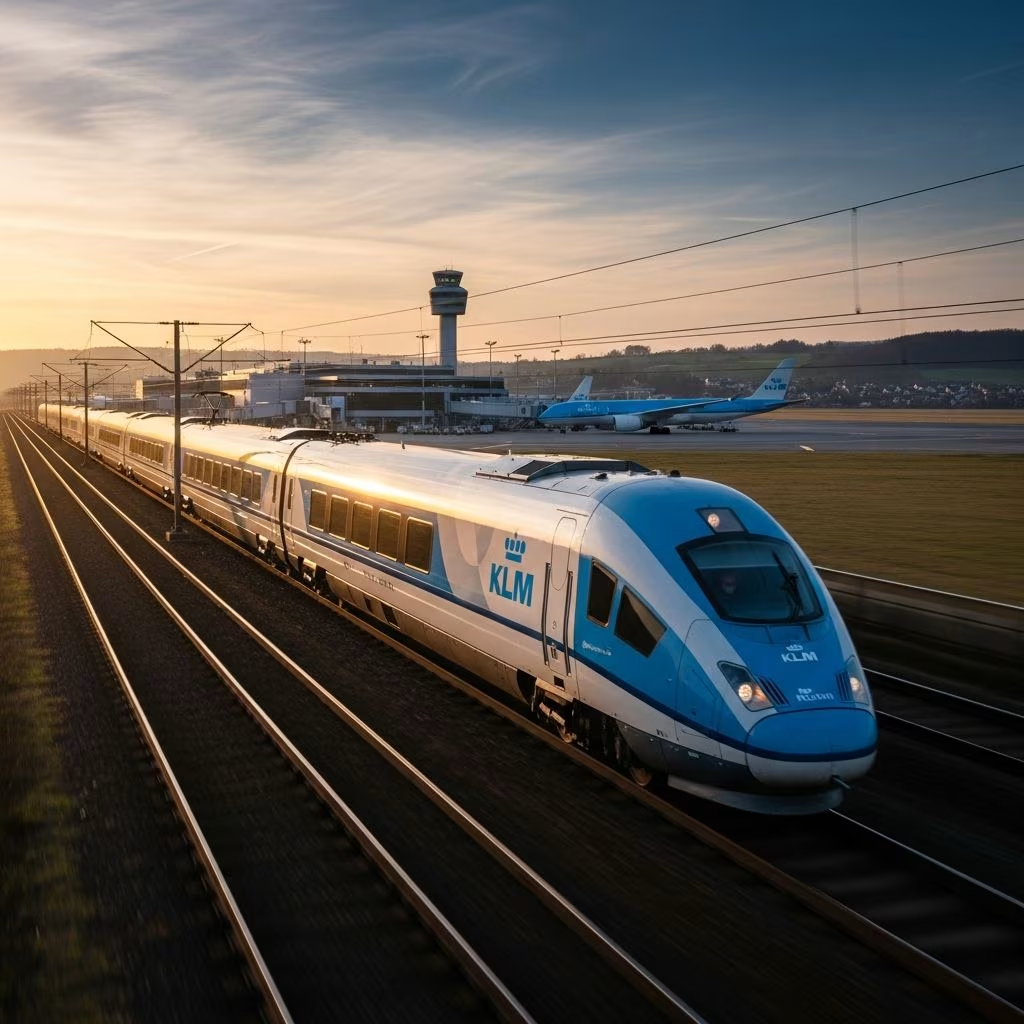
KLM replaced a short Brussels-Amsterdam flight with high-speed rail, cutting emissions and freeing airport slots for more valuable long-haul service.
 Travel Essentials
In March 2020, Royal Dutch Airlines (KLM) made a groundbreaking decision that would reshape how European carriers approach short-distance travel. The airline announced plans to eliminate one of its five daily flights between Brussels and Amsterdam Airport Schiphol, replacing this route with high-speed train capacity operated through a partnership with Thalys, a leading Franco-Belgian rail operator. This move represented more than a simple operational adjustment—it embodied a fundamental rethinking of how modern airlines can balance commercial demands with environmental responsibility.
The decision emerged from months of collaborative planning between KLM, Thalys, and NS Dutch Railways, all working toward a unified objective: creating transportation solutions that would maintain passenger appeal while reducing the airline’s carbon footprint. This initiative marked the beginning of what many industry observers expected to become a broader trend across European aviation.
The Brussels-Schiphol corridor presented an interesting case study in aviation inefficiency. Despite being one of KLM’s busiest European routes, the actual flying time amounted to merely 20 minutes—a duration so brief that passengers spent considerably more time on ground procedures than in the air. When accounting for check-in requirements, security screening, boarding processes, and baggage collection, the total journey time by air often exceeded that of the alternative rail service.
In contrast, the Thalys high-speed train journey between these two cities consumed approximately two hours, yet offered distinct advantages that the airline recognized as compelling to many travelers:
Understanding these dynamics proved crucial to KLM’s strategic planning. The airline recognized that passengers on this route weren’t exclusively motivated by speed—many valued convenience, comfort, and environmental consciousness equally, if not more.
Beyond sustainability considerations, KLM faced a more immediately pressing operational challenge: Amsterdam Airport Schiphol operates under strict restrictions governing the number of daily flights. These capacity limitations create a bottleneck that directly impacts the airline’s ability to expand long-haul services—the routes that generate substantially higher revenue and profitability margins.
By reducing short-haul flight frequency on the Brussels route, KLM effectively freed up valuable take-off and landing slots that could be reallocated toward intercontinental services. This strategic redeployment transformed what might initially appear as a loss—eliminating a profitable European route—into a net gain for the airline’s overall business model. Each slot preserved for long-haul operations represented significantly greater commercial value than maintaining redundant short-distance flights.
This mathematical reality underpinned the financial logic of the rail replacement initiative. Rather than cannibalizing revenue, the strategy redirected resources toward higher-value operations while simultaneously advancing corporate sustainability objectives.
The cornerstone of KLM’s new approach materialized through the development of the Air&Rail service—a seamlessly integrated travel product that positioned train journeys as equivalent to flight segments within a unified booking ecosystem. Before this innovation, passengers had theoretically always possessed the option of purchasing separate train and airline tickets, yet few did so because the fragmented booking process created friction and uncertainty.
The Air&Rail framework fundamentally transformed this experience by:
Before the COVID-19 pandemic interrupted normal travel patterns, approximately 20 to 25 percent of passengers traveling the Brussels-Schiphol route as connectors to intercontinental flights chose the train option when presented through this streamlined product offering. This represented roughly 36,000 annual customers voluntarily selecting the rail alternative—a compelling validation of market demand for this transportation model.
A critical element distinguishing KLM’s Air&Rail success involved the fortunate geographic circumstance that Thalys high-speed trains terminate directly at a station connected to Amsterdam Airport Schiphol. This proximity enabled the seamless intermodal connections that passengers demanded. Travelers could arrive at the airport by train and proceed directly to their international flight without navigating external ground transportation or time-consuming transfer logistics.
The Thalys TGV trains, which operate as part of an extensive European high-speed network connecting Paris with Amsterdam in just over three hours, became integral components of KLM’s broader network architecture. Rather than viewing rail services as competitors to aviation, KLM reimagined them as complementary infrastructure that enhanced rather than diminished the airline’s overall value proposition.
The physical infrastructure supporting this integration included specialized check-in facilities at Brussels-Midi/Zuid railway station. The Air&Rail terminal at this location enabled passengers to receive boarding passes for their entire journey—both train and subsequent flights—at a single point, mirroring the convenience passengers expected from traditional airline services.
While operational and financial considerations drove much of KLM’s strategic calculus, the sustainability narrative represented an equally important motivating factor. The European aviation industry faced mounting pressure from regulators, investors, and consumers to reduce carbon emissions and demonstrate environmental stewardship. Short-haul flights, which generate disproportionately high emissions relative to passenger-kilometers traveled, became particular targets for emissions reduction initiatives.
By substituting rail transport for aviation on these routes, KLM contributed to broader European Union objectives regarding transportation sector decarbonization. High-speed trains, particularly those powered by renewable energy sources, produced dramatically lower per-passenger emissions than commercial aircraft. For environmentally conscious travelers, the ability to reach European destinations via train while retaining seamless connection to long-haul flights offered an increasingly attractive proposition.
KLM’s stated commitment involved gradually expanding this model beyond the Brussels route, implementing replacement service on additional short-haul corridors where comparable conditions existed. The airline positioned this evolution not as grudging adaptation to regulatory pressure but as a positive innovation reflecting modern consumer preferences and corporate values.
The successful implementation of Air&Rail required unprecedented coordination between distinct transportation operators historically accustomed to autonomous operation. KLM, Thalys, NS Dutch Railways, and Amsterdam Airport Schiphol established formal mechanisms for service integration, including:
| Operational Aspect | Coordination Mechanism |
|---|---|
| Baggage Handling | Through-checked luggage from final destination to origin |
| Schedule Synchronization | Train departure times aligned with connection requirements |
| Disruption Management | KLM rebooking authority for rail and air service interruptions |
| Check-in Procedures | Unified Air&Rail terminals at both Brussels and Amsterdam |
| Customer Information | Coordinated communication about transfers and journey preparation |
These coordination frameworks extended beyond standard operational protocols. KLM committed to managing passenger rebooking when either rail or air services experienced disruptions, positioning itself as the single point of accountability from a customer perspective. This unified service responsibility model distinguished the Air&Rail product from typical intermodal offerings where passengers navigated multiple service providers independently.
The commercial viability of KLM’s Air&Rail initiative ultimately depended upon passenger acceptance and utilization patterns. Initial results proved encouraging. The pre-pandemic adoption rate of approximately 20 to 25 percent demonstrated substantial latent demand for this transportation option when presented through convenient booking mechanisms and integrated service delivery.
Demographic analysis suggested that Air&Rail appealed particularly to business travelers with flexible scheduling, environmentally conscious consumers, and passengers prioritizing comfort and convenience over absolute speed. The service proved especially attractive for those whose final destinations involved Brussels or intermediate Belgian locations, eliminating unnecessary aviation segments for these travelers.
Beyond pure ridership metrics, the initiative generated broader competitive dynamics within European aviation. Other carriers began evaluating comparable partnerships with rail operators on short-haul routes within their networks, recognizing both the business logic and market positioning advantages of rail integration strategies.
For KLM’s Air&Rail model to achieve its stated objective of becoming a primary transportation option rather than a niche offering, several conditions required continuous attention:
KLM’s conditional statement regarding willingness to expand rail substitution—contingent upon trains maintaining speed, reliability, and comfort parity with aviation—reflected this reality. The airline recognized that sustainable transportation transitions required genuine product improvements rather than mere cost optimization or environmental virtue signaling.
The KLM-Thalys partnership, initiated in 2020 and subsequently expanded and refined, established a template that transportation industry observers anticipated would be replicated across Europe. As capacity constraints intensified at major hub airports and regulatory pressure on aviation emissions increased, short-haul flight elimination through rail substitution increasingly appeared as optimal strategy for network carriers.
The model demonstrated that environmental sustainability, operational efficiency, and financial performance need not exist in tension. Through creative business model innovation and strategic partnership development, airlines could simultaneously reduce carbon emissions, liberate scarce airport capacity for higher-value operations, and enhance customer experience on certain routes.
As European transportation systems continue evolving toward integrated multimodal networks, the Air&Rail concept represents a sophisticated response to the complex optimization challenges confronting 21st-century mobility. KLM’s pioneering approach suggests that the future of regional aviation may involve substantially fewer flights, more abundant rail options, and seamless integration between these transportation modes rather than continued competition between them.
