

 Travel Essentials
 Travel Essentials

Lake Tahoe's clarity hit levels not seen since the 1980s in 2022 due to native zooplankton resurgence, amid ongoing restoration challenges and recent murkiness.
 Travel Essentials
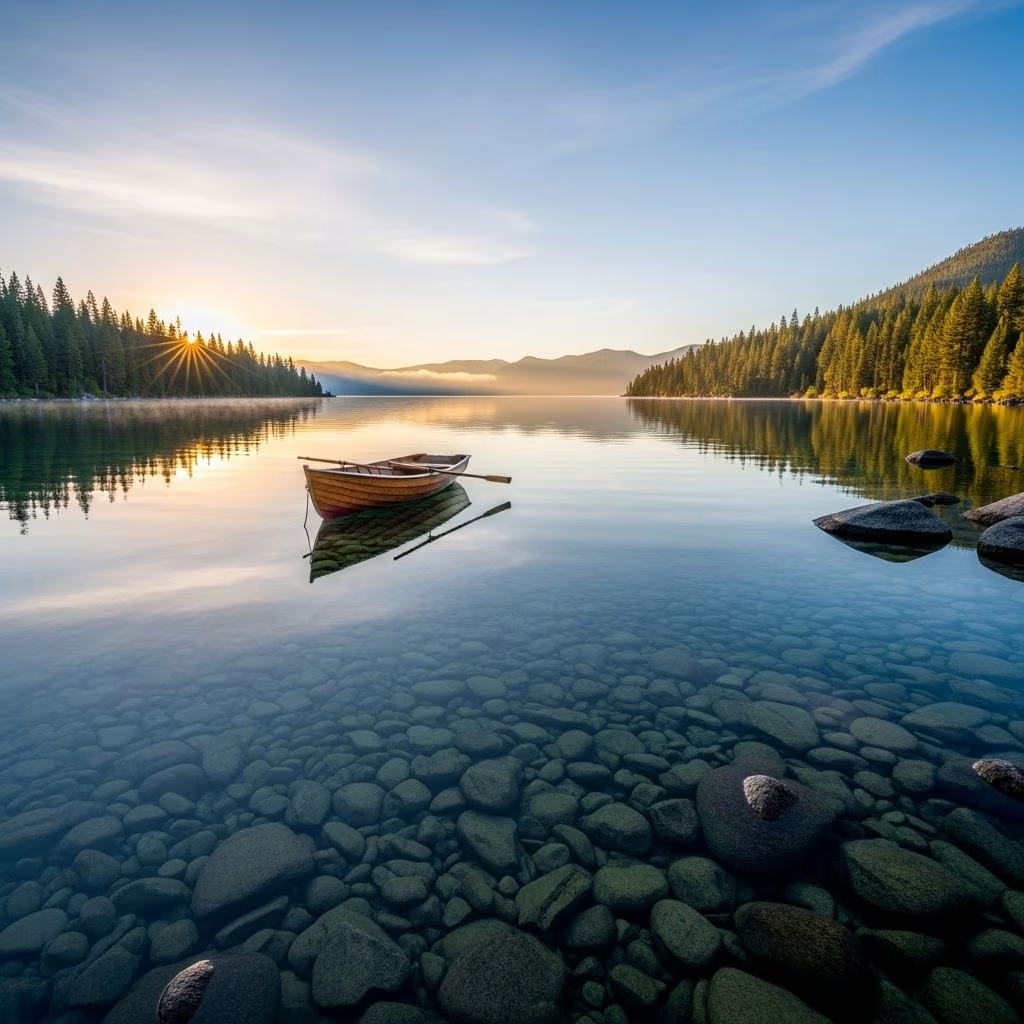
Lake Tahoe, a stunning alpine lake shared by California and Nevada, achieved remarkable water clarity in 2022, the best since the 1980s, primarily due to a resurgence of native zooplankton species that naturally filter particles from the water. This improvement, measured at an average of 71.7 feet using the Secchi disk method, marked a significant rebound from 2021’s 61 feet, especially during the latter half of the year when visibility reached 80.6 feet.
Lake Tahoe’s mesmerizing turquoise hue stems from its exceptional depth—over 1,600 feet—and low nutrient levels that limit algal growth, allowing light to penetrate deeply and scatter blue wavelengths. Clarity is quantified via the Secchi disk, a 10-inch white disk lowered into the water until invisible; greater depths indicate cleaner water. Historical peaks hit 102 feet in 1968, but decades of decline pushed averages to 60-70 feet recently.
Primary clarity threats include fine particles like silt, clay, and phytoplankton such as Cyclotella, which scatter light in the 1-5 micrometer range. Native zooplankton like Daphnia and Bosmina consume these particles, acting as biological filters. Their decline post-1960s, following invasive Mysis shrimp introduction, allowed particle buildup.
In late 2021, the invasive Mysis shrimp population crashed unexpectedly, enabling Daphnia and Bosmina to rebound dramatically by late 2022. These tiny herbivores grazed on phytoplankton and particles, boosting clarity to 80.6 feet from August to December—the clearest since the 1980s. UC Davis Tahoe Environmental Research Center (TERC) Director Geoffrey Schladow noted this as a natural cleanup mechanism after decades of suppression.
Boat captain Brant Allen predicted further gains in 2023, potentially matching 1970s levels despite heavy snowmelt runoff. This event underscores the lake’s food web dynamics: Mysis preys on zooplankton, which in turn control clarity-impairing algae.
| Year/Period | Average Secchi Depth (feet) | Key Factors |
|---|---|---|
| 1968 | 102 | Pre-development pristine conditions |
| 1970s average | ~97 | Early monitoring baseline |
| 1980s | High (80+ in peaks) | Zooplankton dominance |
| 2017 | Murkiest on record | High particles |
| 2021 | 61 | Record particles, wildfires |
| 2022 | 71.7 (80.6 late year) | Zooplankton resurgence |
| 2024 | Third murkiest | Persistent challenges |
This table illustrates Tahoe’s clarity fluctuations: a steep drop through the 1990s due to development, stabilization, and the 2022 spike. Despite billions invested, 2024 saw third-worst levels, 16 feet shy of 2031 goals.
Urbanization since the mid-20th century introduced fine sediments and nutrients via roads, construction, and stormwater. Agencies now prevent over 500,000 pounds of pollutants annually through erosion controls and road upgrades. Wildfires, like those boosting 2021 particles, deposit ash, exacerbating murkiness. Atmospheric deposition of nitrogen from distant sources also fuels algae.
Climate change intensifies challenges: prolonged droughts reduce flushing, while intense storms increase runoff. Winter clarity often exceeds summer due to mixing, but 2024 bucked this with poor seasonal readings.
Restoration has removed over 500,000 pounds of sediment yearly. Hotels like Ritz-Carlton Lake Tahoe and Edgewood Tahoe Resort partner on cleanups, plastic bans, and sediment reduction. The EPA targets 97.4 feet clarity, blending natural recovery with policy.
These efforts, combined with the zooplankton surge, offer hope, though experts stress sustained action amid climate pressures.
Tourists play a vital role:
Simple habits amplify billions in public investments.
Optimism from 2022 tempered by 2024’s murkiness. Experts anticipate zooplankton benefits persisting, but record snowpacks and warming threaten runoff. Achieving 2081 goals requires 35-foot gains, demanding integrated ecology-management strategies. TERC continues research to unravel recent declines.
The crash of invasive Mysis shrimp allowed native Daphnia and Bosmina to thrive, filtering particles.
Using a Secchi disk: depth (feet) where a 10-inch white disk vanishes.
Development sediments, invasives, nutrients, wildfires, climate change.
2022 yes, but 2024 third-murkiest; stable but not advancing toward goals.
Minimize waste, stay on paths, support conservation.
Best viewing: Emerald Bay, Vikingsholm, Cave Rock. Dive or kayak for immersive blues. Winter snow enhances contrast; monitor TERC reports for peak clarity.
