

 Travel Essentials
 Travel Essentials

Explore contemporary approaches to understanding ancient Egypt through digital platforms, interactive experiences, and educational resources.
 Travel Essentials
The mysteries of ancient Egypt have captivated scholars, historians, and curious minds for centuries. From the monumental pyramids that pierce the desert sky to the intricate hieroglyphic inscriptions adorning temple walls, Egypt’s ancient civilization represents one of humanity’s most enduring achievements. Traditionally, engaging with this heritage meant either traveling to Egypt itself or studying dusty textbooks in academic settings. Today, however, the landscape of Egyptology has transformed dramatically. Technological innovations and educational advancements have democratized access to Egyptian knowledge, allowing enthusiasts worldwide to explore this magnificent civilization through diverse and engaging methodologies.
Understanding ancient Egypt has undergone a significant transformation over the past decade. Previously, knowledge about Egyptian civilization remained largely confined to university departments, museum collections, and archaeological expeditions. The study of ancient Egypt encompasses a multidisciplinary exploration of the civilization that thrived along the Nile River thousands of years ago, involving examination of Egyptian history, culture, religion, architecture, and societal structures through artifacts, inscriptions, texts, and archaeological sites. This comprehensive approach has now become accessible to the general public through innovative platforms and experiences.
The democratization of Egyptological education reflects broader shifts in how cultural heritage is preserved and shared. Museums, universities, and cultural organizations have recognized the importance of making ancient knowledge available beyond academic circles. This shift has created multiple pathways for learners of different ages, backgrounds, and interests to connect with Egypt’s past.
Online learning has become a cornerstone of modern Egyptological education. Major universities and educational institutions now offer comprehensive courses dedicated to ancient Egyptian civilization. These programs typically examine various aspects of Egyptian culture, including the significance of pharaohs and beliefs about the afterlife, allowing learners to gain valuable insights into one of the world’s oldest and most influential civilizations.
Universities such as the University of Pennsylvania have made ancient Egypt accessible through flexible online formats. These courses feature engaging content that covers colossal pyramids, imposing temples, golden treasures, enigmatic hieroglyphs, powerful pharaohs, and the mysterious religious practices of this ancient culture. The modular structure of these programs allows learners to progress at their own pace, making them ideal for professionals, students, and lifelong learners.
Beyond university-level offerings, specialized educational websites have emerged to cater to diverse learning preferences. Interactive platforms now provide opportunities to explore ancient monuments using virtual maps, high-quality photographs, architectural drawings, and historical paintings. These tools enable learners to examine temples and pyramids from multiple angles, deepening their understanding of Egyptian engineering and artistic achievement.
One of the most engaging innovations in Egyptological education involves interactive tools that transform passive learning into active engagement. Hieroglyphic typewriters allow learners to write their names in ancient Egyptian script, creating a tangible connection to the written language of the pharaohs. This hands-on approach helps demystify hieroglyphic writing and demonstrates the sophistication of Egyptian linguistic systems.
Mathematical enthusiasts can explore Egyptian numerals through specialized learning modules. Historical number systems provide fascinating insights into how ancient Egyptians approached mathematics and solved practical problems. These interactive challenges present mathematical problems formatted using ancient numerical notation, allowing modern learners to experience how ancient scholars approached calculation and quantification.
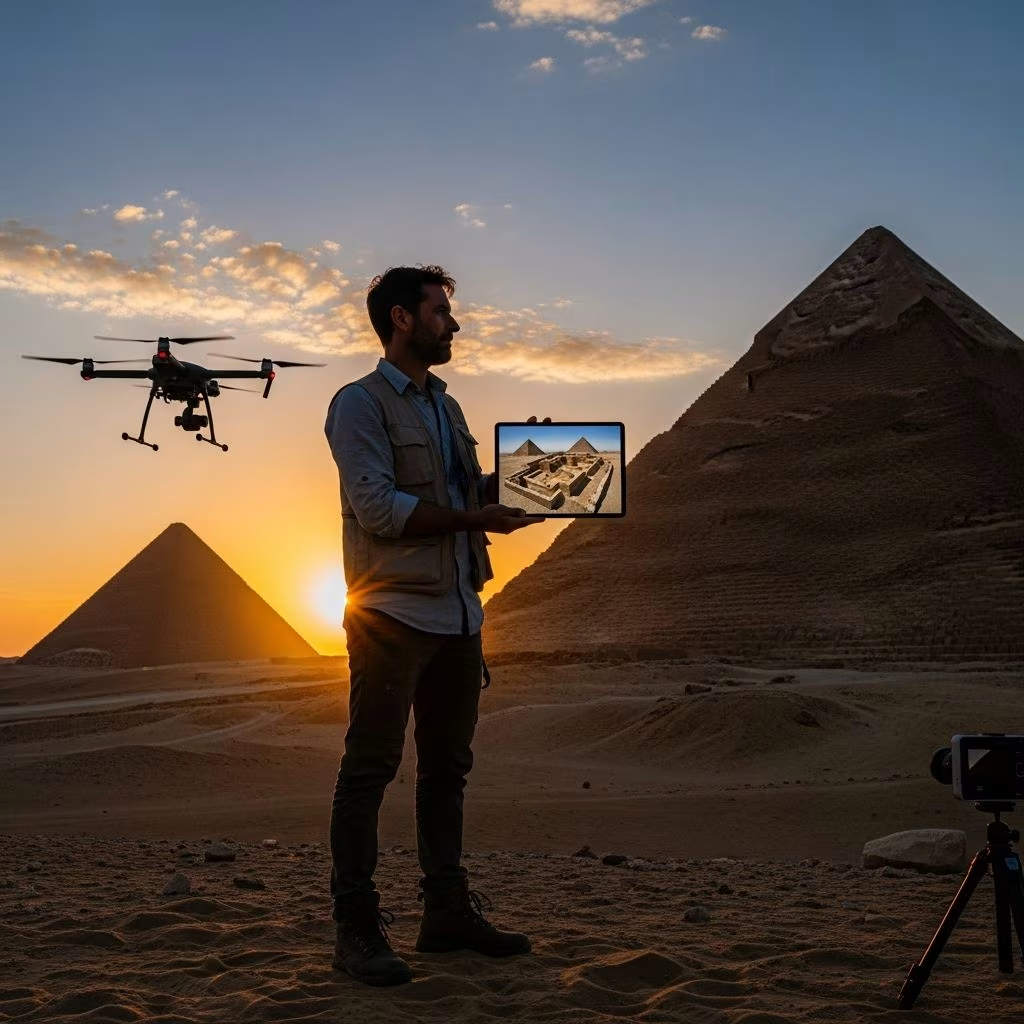
Three-dimensional reconstructions of temples and shrines represent another frontier in immersive learning. These digital recreations illustrate how ancient structures may have appeared to the eyes of ancient Egyptians themselves. Virtual temple exploration enables learners to navigate sacred spaces and understand the architectural principles underlying Egyptian religious buildings.
Modern educational resources provide extensive coverage of Egyptian society across multiple dimensions:
Understanding ancient Egypt requires grasping the central role of the Nile River in shaping Egyptian civilization. The Nile valley provided abundant resources that allowed the culture of ancient Egypt to flourish, earning the civilization its designation as the “gift of the Nile.” Educational resources now emphasize how Egypt’s dependency on the yearly flooding of the Nile created unique agricultural conditions and social structures.
Advanced academic lectures, such as those offered through prestigious university initiatives, explore the complexities of the Nile’s influence on Egyptian society. Scholarly discussions examine how Egyptian states created riparian towns along the Nile, adapted to changing climatic conditions, and responded to environmental challenges. These discussions illustrate that ancient Egyptians were not simply passive recipients of the Nile’s bounty but active agents who shaped their environment and responded to its demands.
Cultural organizations dedicated to Egyptian studies have developed specialized collections of educational materials. The Egypt Exploration Society, for instance, provides a variety of educational guides and activities created by specialists, covering a wide range of topics about the history of Egypt and Sudan. These resources cater to different learning styles and educational levels, from introductory materials for casual learners to advanced content for dedicated researchers.
These specialized resources often combine historical scholarship with accessible presentation methods. By collaborating with experts in Egyptology, cultural institutions ensure that educational content maintains academic rigor while remaining engaging for general audiences.
Modern approaches to Egyptological education recognize that learners enter with varying levels of prior knowledge and interest. Educational frameworks typically organize content hierarchically:
| Learning Level | Focus Areas | Typical Format |
|---|---|---|
| Introductory | Basic geography, timeline, major monuments | Interactive websites, short videos |
| Intermediate | Cultural practices, religious beliefs, daily life | Online courses, documentaries |
| Advanced | Archaeological methodology, scholarly debates | University courses, academic lectures |
| Specialized | Regional variations, period-specific studies | Research seminars, expert discussions |
Contemporary educational approaches emphasize direct engagement with archaeological evidence. Rather than simply reading descriptions of artifacts, learners now access detailed digital documentation of objects housed in museums worldwide. High-resolution photographs and three-dimensional models allow examination of intricate details that reveal information about Egyptian artistry, manufacturing techniques, and cultural values.
Inscriptions and textual evidence form another critical component of modern Egyptological learning. Educational platforms translate and contextualize hieroglyphic inscriptions, allowing learners to read actual messages from ancient Egyptians. This direct connection to ancient voices makes history feel immediate and personal rather than distant and abstract.
No. Modern educational resources are designed to accommodate learners at all experience levels. Introductory courses and websites require no prerequisite knowledge and provide necessary background context.
Timeline varies significantly. A basic understanding can be achieved through several weeks of casual exploration, while comprehensive mastery typically requires months or years of dedicated study.
Many online offerings from universities carry equivalent academic weight. However, informal learning platforms provide valuable knowledge without formal academic credentials. The choice depends on your educational goals.
Absolutely. Many resources are specifically designed for younger audiences, with age-appropriate content, interactive games, and engaging visual materials.
Modern approaches emphasize interactivity, accessibility, and multidisciplinary perspectives. They leverage technology to create immersive experiences while maintaining scholarly rigor.
Effective learning about ancient Egypt benefits from combining multiple resource types. Students might begin with introductory online platforms to establish foundational knowledge, progress to university-level courses for deeper understanding, and supplement their learning with specialized resources focusing on particular interests such as religious practices, architectural achievements, or daily life.
This multifaceted approach mirrors how professional archaeologists and historians approach the subject, drawing on diverse evidence sources and methodologies to construct comprehensive understandings of ancient civilization.
The trajectory of Egyptian heritage education continues evolving with technological advancement. Virtual reality experiences promise even more immersive engagement with ancient monuments and spaces. Artificial intelligence applications may personalize learning pathways to individual needs and interests. Augmented reality applications could overlay historical information onto photographs of modern Egypt, bridging ancient and contemporary perspectives.
As these innovations emerge, the core purpose remains consistent: making the achievements of ancient Egypt accessible, comprehensible, and inspiring to audiences worldwide. Whether learners are motivated by academic curiosity, cultural interest, or simple fascination with human achievement, contemporary educational pathways ensure that Egypt’s ancient heritage remains vibrant and engaging for new generations of explorers and scholars.
