

 Travel Essentials
 Travel Essentials

Discover the epic journeys that reshaped trade, culture, technology, and exploration—from Silk Road caravans to space missions.
 Travel Essentials
Throughout human history, intrepid travelers have pushed boundaries, braving unknown terrains to connect distant lands and uncover hidden wonders. These monumental expeditions not only redrew the world’s maps but also sparked cultural exchanges, economic booms, and technological leaps that echo into the present day. From overland silk caravans to oceanic fleets and high-altitude treks, this article delves into the most influential journeys, highlighting their challenges, triumphs, and lasting legacies.
Land-based voyages across vast continents demanded resilience against harsh climates, hostile terrains, and political barriers. These treks laid the groundwork for global trade networks and cultural diffusion.
These overland feats demonstrated human ingenuity in navigation and logistics, turning impassable barriers into bustling highways of commerce.
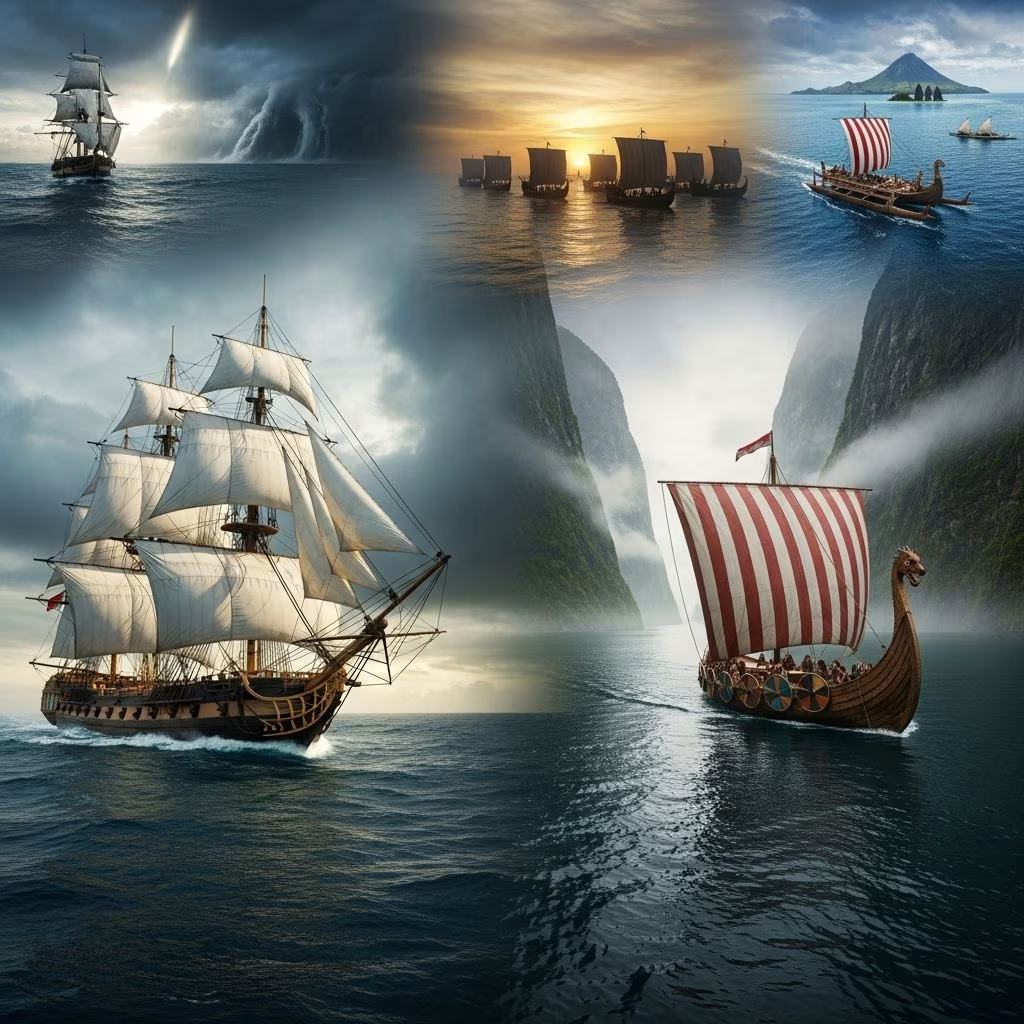
The seas presented their own formidable trials—storms, scurvy, and uncharted waters—but yielded discoveries that shrank the planet. Bold navigators harnessed winds and stars to claim new horizons.
| Explorer | Journey | Key Achievement | Duration |
|---|---|---|---|
| Christopher Columbus | Atlantic to Americas (1492) | Opened transatlantic routes | 71 days |
| Ferdinand Magellan | Circumnavigation (1519-1522) | First global loop | 3 years |
| Zheng He | Indian Ocean fleets (1405-1433) | Diplomatic treasure voyages | 28 years (7 voyages) |
Columbus’s four voyages sparked European colonization, while Magellan’s crew completed the first circumnavigation despite his death en route. Zheng He’s massive armadas, with ships dwarfing Europe’s, projected Ming Dynasty power across Asia and Africa, carrying giraffes and porcelain as gifts.
The 19th century’s steam-powered rails transformed journeys from grueling months into swift days, knitting continents together and fueling industrialization.
These iron veins accelerated migration, resource extraction, and cultural blending, reshaping demographics and economies.
Rivers offered vital arteries for exploration, from source-to-sea descents that revealed tropical secrets.
David Livingstone traced Africa’s Zambezi River in the 1850s-60s, discovering Victoria Falls and combating the slave trade. His journals inspired missionary zeal and imperial ambitions. Similarly, Henry Stanley navigated the Congo River (1874-1877), mapping its treacherous rapids and dense jungles, paving paths for colonial exploitation.
Pre-modern routes like the Incense Trail and Amber Road preceded silk paths, trading luxuries that symbolized wealth and power.
These conduits spread religions, technologies, and cuisines, weaving the tapestry of Eurasian civilizations.
Books immortalized journeys, inspiring readers to follow in fictionalized footsteps.
Jack Kerouac’s On the Road (1957) captured Beat Generation hitchhikes across America, embodying post-WWII freedom. Ernest Hemingway’s African safaris influenced safari tourism, while Jules Verne’s Around the World in Eighty Days popularized global circuits.
20th-century automobiles enabled spontaneous epics, from dust bowls to dream routes.
Foot-powered quests tested endurance, blending spirituality and survival.
Canadians Warburton and Wells trekked 5,000 km across Australia (1872-73), surviving on wallaby meat amid deserts. Japan’s Shikoku Pilgrimage (88 temples, 1,200 km) draws 100,000+ annually for reflection. In the Himalayas, the Everest Base Camp trek echoes Edmund Hillary and Tenzing Norgay’s 1953 summit.
Arctic and Antarctic expeditions epitomized ultimate human grit against ice and isolation.
These voyages advanced science, mapping ice shelves and magnetic fields.
Aviation shrank distances, turning days into hours.
Amelia Earhart’s 1932 solo Atlantic crossing defied gender norms. Charles Lindbergh’s 1927 New York-Paris flight (33.5 hours) ignited commercial aviation. The Wright Brothers’ 1903 Kitty Hawk flights birthed powered flight.
From Yuri Gagarin’s 1961 orbit to Apollo 11’s 1969 Moon landing, space journeys redefined exploration. NASA’s Voyager probes (1977) carry golden records into interstellar void, humanity’s cosmic missive.
These sagas teach adaptability, courage, and collaboration. Modern travelers can emulate by preparing meticulously, respecting locals, and embracing detours. Sustainable tourism now honors these paths without eroding them.
The Trans-Siberian Railway spans 9,289 km, but Magellan’s circumnavigation covered 60,000 km by sea.
Jeanne Baret in 1769, disguised as a man on Bougainville’s expedition.
They established tribute systems, spread technologies, but were halted, limiting China’s oceanic dominance.
Yes, like the Silk Road via trains/buses, Route 66 drives, and Camino de Santiago pilgrimages.
Solo Pacific rows or Mars simulations, pushing physiological limits akin to polar treks.
