

 Travel Essentials
 Travel Essentials

Discover Liverpool's architectural history through its key eras, iconic structures like the Three Graces, and enduring landmarks that reflect its port city heritage.
 Travel Essentials
Liverpool’s built environment tells a compelling story of transformation, driven by its role as a pivotal port in the British Empire. From humble medieval beginnings to grand Victorian expanses and bold 20th-century experiments, the city’s architecture mirrors its economic booms, social shifts, and cultural ambitions. This exploration traces the chronological development of Liverpool’s skyline, highlighting pivotal structures and the forces that shaped them.
The roots of Liverpool’s architecture stretch back to the 13th century, when the settlement emerged as a modest port on the River Mersey. King John granted it borough status in 1207, fostering basic timber-framed dwellings clustered around emerging streets like Castle Street and Water Street. Little survives from this period, but the foundational layout persists in the city’s core.
One early highlight was Liverpool Castle, erected between 1232 and 1235 by William de Ferrers. This fortress served defensive purposes until its demolition in the 18th century, symbolizing the town’s initial strategic importance. Transitioning into the Tudor and Elizabethan periods, grander timber-framed buildings with steep roofs appeared, exemplified by Speke Hall south of the city center—a rare survivor showcasing intricate woodwork and historical interiors.
By the early 18th century, the Bluecoat Chambers on School Lane stands as the oldest intact building in central Liverpool. Built between 1716 and 1718 in Queen Anne style, its symmetrical facade and graceful proportions earned it Grade I listing, reflecting a shift toward refined civic architecture.
The Georgian era (1714–1837) marked Liverpool’s ascent as a global trading hub, fueled by transatlantic commerce including the slave trade. This wealth funded opulent public buildings and residential quarters. Liverpool Town Hall, designed by John Wood the Elder in Palladian style and completed between 1749 and 1754, exemplifies this grandeur. Extended by James Wyatt in the 1780s, its neoclassical interiors—overseen by John Foster Sr.—feature lavish stucco work and symbolize municipal pride.
The Georgian Quarter, centered on Hope Street, boasts elegant townhouses with sash windows, pedimented doorways, and uniform brick facades. These structures not only housed merchants but also embodied the era’s emphasis on symmetry and proportion, drawing from classical influences.
The Victorian period (1837–1901) saw explosive growth as Liverpool became Europe’s premier port during the Industrial Revolution. Vast docks, warehouses, and commercial headquarters sprang up, characterized by intricate ironwork, bay windows, and robust stonework. St. George’s Hall, a neoclassical masterpiece completed in 1854, blends Greek Revival elements with advanced engineering, serving as a concert hall and law courts.
The Albert Dock, designed by Jesse Hartley and opened in 1846, revolutionized warehousing with fireproof cast-iron columns and granite quays. Once a bustling commerce center, it fell into disuse post-war but was revitalized in the 1980s into a vibrant cultural hub housing museums and galleries.
| Era | Key Features | Iconic Example |
|——|————–|—————-|
| Georgian | Symmetry, sash windows | Town Hall |
| Victorian | Ornate facades, ironwork | Albert Dock |
| Purpose | Residential/Commercial | Cultural revival |
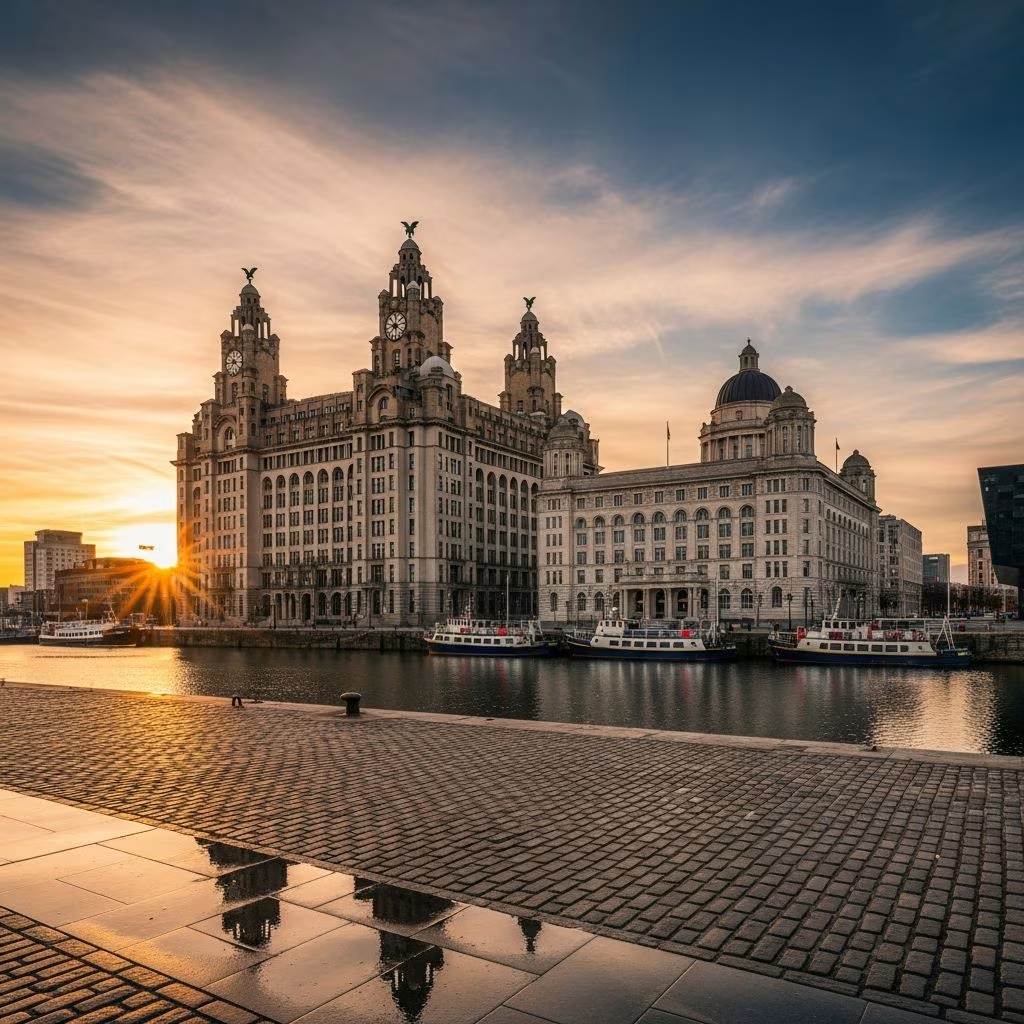
Dominating Pier Head are the Three Graces: the Royal Liver Building (1911), Cunard Building (1916), and Port of Liverpool Building (1907). These early 20th-century landmarks embody Edwardian Baroque and symbolize maritime supremacy. The Royal Liver Building, an engineering feat in reinforced concrete, features twin 15-story towers topped by 5.5-meter Liver Birds—one overlooking the Mersey, the other the city. Built for the Royal Liver Friendly Society, it provided insurance for working families.
The Cunard Building’s Italian Renaissance style and the Port of Liverpool Building’s Baroque exuberance complete the trio, forming a UNESCO-recognized ensemble that underscores Liverpool’s global trade era.
The interwar years introduced Art Deco flair, with the Philharmonic Hall (1939) showcasing geometric motifs, chrome accents, and luxurious interiors—one of Europe’s finest concert venues. The former Littlewoods Building exemplifies bold streamlining and modernity.
Post-WWII reconstruction embraced concrete and modernism. The Metropolitan Cathedral (1967), with its circular design and crown-like tower by Frederick Gibberd, contrasts the Gothic Anglican Cathedral (started 1904, completed 1978) by Giles Gilbert Scott. The latter’s towering spire dominates the skyline, blending Perpendicular Gothic with scaled-down ambition.
Brutalism emerged in structures like the University of Liverpool Precinct, while the Museum of Liverpool (2011) represents contemporary regeneration, integrating glass and steel with historical context.
Recent decades focus on adaptive reuse and sustainability. The Baltic Triangle repurposes industrial warehouses into creative spaces, while new developments like Paddington Village blend high-rises with green features. Liverpool ONE, a mixed-use regeneration, harmonizes modern retail with heritage elements.
Challenges include preserving UNESCO status amid high-rise proposals, balancing growth with legacy.
Explore Liverpool on foot:
Tours by RIBA offer expert insights into these paths.
Bluecoat Chambers (1716-1718), a Grade I-listed Queen Anne structure.
They represent Liverpool’s Edwardian maritime peak and are UNESCO World Heritage icons.
It financed Georgian landmarks like Town Hall.
Ornate details, engineering feats like Albert Dock.
Yes, Museum of Liverpool and cathedral contrasts.
UNESCO status since 2004 protects the waterfront, but ongoing debates over developments test conservation efforts. Community initiatives and restorations ensure these structures inspire future generations, maintaining Liverpool’s unique blend of history and innovation.
