

 Travel Essentials
 Travel Essentials

Explore the story of London's stretcher fences, made from WWII emergency stretchers, now at risk of demolition. Learn their history, locations, and preservation efforts.
 Travel Essentials
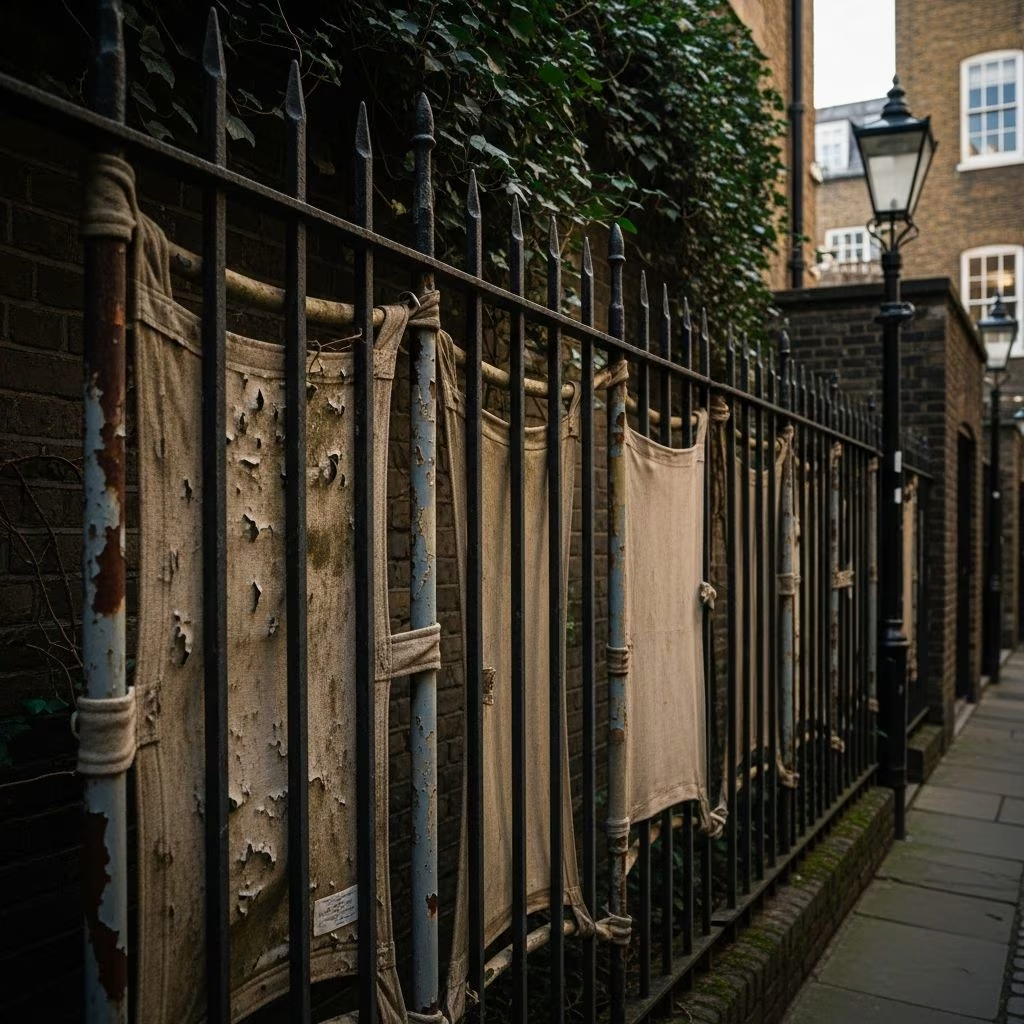
Hidden in plain sight across London’s urban landscape, a unique form of railing tells a gripping story of wartime ingenuity and resilience. These unassuming metal fences, composed of welded steel frames with distinctive kinks, were once life-saving stretchers deployed during the intense bombing campaigns of World War II. As modern development pressures mount, a passionate movement has emerged to safeguard these artifacts from oblivion.
During the late 1930s and early 1940s, Britain anticipated the devastating impact of aerial warfare. The government mass-produced over 600,000 steel stretchers designed specifically for Air Raid Precautions (ARP) wardens. Unlike traditional canvas or wooden models, these were built for durability and hygiene: two parallel steel poles encased a wire mesh body, allowing easy disinfection amid fears of gas attacks and widespread casualties.
The Blitz, from September 1940 to May 1941, validated this foresight. German Luftwaffe raids pummeled London, killing over 40,000 civilians and injuring countless more. ARP teams relied on these lightweight, portable stretchers to evacuate the wounded from rubble-strewn streets to makeshift shelters and hospitals. The poles featured strategic bends—indents at each end—that elevated the frame slightly off the ground for quick lifting and transport.
Post-war, Britain faced a surplus of these stretchers alongside a shortage of fencing. During the conflict, iron railings from parks, squares, and housing estates were scrapped for the war effort, melted down to produce tanks, ships, and munitions. London’s housing authorities, particularly the London County Council (LCC), ingeniously repurposed the excess stretchers.
Workers welded the stretchers vertically side-by-side, embedding them into concrete posts to form sturdy barriers around public estates. This practical solution restored privacy and security to bomb-damaged neighborhoods while recycling wartime materials. Today, the telltale kinks remain visible, a subtle nod to their origins that most passersby overlook.
These railings cluster in south and east London, encircling post-war housing developments. Key spots include:
Daily, hundreds of thousands traverse these areas via busy streets and Underground lines, unaware of the historical freight carried by the barriers at their elbows.
Decades of exposure have taken a toll. Rust corrodes the steel, welds weaken, and urban renewal projects prioritize sleek modern replacements. Local councils, facing budget constraints, often opt for cost-effective new fencing over costly conservation. Without intervention, these relics risk vanishing entirely, erasing a tangible link to the Blitz.
| Challenge | Impact | Examples |
|---|---|---|
| Corrosion and Wear | Structural failure | South London estates showing flaking paint and bent poles |
| Regeneration Projects | Complete Removal | Oval housing redevelopment proposals |
| Lack of Awareness | No Protection | Public ignorance hinders listing efforts |
In response, dedicated historians and enthusiasts formed the Stretcher Railing Society. Led by figures like Rosie Shaw, the group leverages social media—Facebook, X (formerly Twitter)—and a dedicated website to spotlight surviving fences. Their goals: raise funds for restoration, advocate for heritage status, and install informative plaques at sites.
Public engagement is central. Citizens are encouraged to photograph and report sightings, building a comprehensive map of remaining installations. Partnerships with local councils aim to integrate preservation into planning policies, ensuring these fences gain protected status akin to other WWII landmarks.
Beyond aesthetics, stretcher fences embody resourcefulness amid crisis. They symbolize the Blitz’s human cost—the hurried evacuations, the ARP wardens’ bravery—and the post-war drive for normalcy. Preserving them educates future generations on sustainable reuse and historical continuity in a city constantly reinventing itself.
Comparatively, other nations repurposed war surplus differently: U.S. Quonset huts became homes, while in Japan, ration tins fueled crafts. London’s approach uniquely fused medical history with civic design.
Visitors and locals can contribute meaningfully:
Guided walks and virtual tours are in development, merging history with urban exploration.
They are WWII ARP stretchers, steel frames with wire mesh, welded into railings post-war to replace scrapped iron fences.
Over 600,000, stockpiled for anticipated Blitz casualties.
South London hotspots like Peckham, Brixton, and Tabard Street near Borough station.
Aging materials and modern replacements threaten their existence without conservation.
Join the Stretcher Railing Society online, report sightings, and support fundraising.
The stretcher fence saga highlights challenges in preserving ephemeral wartime remnants. In a metropolis layering Roman walls with Victorian sewers and 21st-century skyscrapers, such artifacts anchor collective memory. Successful campaigns could inspire similar efforts for other overlooked features, like Anderson shelter foundations or barrage balloon anchors.
Experts emphasize listing them on national heritage inventories, potentially unlocking grants. Community involvement proves key: grassroots momentum often sways policy where top-down efforts falter.
Economically, preserved sites boost tourism. Walking tours of Blitz survivals already draw history buffs; adding stretcher fences enriches narratives, supporting local businesses from cafes to guides.
Each stretcher measured roughly 7 feet long, with 1.5-inch diameter poles and galvanized mesh for rust resistance. The kinks, spaced for handgrips, facilitated two-person carries over debris. Welding techniques of the 1940s—oxy-acetylene joins—hold firm but demand periodic maintenance against London’s damp climate.
Restoration involves sandblasting, galvanizing, and powder-coating, costing thousands per section. Plaques, engraved with Blitz context, would cost under £500 each, making them feasible via crowdfunding.
London’s fences aren’t alone. In Berlin, flak towers host clubs; in Hiroshima, bridge girders from bombs became memorials. These transformations honor survival while adapting to peace, a theme stretcher fences exemplify.
