

 Travel Essentials
 Travel Essentials

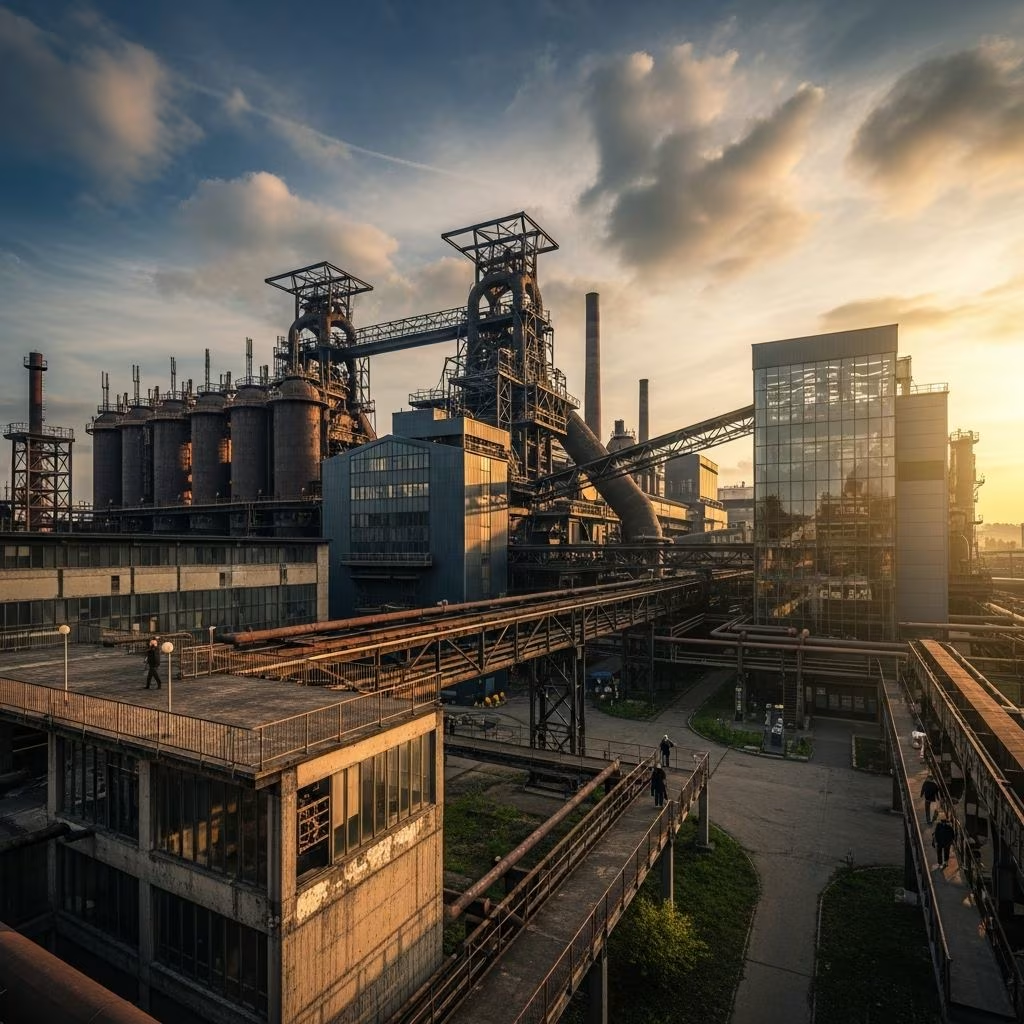
A former steelworks in Ostrava reborn as a cultural landmark, where preserved blast furnaces, museums, and events showcase industrial heritage.
 Travel Essentials
The Lower Vitkovice area in Ostrava stands as a testament to innovative urban renewal, where the echoes of heavy industry have been harmonized with modern cultural and educational pursuits. Spanning over 150 hectares, this former ironworks complex has evolved from a symbol of environmental degradation into one of the Czech Republic’s premier tourist destinations, drawing hundreds of thousands of visitors annually.
Established in 1828 under the vision of Archduke Rudolf of Austria, the Vitkovice ironworks quickly became a cornerstone of Central European industry. The site integrated coal mining, coke production, and iron smelting within a compact 200,000 square meters, making it uniquely comprehensive in Europe. By the early 20th century, six blast furnaces roared to life, fueling the Austro-Hungarian Empire’s military efforts during World War I and later supporting Germany’s war machine in World War II.
Post-war, under communist rule, the complex expanded into a massive operation employing thousands, producing pig iron until its closure in 1998 amid severe pollution from coke ovens and chemical plants. The northern section housed the Hlubina coal mine and blast furnaces, the central area focused on mechanical engineering, and the south featured administrative buildings—a layout that defined Ostrava as the ‘steel heart’ of Czechoslovakia.
The rebirth began in earnest around 2007-2010, spearheaded by Czech entrepreneur Jan Svetlik, who acquired the site from the state. Dubbed the ‘father of the idea,’ Svetlik collaborated with architect Josef Pleskot to preserve heritage while infusing new life. The Dolni oblast Vitkovice association was formed in 2007 to coordinate revitalization efforts, securing EU and state funding, including a 500 million CZK grant by 2009.
Challenges abounded: 139 derelict buildings were demolished, contaminated soils remediated, and new infrastructure installed. Despite this, core structures like the 1921 gas holder were meticulously retained, with its bell raised to emphasize its grandeur without altering original materials. Completion of key phases, such as the gas holder’s renovation from 2010-2012, marked public openings in 2012.
At the heart of Lower Vitkovice’s allure is its adaptive reuse of industrial giants. The iconic gas holder, transformed into the ‘Gong’ multifunctional center by Josef Pleskot, now hosts a 1,500-seat conference hall, gallery, and café. Internal steel frameworks were inserted seamlessly, preserving the exterior’s raw authenticity while enabling modern functions.
Blast Furnace No. 1 offers educational tours with panoramic city views, while the Sixth Power Plant, redesigned by architects Zemanek, became an interactive museum and educational hub by 2013. The Hlubina mine shaft, once a coal pit from 1852, now features hotels, restaurants, cinemas, climbing walls, and a shopping center called Karolina. These conversions maintain the ‘industrial spirit’ while adding layers of contemporary architecture.
| Original Structure | New Function | Key Architect/Designer | Completion Year |
|---|---|---|---|
| Gas Holder (1921) | Gong Conference Center | Josef Pleskot | 2012 |
| Sixth Power Plant | Interactive Museum & Education Center | Zemanek couple | 2013 |
| Blast Furnace No. 1 | Educational Tour Route | N/A | Ongoing |
| Hlubina Mine | Hotel, Climbing Wall, Shopping | Various | Post-2007 |
Lower Vitkovice now pulses with cultural energy. The World of Technology attraction blends education and entertainment for families, exploring science amid steel relics. Museums chronicle the site’s history, from 19th-century origins to communist-era peaks. Events venues host concerts, exhibitions, and conferences, with the Gong becoming a landmark for arts and innovation.
Tourists flock to climbing walls in old mine structures, Italian eateries amid furnaces, and guided tours revealing the full production cycle. Ranked in Czechia’s top 5 attractions, it attracts global visitors via planned cable railways linking to Ostrava’s center.
Beyond culture, Lower Vitkovice pioneers sustainability. The ‘Hydrogen City’ district eyes green energy, complementing the site’s industrial memory with cutting-edge tech. Ambitious plans include a ‘City within a City’ residential area for 15,000, blending housing, innovation hubs, and eco-friendly infrastructure.
Added to Europe’s Cultural Heritage list in 2008, the project exemplifies brownfield regeneration, balancing preservation with progress. Ongoing developments promise a ‘new architectural layer,’ making it a model for European urban development.
This site’s magic lies in its duality: towering blast furnaces frame sleek event spaces, gritty mine shafts yield luxury hotels. It narrates Ostrava’s story—from imperial forge to post-industrial phoenix—while forging a sustainable future. Visitors leave inspired by humanity’s capacity to repurpose the past innovatively.
A regenerated 150-ha industrial complex in Ostrava, now a cultural, educational, and tourist hub.
Pig iron production ceased in 1998 due to pollution.
Entrepreneur Jan Svetlik and architect Josef Pleskot.
Yes, with interactive tech exhibits, climbing, and tours.
Hydrogen City and residential districts for thousands.
Via official site; combos save money for multiple attractions.
