

 Travel Essentials
 Travel Essentials

Madagascar stands as a global biodiversity hotspot where 90% of wildlife exists nowhere else, shaped by 165 million years of isolation from mainland Africa.
 Travel Essentials
Positioned hundreds of miles off the southeastern coast of Africa in the Indian Ocean, Madagascar represents one of Earth’s most remarkable natural phenomena. This continental island, ranking as the world’s fourth-largest by area, has earned its reputation as a biodiversity hotspot through an extraordinary geological history spanning millions of years. The island broke away from the African continent approximately 165 million years ago and separated from India roughly 80 million years ago, creating an isolated laboratory where evolution proceeded along entirely distinct pathways. Today, this isolation translates into tangible conservation significance: over 90 percent of Madagascar’s plant and animal species exist nowhere else on Earth, making it scientifically invaluable and visually breathtaking.
Understanding Madagascar’s uniqueness requires examining its geological origin story. The island’s separation from the African mainland occurred during the Pangaean breakup, when continental plates shifted and ocean basins formed. This ancient disconnection meant that Madagascar’s species developed in complete isolation from African wildlife pressures and evolutionary influences. Species that arrived on the island—whether through ocean currents, floating vegetation, or other dispersal mechanisms—faced no competition from larger predators or established ecological communities. Over tens of millions of years, these founding populations diversified into thousands of species, each adapted to Madagascar’s specific environmental niches.
The island’s diverse topography further contributed to biological diversification. Madagascar encompasses multiple climate zones and habitat types, from tropical rainforests receiving substantial precipitation to arid spiny forests in the south. This environmental heterogeneity created numerous opportunities for speciation, allowing single ancestral populations to evolve into multiple distinct species occupying different ecological roles.
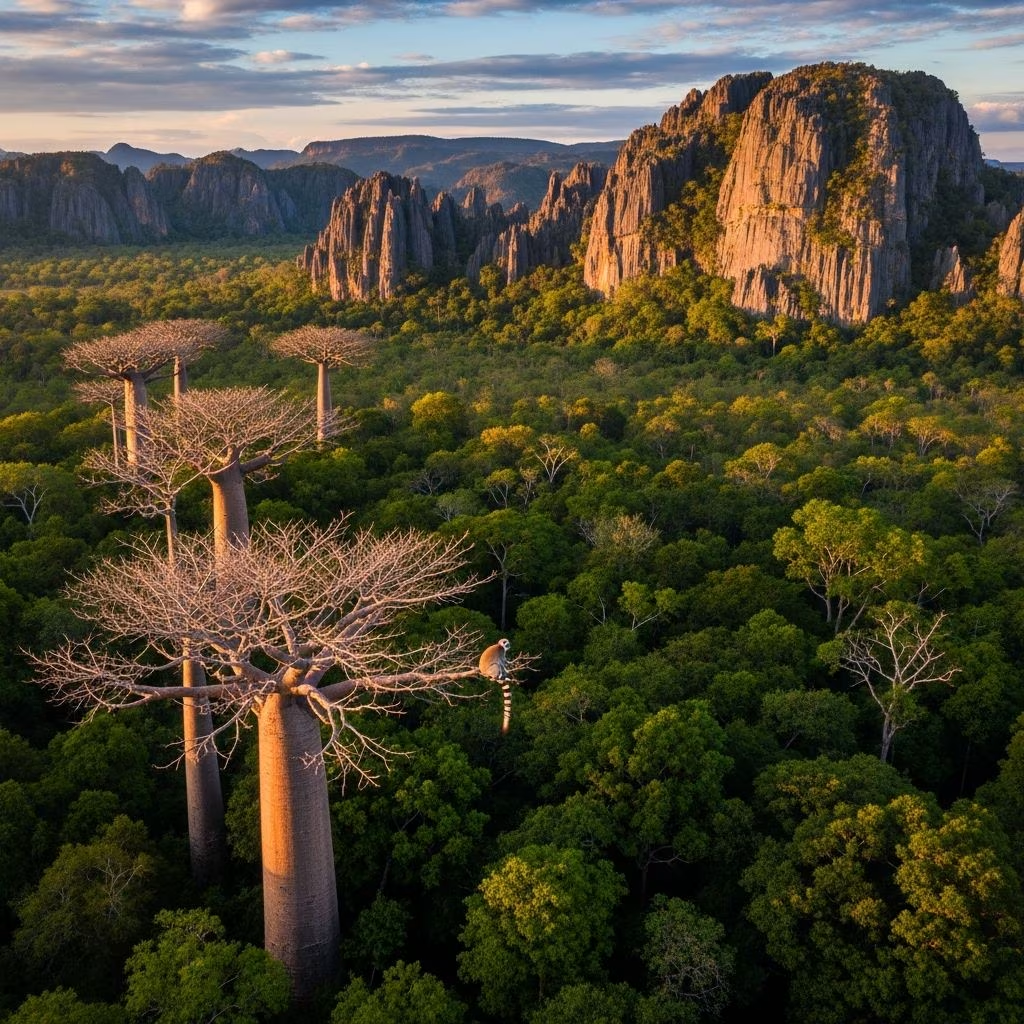
Perhaps no animal symbolizes Madagascar more powerfully than the lemur. Over 100 distinct lemur species inhabit the island, ranging from the diminutive mouse lemur—weighing barely 30 grams—to the larger indri, which produces distinctive haunting vocalizations that echo through forest canopies. Lemurs represent an entire primate radiation unique to Madagascar, having evolved from a small number of ancestral colonizers that somehow crossed the Mozambique Channel millions of years ago.
The diversity within lemurs showcases evolution’s creative potential:
Witnessing lemurs in their natural habitat remains one of Madagascar’s most unforgettable wildlife experiences. Their presence throughout various forest ecosystems serves as both an indicator of environmental health and a reminder of evolution’s infinite variety.
Madagascar’s plant diversity rivals its animal life in terms of uniqueness and abundance. Approximately 90 percent of the island’s flora species are endemic, meaning they occur naturally nowhere else. This botanical distinctiveness extends across multiple ecosystem types, each hosting specialized plant communities.
The spiny forests of southern Madagascar present a particularly alien landscape. Dominated by bizarre-looking succulents, adapted cacti, and drought-resistant shrubs, these forests appear more otherworldly than terrestrial. The plants display remarkable adaptations to the region’s minimal rainfall and intense sunlight, featuring reduced leaves, swollen trunks for water storage, and shallow root systems that capture every drop of precipitation.
Beyond spiny forests, Madagascar hosts:
The Avenue of the Baobabs in Madagascar stands as a botanical monument, where these ancient giants create an avenue resembling a lost world. Their persistence across generations symbolizes Madagascar’s ecological antiquity and evolutionary depth.
Madagascar’s environmental complexity extends far beyond simple forest categorization. The island encompasses distinct ecological zones, each supporting specialized communities of organisms adapted to local conditions:
| Ecosystem Type | Characteristics | Primary Inhabitants |
|---|---|---|
| Tropical Rainforests | High precipitation, dense vegetation, high humidity, layered canopy structure | Golden bamboo lemurs, tree frogs, tropical birds |
| Dry Deciduous Forests | Seasonal rainfall, leaf loss during dry season, moderate biodiversity | Ring-tailed lemurs, fossas, various reptile species |
| Spiny Forests | Minimal rainfall, succulents and cacti, extreme drought adaptation | Specialized reptiles, adapted insects, drought-tolerant mammals |
| Mangrove Ecosystems | Coastal saltwater environments, intricate root systems, marine connectivity | Juvenile fish, crustaceans, aquatic birds |
| High Mountain Plateaus | Cooler temperatures, montane grasslands, restricted elevation zones | Endemic montane species, highland birds, specialized insects |
This ecosystem diversity means that Madagascar functions almost as multiple islands stacked vertically and horizontally, each supporting distinct ecological communities. Travelers exploring different regions encounter vastly different wildlife assemblages, vegetation patterns, and landscape aesthetics within a single island nation.
Madagascar’s geological formations rival its biological assets in terms of visual drama and ecological significance. The Tsingy de Bemaraha National Park showcases dramatic limestone formations that local inhabitants call “tsingy,” meaning “place where one cannot walk barefoot.” These sharp-edged karst towers create a surreal landscape that appears almost extraterrestrial, with towering spires separated by narrow chasms and small caverns.
The Tsingy formation process involved ancient limestone deposits subjected to millions of years of erosion by acidic rainwater. The resulting landscape features:
Beyond the Tsingy, Madagascar presents sandstone canyons, terraced rice paddies climbing hillsides, and white sand beaches stretching along its 3,000-mile coastline. These geological and topographical variations contribute to the island’s overall environmental heterogeneity.
Madagascar’s conservation significance extends beneath its ocean surface. The island’s extensive coral reef systems rank among the world’s largest, harboring vibrant communities of fish, crustaceans, mollusks, and other marine organisms. These reefs function as nurseries for juvenile fish species and serve crucial roles in the broader marine food web.
Coastal destinations showcase Madagascar’s marine attractions:
Madagascar’s mangrove forests play essential ecological roles beyond their aesthetic appeal. These coastal wetlands provide critical habitat for juvenile marine species, support important fisheries, and offer physical protection against coastal erosion and storm surge impacts. The mangrove ecosystems demonstrate interconnectedness between terrestrial and marine systems, illustrating how Madagascar’s uniqueness extends across multiple environmental domains.
Despite Madagascar’s extraordinary biodiversity, numerous species face critical threat levels. Habitat loss through deforestation, agricultural expansion, and unsustainable resource extraction pressures endemic species with nowhere to migrate or adapt. The critically endangered golden bamboo lemur exemplifies these conservation challenges, with populations confined to isolated protected areas and facing ongoing habitat degradation.
International recognition of Madagascar’s conservation significance has driven establishment of multiple national parks and protected areas designed to preserve distinct ecosystems. UNESCO World Heritage designations acknowledge sites like the Rainforests of the Atsinanana and Tsingy de Bemaraha, conferring enhanced protection status and international monitoring attention.
Madagascar’s human dimension enriches its overall significance. The Malagasy people represent a unique cultural synthesis blending African, Asian, and European influences accumulated through centuries of trade, migration, and cultural exchange. This human cultural diversity parallels the island’s biological diversity, creating a destination where natural wonders coexist with vibrant human traditions and customs.
Prospective travelers should understand practical aspects of Madagascar visitation:
Madagascar’s 165 million years of isolation from Africa allowed completely independent evolutionary pathways. Species evolved distinct characteristics adapted to Madagascar’s specific environments, resulting in 90 percent of wildlife existing nowhere else on Earth.
Madagascar is home to over 100 distinct lemur species, ranging from mouse lemurs weighing approximately 30 grams to larger species like the indri. This diversity represents an entire primate radiation unique to the island.
The dry season from April through October generally provides optimal visiting conditions with reduced rainfall and pleasant temperatures, though specific timing depends on intended destinations and activities.
Tsingy de Bemaraha for geological formations, Ranomafana for rainforest biodiversity, and Ankarafantsika for diverse ecosystems represent excellent starting points for experiencing Madagascar’s ecological breadth.
Madagascar stands as Earth’s most extraordinary natural laboratory, where millions of years of isolation created unparalleled biodiversity and unique ecological communities. From lemurs existing only on this island to alien-appearing spiny forests and dramatic limestone formations, Madagascar presents natural wonders accessible nowhere else. Understanding and protecting this remarkable ecosystem represents both a scientific imperative and a moral obligation to preserve Earth’s evolutionary heritage for future generations.
