

 Travel Essentials
 Travel Essentials

Explore Cairo's Mamluk monuments, from the Sultan Al-Ghuri Complex to the Mosque of Sultan Hassan, tracing the rise and fall of a slave warrior dynasty that shaped Islamic architecture.
 Travel Essentials
The walled medieval city of Al Qahira, meaning ‘The Victorious,’ stands as one of the world’s most significant repositories of Islamic architectural achievement. At the heart of this UNESCO World Heritage area lies a remarkable concentration of monuments spanning multiple dynasties, with the Mamluk period (1250-1517 CE) representing the pinnacle of architectural innovation and cultural sophistication. Wandering through the narrow streets and expansive courtyards of Islamic Cairo today reveals the story of an extraordinary military caste that rose from slavery to establish one of history’s most powerful sultanates.
The Mamluk story begins with a strategic military miscalculation. The Ayyubids, who ruled Egypt from 1171 to 1250 CE following their overthrow of the Fatimid dynasty, made a fateful decision to strengthen their military apparatus by recruiting Mamluk slave soldiers from Central Asia and the Caucasus. These trained warriors, initially enslaved for military service, possessed superior combat skills and organizational structures. Rather than remaining subjugated, the Mamluks gradually accumulated power, eventually overthrowing their Ayyubid masters and establishing their own sultanate. This transformation marked the beginning of approximately 250 years of Mamluk rule that would fundamentally reshape Cairo’s physical landscape.
The Mamluks’ ascendance coincided with Cairo’s emergence as one of the medieval world’s largest and most influential cities. This powerful dynasty controlled crucial trade routes connecting Asia, Africa, and Europe, generating immense wealth that they invested in monumental architecture and religious institutions. The physical manifestation of this prosperity remains visible today in the extraordinary concentration of mosques, madrassas (Islamic colleges), mausoleums, and charitable structures that line Islamic Cairo’s ancient streets.
Mamluk architects synthesized diverse influences into a distinctive architectural vocabulary that reflected both their military heritage and their commitment to Islamic principles. These builders drew inspiration from Byzantine structures encountered during military campaigns in Syria and the Levant, incorporating elaborate decorative systems and sophisticated spatial arrangements into their designs. However, rather than simply copying external styles, Mamluk architects transformed these influences into a uniquely coherent aesthetic system that became instantly recognizable.
The religious and social functions of Mamluk complexes extended far beyond simple places of worship. Major mosque and tomb complexes operated as multifunctional community centers, incorporating schools for religious education, hospitals providing medical care, soup kitchens serving the poor, and caravanserais (roadside inns) facilitating commerce. This integrated approach to urban development created self-contained neighborhoods that addressed spiritual, educational, and charitable needs simultaneously, reflecting sophisticated urban planning principles.
The Sultan Al-Ghuri Complex, constructed between 1503 and 1505 CE under the direction of Egypt’s penultimate Mamluk ruler, stands as the final monumental achievement of the entire Mamluk period before Ottoman conquest fundamentally transformed Egypt’s political landscape. Commissioned by Sultan Qansuh al-Ghuri in his final years of rule, this complex represents the culmination of nearly 250 years of architectural refinement and experimentation.
What distinguishes the Al-Ghuri Complex from earlier Mamluk monuments is its unique urban positioning. Rather than occupying a single concentrated site, this complex intentionally straddles Al-Mu’izz Street, one of Islamic Cairo’s primary arteries, creating an integrated urban monument that actively engages with surrounding cityscape. This innovative approach transforms the street itself into a ceremonial processional route while allowing the complex’s various components to maintain distinct functional identities.
The complex comprises four primary structures distributed across both sides of Al-Mu’izz Street:
The minaret that crowns this complex introduces a novel architectural feature that distinguishes it from earlier Mamluk precedents. Rather than employing the traditional circular or octagonal shaft form common throughout Mamluk architecture, the Al-Ghuri minaret features a rectangular profile crowned by a distinctive top story incorporating four bulbous finials. This innovative design represents a stylistic departure that would influence later Ottoman architecture in Egypt.
Visitors to the complex encounter opening hours from 9:00 AM to 5:00 PM, with completely free entrance ensuring accessibility for researchers, students, and casual tourists interested in Islamic architecture. The complex’s location within Islamic Cairo’s densest concentration of medieval monuments places it within walking distance of dozens of other significant architectural achievements, making it an essential component of any comprehensive exploration of Mamluk Cairo.
Dating to 1285 CE, the Madrassa and Mausoleum of Qalaun represents an earlier phase of Mamluk architectural development, yet displays a level of decorative sophistication that overwhelms contemporary observers. The complex’s design displays obvious stylistic debt to the richly ornamented Byzantine monuments that Mamluk military commanders encountered during Syrian campaigns. Elaborate surface decoration, intricate geometric patterning, and refined proportional relationships create a visual impact that immediately distinguishes Qalaun’s complex from surrounding structures.
This complex occupies a crucial position within the chronological development of Mamluk architecture, demonstrating how early Mamluk sultans employed monumental building projects to consolidate their newly established political authority and display their mastery of sophisticated architectural technologies.
Completed in 1363 CE, the Mosque and Madrassa of Sultan Hassan represents perhaps the most colossal religious structure constructed during the entire Mamluk period. Initiated by Hassan, the ambitious seventh son of an earlier Mamluk ruler who ruled only briefly before his assassination at age twenty-seven, this project demonstrates how individual sultans competed for architectural immortality.
The structural dimensions of Sultan Hassan’s complex remain awe-inspiring even by contemporary standards. The main building extends 150 meters in length, spans 68 meters in width, and rises 36 meters in height, creating an internal volume that accommodates thousands of worshippers simultaneously. The ornamental program, while perhaps less refined than some contemporary complexes, maintains an undeniable visual power that testifies to the sultan’s resources and architectural ambitions.
Architectural tradition holds that the mosque’s magnificent floor was taken from the pyramid of Kefren at Giza, connecting the Mamluk structure to Cairo’s even more ancient pharaonic heritage. This appropriation symbolically links Mamluk authority to Egypt’s legendary past, suggesting a continuity of rulership across millennia.
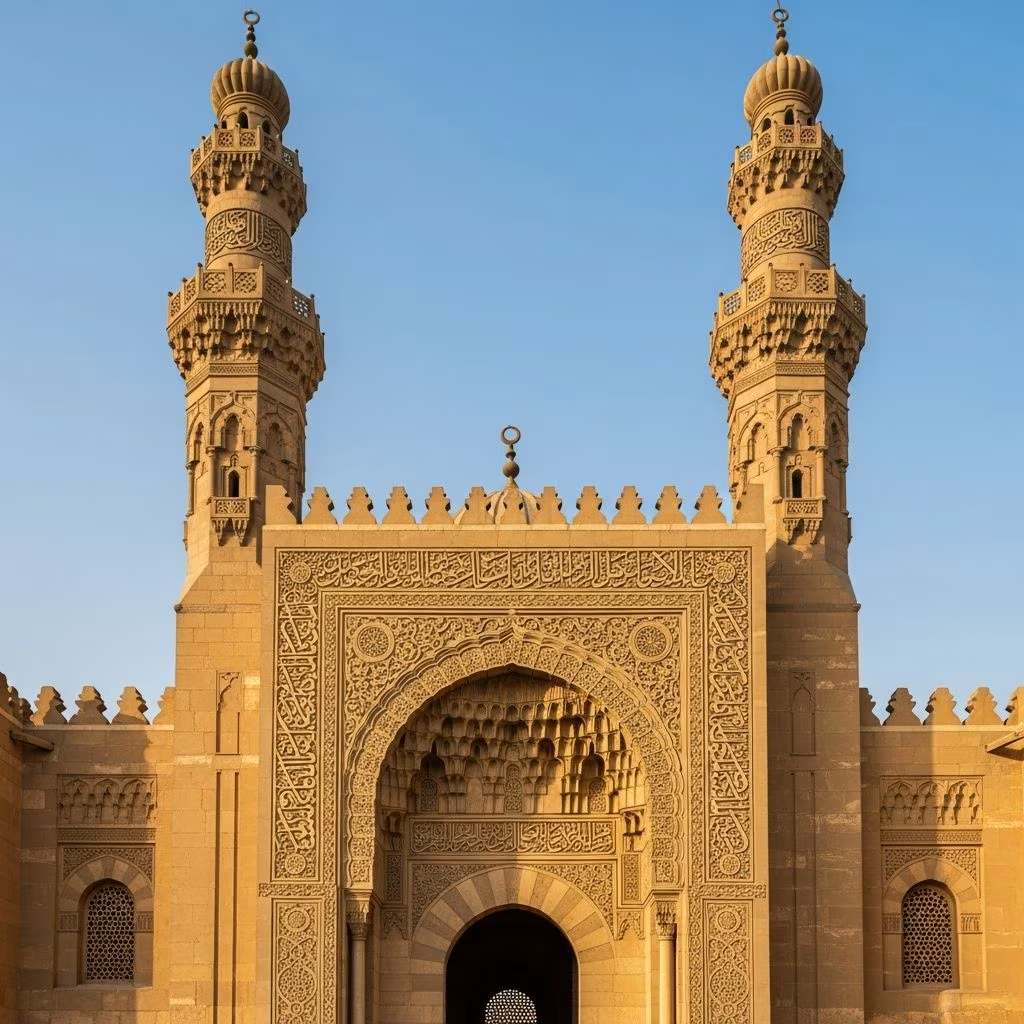
Perched at the terminus of Al-Mu’izz Street, Bab Zuweila (also known as Bab Zuwayla) functions simultaneously as a defensive structure, commemorative monument, and panoramic observation point. Constructed in the eleventh century during the Fatimid period as the southern gate controlling entry into the walled city, this massive structure predates the Mamluk era by more than two centuries. However, the Mamluks substantially modified and enhanced the gate, adding architectural elements that reflected their aesthetic preferences and military concerns.
During the fifteenth century, Mamluk Sultan Al Mu’ayyad Shaykh added twin minarets atop the gate’s towers, creating a visually distinctive silhouette that dominates the surrounding streetscape. The mosque attached to the gate’s left side further enhanced its religious significance, transforming a purely military structure into a multipurpose religious and civic monument. Today, Bab Zuweila remains the only original Fatimid-era city gate that visitors can physically enter and explore, offering unobstructed views across Islamic Cairo’s minaret-studded skyline that remain substantially unchanged from medieval times.
Perched atop the Muqattam Hills overlooking the medieval city, the Citadel functioned as Cairo’s primary seat of power for approximately 700 years. Ayyubid Sultan Saladin fortified this strategic ridge in 1176 CE, establishing a fortress that would subsequently dominate Mamluk political life. All subsequent Mamluk sultans called this fortress home, conducting affairs of state from its fortified precincts and maintaining the military superiority necessary to rule Egypt’s diverse populations.
The Mosque of An Nasir Mohammed remains the most visible remnant of direct Mamluk religious expression within the Citadel, offering a tranquil counterpoint to the fortress’s primarily military functions. However, the Citadel’s true significance to Mamluk history derives not from what survives there today but from the dramatic historical event that occurred within its walls in 1811.
Having gradually lost control of Egypt to external Ottoman forces and internal factional conflicts, the Mamluk order faced its definitive extinction through an act of calculated treachery. Mohammed Ali, having consolidated power as Egypt’s new ruler, invited all 470 Mamluk beys (regional military governors) to the Citadel for a ceremonial banquet celebration. As these powerful warriors processed through the Citadel’s narrow corridors, Mohammed Ali’s troops systematically executed the entire Mamluk leadership in a single coordinated massacre. This ruthless elimination of the Mamluk military caste in this “dreary stone corridor” provided the tragic bookend to an extraordinary era of Islamic civilization.
The concentrated assemblage of Islamic monuments spanning the Fatimid (969-1171 CE), Ayyubid (1171-1250 CE), and Mamluk periods creates an unparalleled historical record encoded in architecture. The Sultan Al-Ghuri Complex physically and chronologically bridges these three distinct eras, serving as a geographical connection between northern Fatimid monuments and southern Ayyubid and early Mamluk structures. This spatial organization itself carries historical significance, allowing visitors to literally walk through time as they traverse Islamic Cairo’s ancient streets.
The collection of monuments within Islamic Cairo represents far more than an assembly of beautiful buildings. These structures collectively document the evolution of Islamic architectural thought, the rise and fall of dynasties, the technological innovations of medieval builders, and the social organization of medieval Islamic societies. Each mosque, madrassa, mausoleum, and gate tells specific stories about particular historical moments while contributing to a larger narrative about human creativity and political power.
Several factors enhance the experience of exploring Mamluk Cairo’s monuments. Most complexes maintain regular daytime hours, typically operating from morning through late afternoon, allowing sufficient time for thorough examination of architectural details and interior spatial arrangements. Many major monuments offer free or minimal-cost entry, ensuring accessibility regardless of visitor budget. The walkable scale of Islamic Cairo’s medieval street network allows pedestrians to move efficiently between sites while remaining immersed in the historical atmosphere.
The best vantage points for comprehending Islamic Cairo’s overall character include elevated positions such as Bab Zuweila’s towers, which provide perspective on the monument-filled cityscape stretching in multiple directions. Extended explorations lasting full days reveal architectural subtleties and neighborhood character that brief visits cannot adequately capture.
The Mamluk monuments of Cairo remain actively used by local residents for religious observance, cultural education, and community gathering, rather than existing as purely historical museum pieces. This living relationship between contemporary Cairo’s inhabitants and medieval architecture ensures continuous maintenance attention while creating authentic experiences for visitors who encounter worshippers engaged in daily devotional practices within these magnificent spaces.
The UNESCO World Heritage designation recognizes Islamic Cairo’s exceptional universal value and the international responsibility to preserve these irreplaceable monuments for future generations. Conservation efforts balance contemporary usage requirements with scholarly preservation standards, navigating the complex relationship between historical authenticity and practical sustainability.
