

 Travel Essentials
 Travel Essentials

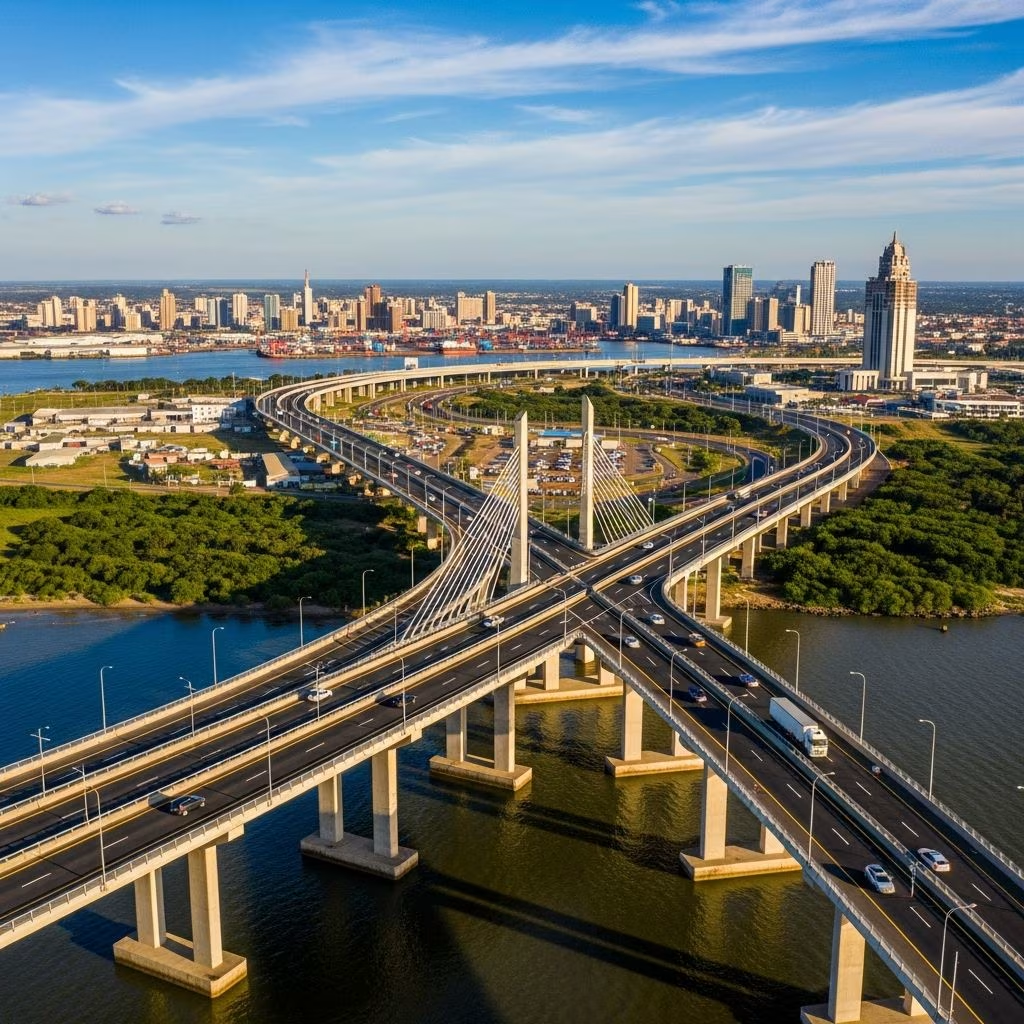
The Maputo-Catembe Bridge dramatically reduces travel time between South Africa and Mozambique, opening new possibilities for self-drive tourism and regional economic development.
 Travel Essentials
The completion of Africa’s longest suspension bridge has fundamentally altered the landscape of self-drive tourism across southern Africa. This engineering achievement has created unprecedented connectivity between South Africa’s KwaZulu-Natal province and Mozambique, establishing a seamless corridor that was previously inaccessible by road. The transformation extends far beyond simple convenience—it represents a complete reimagining of how travelers can experience the diverse cultures, landscapes, and attractions spanning this dynamic region.
The Maputo-Catembe Bridge stands as a testament to modern engineering prowess, spanning Maputo Bay with remarkable architectural elegance. Constructed through a collaboration between Chinese and Mozambican governments at a cost exceeding US$700 million, this suspension bridge connects the vibrant capital city of Maputo on the northern bank with the suburb of Katembe on the southern bank. The construction project, carried out by the China Road and Bridge Corporation and financed through loans from the Chinese Exim Bank, began in 2014 and officially opened to traffic on November 10, 2018.
The bridge’s design draws aesthetic inspiration from iconic global structures, particularly the Golden Gate Bridge in San Francisco, creating a visually striking landmark that enhances the region’s appeal. At 3 kilometers in length, this suspension bridge represents one of the continent’s most significant infrastructure investments, demonstrating the potential for transformative regional development through strategic international cooperation.
Perhaps the most dramatic impact of this infrastructure project involves the transformation of travel times across the region. Prior to the bridge’s completion, travelers navigating the route from KwaZulu-Natal to Maputo faced arduous journeys. Journey times varied significantly based on weather conditions and road accessibility, with typical travel times ranging from three to six hours depending on the specific conditions encountered during transit.
The bridge has fundamentally compressed these distances. The driving time between Maputo and Kosi Bay—KwaZulu-Natal’s eastern border post—has been reduced from six hours to approximately 90 minutes. This represents more than a simple reduction in travel duration; it fundamentally changes the feasibility of various travel itineraries and tourism experiences. What was previously an exhausting day’s journey has become a manageable morning or afternoon drive, opening possibilities that simply didn’t exist before.
This efficiency gain extends throughout the broader regional network. The bridge provides direct arterial connectivity linking Durban to Maputo while simultaneously offering enhanced access to critical transportation and economic infrastructure, including Richards Bay and Durban harbors, King Shaka International Airport, and the Dube TradePort Special Economic Zone. These connections amplify the bridge’s significance beyond tourism, positioning it as a cornerstone of regional trade and economic development.
Understanding the bridge’s significance requires acknowledging the transportation challenges that preceded its construction. Historically, travelers crossing Maputo Bay had no direct road option. Instead, ferry services provided the only method of crossing, with services proving notoriously unreliable and subject to weather disruptions. This dependency on ferry transportation created significant uncertainty for travelers and restricted regional mobility to those willing to tolerate substantial delays and logistical complications.
The unreliability of ferry services extended beyond simple inconvenience. Weather conditions frequently rendered ferry crossings impossible, effectively isolating communities and disrupting economic activity. For tourists accustomed to self-drive itineraries with flexible scheduling, this uncertainty created substantial planning complications and discouraged spontaneous regional exploration. The bridge’s introduction of a dependable, weather-resilient crossing transforms this dynamic entirely.
The infrastructure investment carries profound economic consequences extending throughout the region. The bridge and associated road improvements are projected to generate approximately 1,500 jobs in Mozambique over a two-year implementation period. These employment opportunities span construction, maintenance, hospitality, retail, and transportation sectors, creating multiplier effects throughout local economies.
Beyond immediate employment generation, the bridge catalyzes broader economic transformation. The reduced travel barriers facilitate increased trade flows between South Africa and Mozambique, particularly through northern routes that historically channeled commerce through Komatipoort in Mpumalanga. This geographic redistribution of trade routes strengthens economic integration across the region while creating new commercial opportunities for previously peripheral communities.
Tourism represents perhaps the most visible beneficiary of improved connectivity. Ndabo Khoza, CEO of KZN Tourism, emphasized that the bridge and associated road infrastructure create significant tourism advantages. The infrastructure enables multi-destination tourism itineraries that would have been logistically impractical previously. Travelers can now efficiently incorporate Mozambique into broader southern African tourism circuits, visiting multiple countries within single trips without excessive driving burdens.
The bridge’s completion facilitates an innovative regional tourism concept that has captured significant marketing attention. Tourism boards have promoted the possibility of experiencing breakfast in Eswatini, lunch in Maputo, and dinner in Durban—a culinary metaphor illustrating the unprecedented accessibility now available to self-drive tourists. While playful in expression, this concept reflects genuine possibilities that the bridge infrastructure enables.
This multi-destination accessibility transforms tourism planning. Rather than selecting single-country destinations, travelers can now design comprehensive regional itineraries incorporating South Africa, Mozambique, and Eswatini within efficiently connected circuits. The bridge serves as the crucial connector enabling this integration, particularly for travelers preferring road-based exploration over repeated flights.
The bridge also enhances access to southern Mozambique’s coastal attractions, including the extension toward Ponta do Ouro—a destination increasingly attracting beach tourism and water sports enthusiasts. Improved connectivity to these previously remote destinations creates new market opportunities for local hospitality and tourism enterprises.
The bridge’s completion catalyzes significant demographic and infrastructural change. Forecasts project population growth of up to 400,000 inhabitants in Katembe as improved accessibility attracts residents and commercial activity. This demographic transformation reflects confidence in the region’s future accessibility and economic prospects, with investors and residents recognizing the long-term implications of improved connectivity.
Urban development accompanying this population growth creates construction and service sector employment while establishing new commercial opportunities. Shopping centers, hospitality establishments, and transportation hubs emerge to serve growing populations, creating multiplier effects throughout regional economies.
While the bridge dramatically improves accessibility, crossing involves toll charges structured according to vehicle classification. Understanding these costs enables effective travel planning and budget management:
| Vehicle Classification | Examples | Toll Cost (Meticais) | Approximate Euro Equivalent |
|---|---|---|---|
| Class One | Motorcycles, Light Cars | 160 | €2.34 |
| Class Two | Standard Vehicles, Up to Two Axles | 320 | €4.68 |
| Class Three | Heavy Trucks, Three to Four Axles | 750 | €11.00 |
| Class Four | Heavy Load Vehicles, Five+ Axles | 1,200 | €17.50 |
These toll structures reflect a tiered pricing model designed to generate revenue for bridge maintenance and operations while remaining accessible to standard tourist vehicles. For self-drive tourists operating typical rental cars, crossing costs remain modest—less than €5 per crossing. This affordability enhances the bridge’s appeal, ensuring that toll charges don’t discourage regional tourism exploration.
The bridge’s positioning within regional trade networks amplifies its significance beyond tourism. Historically, most trade between South Africa and Mozambique moved through Lebombo Border in Komatipoort, creating inefficiencies for businesses targeting northern routes. The bridge establishes an alternative arterial line that reduces trade friction while improving commercial efficiency.
This geographic redistribution of trade routes benefits ports and transportation hubs previously peripheral to major commerce flows. Richards Bay gains enhanced connectivity to northern markets, while Durban’s port authority recognizes improved access to interior regions. King Shaka International Airport similarly benefits from improved access for businesses and travelers utilizing this enhanced corridor.
The bridge represents more than engineering achievement—it exemplifies collaborative governance between neighboring nations. A joint tourism plan coordinated among Mozambique, South Africa’s KwaZulu-Natal province, and the Kingdom of Eswatini aims to leverage improved connectivity for mutual tourism benefit. This institutional collaboration demonstrates commitment to regional integration beyond mere infrastructure construction.
The tourism integration strategy acknowledges that improved connectivity creates shared opportunities requiring coordinated marketing and service delivery. Promotional campaigns targeting international tourists emphasize the seamless regional experience now possible, while border procedures and regulations evolve to facilitate cross-border movement. This institutional alignment transforms infrastructure investment into coordinated regional development strategy.
For travelers considering self-drive itineraries through this region, the bridge infrastructure creates unprecedented planning opportunities. Several practical considerations enhance the experience:
The bridge represents foundational infrastructure enabling anticipated regional growth across multiple sectors. Expected employment generation and population expansion reflect confidence in sustained regional development. Tourism businesses operating across the connected region recognize opportunities for expanded market reach and enhanced operational efficiency.
Infrastructure improvements extend beyond the bridge itself, with road network enhancements designed to facilitate traffic flow throughout the region. These complementary investments multiply the bridge’s effectiveness, creating integrated transportation networks rather than isolated crossing points. The infrastructure vision encompasses comprehensive regional connectivity rather than single project implementation.
