

 Travel Essentials
 Travel Essentials

Explore the March 13-14, 2025 total lunar eclipse: timings, visibility across regions, science behind the red hue, and top viewing tips for the Blood Worm Moon event.
 Travel Essentials
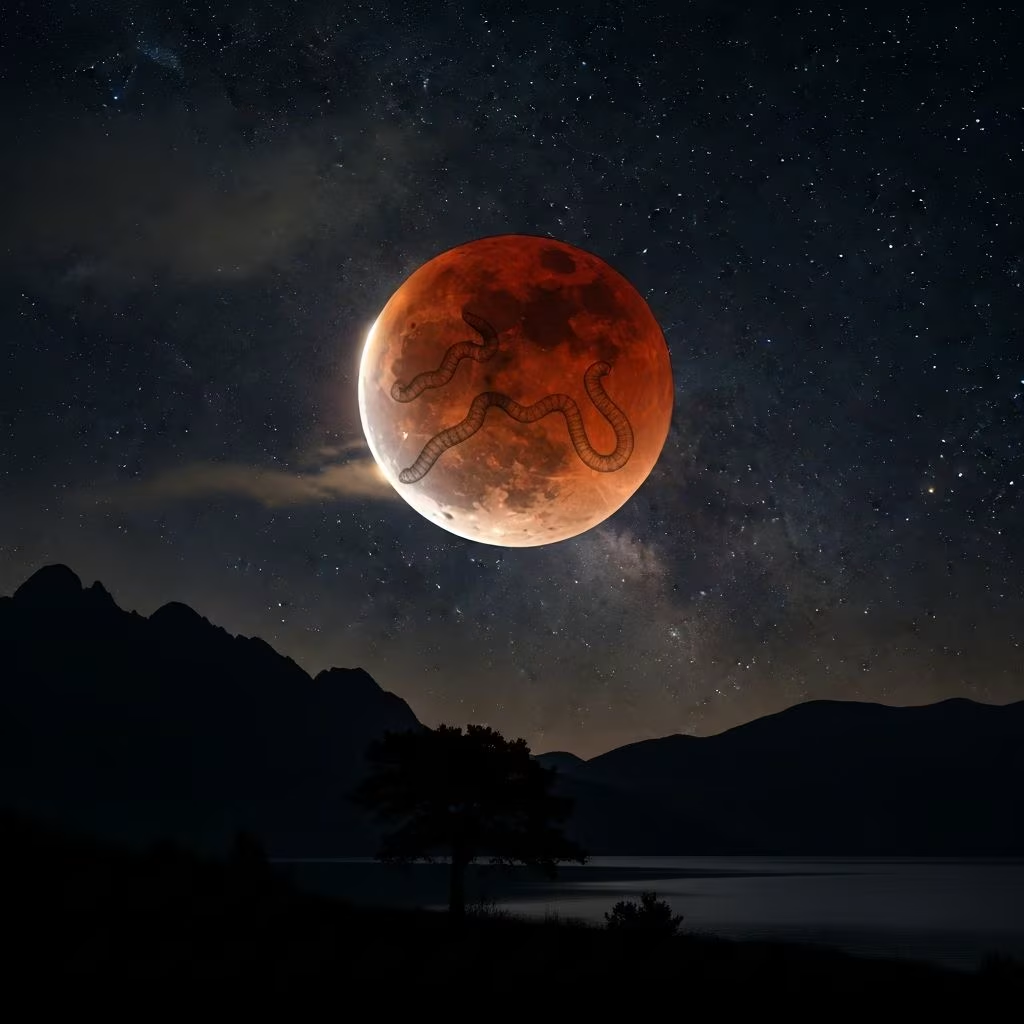
The total lunar eclipse on March 13-14, 2025, transforms the Full Worm Moon into a mesmerizing Blood Moon, captivating skywatchers worldwide with its deep red glow. This event, where Earth’s shadow engulfs the Moon, offers a rare opportunity to observe a natural phenomenon visible primarily across the Western Hemisphere and parts of Europe, Africa, and beyond.
A lunar eclipse occurs when the Sun, Earth, and Moon align perfectly, with Earth positioned between the two luminaries. Earth casts two shadows on the Moon: the faint penumbra and the darker umbra. During a total eclipse, the Moon passes entirely through the umbra, blocking direct sunlight and scattering it through Earth’s atmosphere to create the signature reddish tint known as a Blood Moon.
This atmospheric refraction acts like a global sunset, filtering shorter blue wavelengths and allowing longer red ones to reach the lunar surface. The intensity of the red hue varies based on global conditions like volcanic activity or wildfires, which can enhance the color dramatically.
The eclipse unfolds over several hours, with distinct phases marked by precise timings in Coordinated Universal Time (UTC). Full Moon peaks at 06:55 UTC on March 14, just minutes before the eclipse’s midpoint.
| Phase | UTC Time (March 14) | PDT (March 13) | EDT (March 13-14) | Description |
|---|---|---|---|---|
| Penumbral Begins | 03:57 | 20:57 (8:57 PM) | 22:57 (10:57 PM) | Moon enters outer shadow; subtle dimming starts. |
| Partial Begins | 05:09 | 22:09 (10:09 PM) | 00:09 (12:09 AM) | Dark umbra bite appears on Moon’s edge. |
| Totality Begins | 06:26 | 23:26 (11:26 PM) | 01:26 (1:26 AM) | Full immersion in umbra; red glow emerges. |
| Mid-Totality | 06:58 | 23:58 (11:58 PM) | 01:58 (1:58 AM) | Peak red coloration and darkness. |
| Totality Ends | 07:32 | 00:32 (12:32 AM) | 02:32 (2:32 AM) | Moon begins exiting umbra. |
| Partial Ends | 08:48 | 01:48 (1:48 AM) | 03:48 (3:48 AM) | Umbra fully cleared. |
| Penumbral Ends | 10:00 | 03:00 (3:00 AM) | 05:00 (5:00 AM) | Event concludes; Moon returns to normal. |
Totality lasts 66 minutes, providing ample time for observation.
This eclipse graces the night skies over North and South America, western Europe, western Africa, the Atlantic and Pacific Oceans, Antarctica, and eastern reaches of Australia, Japan, and Russia. In the U.S., it’s visible coast-to-coast, starting late evening on the West Coast and pre-dawn on the East Coast.
Clear skies are crucial for lunar eclipses, as clouds can obscure the view. Forecasts indicate favorable conditions in the lower Great Lakes, Ohio Valley, Central Plains, and Texas, with low cloud cover.
Monitor local National Weather Service updates for real-time satellite imagery.
Seek dark-sky sites away from city lights to maximize contrast during totality. National parks, rural fields, or hilltops provide ideal vantage points.
Plan for cold March nights—layer up and arrive early to acclimate eyes to darkness.
No telescope required; a DSLR or smartphone on a tripod suffices. Key techniques:
Practice manual focus on infinity; use live view for composition.
Jupiter and Mars shine brightly in the western sky during totality, framing the Blood Moon like cosmic jewels. Jupiter’s glow aids in locating the eclipsed Moon amid fading twilight.
Native American tribes named March’s Full Moon the Worm Moon, signaling earthworm emergence as soil thaws. Blood Moons have inspired myths worldwide, from apocalyptic omens to harvest celebrations, blending science with human storytelling.
Lunar eclipses pose no eye risk—view naked-eye safely. Avoid staring at the Sun during any overlap, though not applicable here.
Cloudy weather? Online broadcasts from observatories like Griffith or international feeds ensure everyone experiences the event. Check platforms like YouTube for real-time coverage.
Earth’s atmosphere scatters sunlight, bending red rays onto the Moon during totality.
Some nocturnal creatures may quiet, mistaking totality for daytime, though effects vary.
Primarily partial or penumbral; full totality favors Americas.
No—eyes, binoculars optional for detail.
About every 1-2 years, but visibility depends on location.
Coinciding with the Worm Moon at perigee, the Moon appears larger and brighter pre-eclipse, amplifying the drama. As the first total lunar eclipse of 2025, it sets the stage for a year of celestial wonders.
