

 Travel Essentials
 Travel Essentials

Explore March 2026's top celestial highlights: a total lunar eclipse, Venus-Saturn pairing, Jupiter's moons, and the vernal equinox. Perfect for stargazers worldwide.
 Travel Essentials
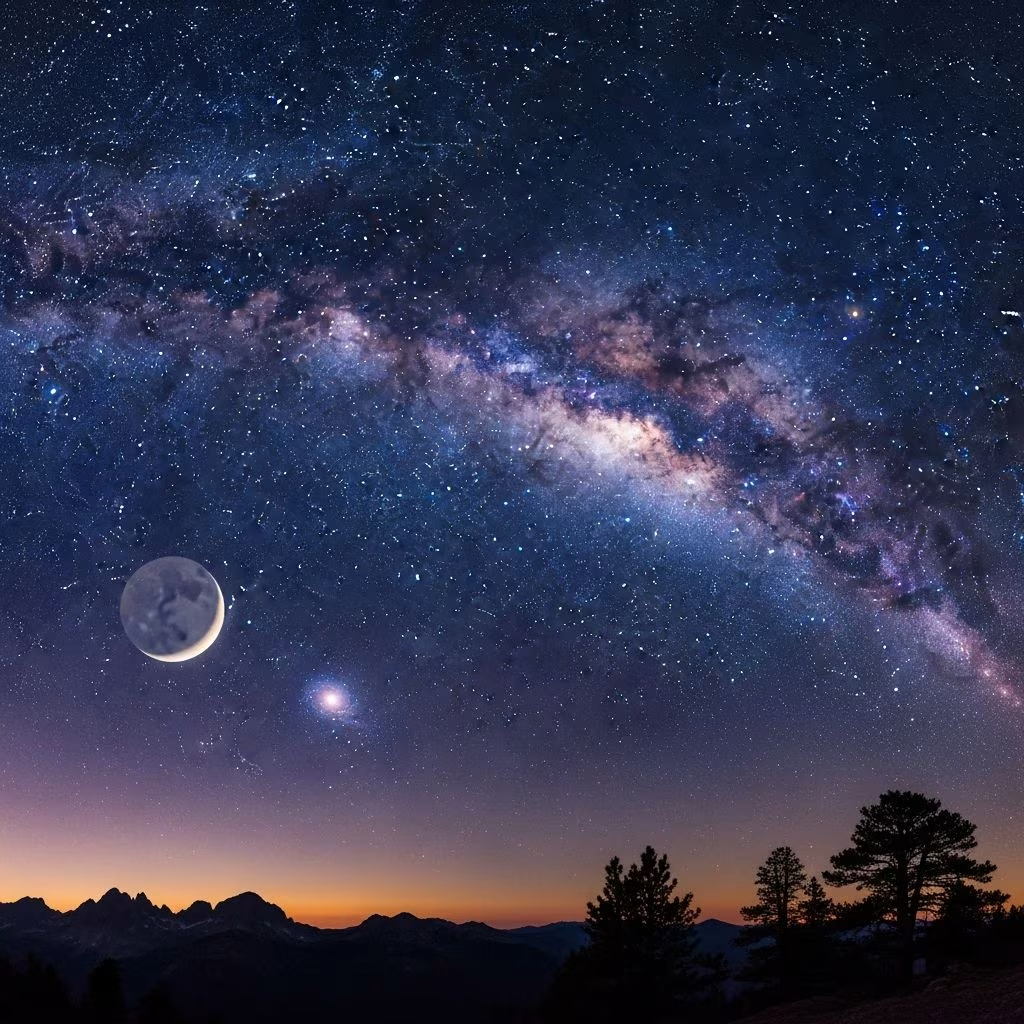
The night sky in March 2026 promises unforgettable spectacles for astronomy enthusiasts. From a striking total lunar eclipse to close planetary encounters and the arrival of spring in the Northern Hemisphere, this month offers diverse opportunities to connect with the cosmos. Whether you’re using the naked eye, binoculars, or a telescope, these events are accessible from various locations around the globe.
March kicks off with one of the year’s most dramatic events: a total lunar eclipse that bathes the Moon in a reddish glow. Planetary alignments add excitement, as brilliant Venus pairs with dimmer Saturn, while mighty Jupiter commands the evening sky with its retinue of moons. The vernal equinox marks a seasonal shift, balancing day and night.
On the night of March 2-3, a total lunar eclipse captivates observers as Earth passes between the Sun and Moon, casting a shadow that turns our satellite deep orange-red. This ‘Blood Moon’ effect arises from sunlight refracted through Earth’s atmosphere scattering blue light and allowing red hues to dominate.
The penumbral phase begins subtly at 3:43 a.m. EST on March 3, with partial umbral entry at 4:50 a.m. EST. Totality peaks around 6:12 a.m. EST, lasting over an hour. Visibility spans most of North and South America in predawn hours, eastern Asia in evening, and Australia fully overnight.
| Phase | Time (EST) | Visibility Notes |
|---|---|---|
| Penumbral Begins | 3:43 a.m. | Subtle darkening across Americas |
| Partial Umbral | 4:50 a.m. | Visible from eastern North America |
| Totality Starts | 6:17 a.m. | Blood Moon glow; western edges best |
| Totality Ends | 7:08 a.m. | Fading eclipse in twilight |
Prime viewing spots include clear horizons in rural areas. No equipment needed, but a telescope reveals crater details during totality. Weather permitting, this eclipse rivals meteor showers in allure.
Early March features Venus, at magnitude -3.9, dazzling low in the west post-sunset. On March 7-8, it cozies up to Saturn (magnitude 1.0) in Pisces, separated by just 1 degree—fitting neatly in binoculars. Spot them 30 minutes after sunset when Venus is 7 degrees high; both set 70 minutes later.
Neptune lurks 1 degree northwest of Saturn but challenges twilight viewers. Venus climbs higher through the month, reaching a 97% illuminated 10-arcsecond disk in telescopes. A thin crescent Moon photobombs on March 19-20: tough on the 19th (6 degrees lower right, 45 minutes post-sunset), easier on the 20th (9 degrees above).
Jupiter reigns supreme in Gemini at magnitude -2.4, peaking south around 8:30 p.m. early month (shifting to 7:30 p.m. by month’s end due to daylight saving on March 8). Visible most of the night until 3 a.m. on March 31, it forms a triangle with Wasat and Mekbuda stars.
Stationary on March 10, its Galilean moons deliver action: Io transit March 13 (2:52 a.m. EDT March 14), shadow transits, occultations (e.g., Io at 12:10 a.m. EDT March 15), and Callisto reappearance March 26 (1:30 a.m. CDT). Telescopes unveil cloud bands and the Great Red Spot.
Uranus, magnitude-appropriate for binoculars, hovers 0.5 degrees southwest of 13 Tauri (magnitude 5.7) early March, south of the Pleiades (M45). Naked-eye possible if stars are visible; it drifts slowly.
The Moon’s cycle frames observations: Full Moon March 3 at 10:38 p.m. AEDT (coinciding with eclipse), Last Quarter March 11 at 8:38 p.m. AEDT, New Moon March 19 at 12:23 p.m. AEDT. Optimal for deep-sky objects around New Moon.
March 20-21 brings the vernal equinox at 14:45 UTC March 20 (1:46 p.m. AEDT March 21), when the Sun crosses the celestial equator. Days and nights equalize globally; spring dawns north, autumn south. Pair with Moon-Venus views.
For Beginners: Naked eye for planets, Moon, eclipse. Apps like Stellarium simulate skies.
Binoculars: 7×50 or 10×50 for conjunctions, Uranus, Pleiades.
Telescopes: 4-inch+ for Jupiter details, Venus phase.
Find dark sites away from city lights. Check local weather; polar alignment aids tracking. Log sightings for personal records.
| Event | Americas | Europe/Africa | Asia-Pacific |
|---|---|---|---|
| Lunar Eclipse | Predawn March 3 | Partial/Miss | Evening March 2-3 |
| Venus-Saturn | Post-sunset Mar 7-8 | Low west | Visible early evening |
| Jupiter | Evening all month | Midnight rise | Overhead evenings |
Yes, unlike solar eclipses, lunar ones pose no eye risk—stare freely!
Webcasts from observatories like NASA stream live.
A Dobsonian 6-inch reflector excels for Jupiter and Moon.
It balances light but doesn’t directly influence weather; cultural celebrations abound.
Wide-angle lens on tripod, 10-30 second exposures at ISO 800.
Asteroid Iris pairs with companions mid-month, shifting angles visibly. Observe drift near Pleiades. Gemini hosts Jupiter amid star clusters like M35.
Post-New Moon, target faint galaxies without moonlight interference.
