

 Travel Essentials
 Travel Essentials

Explore May 2025's highlights: Eta Aquariid meteors, Full Flower Micromoon, planet conjunctions, and moon phases. Perfect for beginner and expert skywatchers.
 Travel Essentials
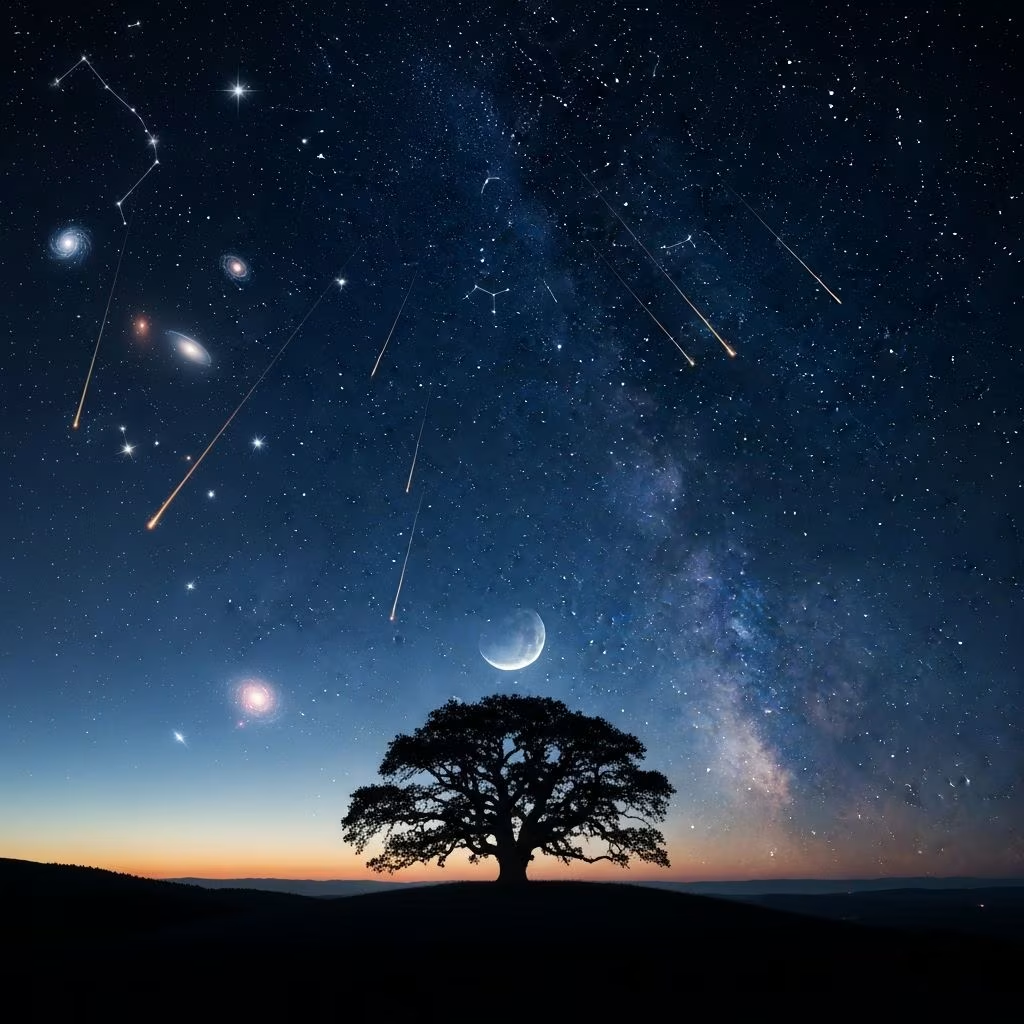
Month of May 2025 offers a rich tapestry of celestial phenomena, making it an ideal time for skywatchers to step outside and gaze upward. From the swift streaks of the Eta Aquariid meteor shower to the gentle glow of the Full Flower Moon, and captivating planetary groupings, this period brims with opportunities to connect with the cosmos. Whether you’re in the northern or southern hemisphere, these events provide moments of wonder accessible to the naked eye or enhanced by simple binoculars.
The standout attractions include dynamic meteor activity, lunar phases with cultural names, and close encounters between planets and stars. Venus shines prominently as the morning star, while the moon dances with Mars, Saturn, and others throughout the month. Dark skies away from city lights will maximize your viewing experience, especially for fainter objects like star clusters.
One of the year’s most reliable meteor displays, the Eta Aquariids, peaks during the nights of May 5-6. Originating from dust particles left by Halley’s Comet, these meteors radiate from the constellation Aquarius in the eastern sky. Observers in the southern hemisphere may witness up to 50 meteors per hour under perfect conditions, while northern viewers can expect 10-30 per hour in the pre-dawn hours.
To optimize sightings, position yourself in a location with minimal light pollution 90 minutes before sunrise. The moon, at about 72% illumination, sets after midnight, providing darker skies later. No equipment is needed, but a comfortable chair and warm clothing enhance the experience as you trace these swift, graceful trails across the heavens.
On May 12, the Full Flower Moon reaches peak illumination at 12:56 p.m. EDT (16:56 GMT), rising dramatically in the southeast around sunset. Known for coinciding with spring wildflower blooms in North America, this moon appears in the constellation Libra, accompanied by bright stars Spica and Arcturus overhead.
This particular Full Moon is a Micromoon, occurring when the moon is at apogee—its farthest point from Earth—making it roughly 5% smaller and 10% dimmer than average. It remains visually full for the nights surrounding May 12, offering multiple chances for observation. Jupiter and Mars linger in the western sky at moonrise, adding to the scenic display.
May 2025 features Venus dominating the predawn east-southeast sky, outshining all other points of light. Saturn joins nearby early in the month, creating striking pairs. Mars, fading in the evening west, interacts with the moon and star clusters, while Jupiter sets in twilight, revealing its moons through binoculars.
| Date | Event | Location & Tips |
|---|---|---|
| May 1 | Venus-Saturn conjunction | East-southeast predawn; naked eye visible |
| May 3-4 | Moon near Mars | Western sky evening; binoculars for Beehive cluster on May 4-5 |
| May 10 | Near-full moon with Spica | Rises east; stays visible till dawn |
| May 13 | Moon-Antares pairing | Southeast after dark; red supergiant star |
| May 22-23 | Crescent moon with Saturn, Neptune, Venus | Predawn east-southeast; earthshine on moon |
| May 31 | Waxing crescent near Mars | West at dusk; earthshine prominent |
Mercury hugs the eastern horizon pre-dawn, best for southern observers. These alignments showcase the solar system’s geometry, with planets appearing to wander among fixed stars.
Earthshine, the faint reflection of sunlight off Earth illuminating the moon’s dark side, enhances crescent phases on May 22, 23, and 31. Capture these with a smartphone camera against the twilight sky.
Escape urban glow to rural spots; use apps like Stellarium or SkySafari for real-time charts. Binoculars (7×50 recommended) reveal Jupiter’s Galilean moons—Io, Europa, Ganymede, Callisto—shifting nightly. Small telescopes uncover planetary details: Venus’ phases, Saturn’s rings (though edge-on this year), Mars’ polar caps.
Patience is key for meteors; allow 20-30 minutes for night vision. Weather matters—check forecasts for clear nights. Southern hemisphere stargazers enjoy superior Eta Aquariid rates and higher Milky Way visibility post-midnight.
Beyond highlights, seek the Beehive Cluster (M44) in Cancer during Mars’ passage May 4-5—hundreds of stars resembling a swarm in dark skies. Antares, the red supergiant in Scorpius, pairs with the waning moon on May 13, its fiery hue contrasting the lunar glow. The Milky Way arches overhead by month’s end, perfect for wide-field photos.
This month blends annual reliables like Eta Aquariids with unique micromoon subtlety and multi-planet vistas. It’s family-friendly: events span evenings and mornings, naked-eye dominant. Tie observations to nature—Flower Moon evokes blooming landscapes, meteors mimic fireflies.
For advanced viewers, note Nova possibilities hinted in broader 2025 guides, though unconfirmed for May. Track rocket launches via official calendars for bonus streaks.
Debris from Halley’s Comet burns up in Earth’s atmosphere, creating radiant streaks from Aquarius.
No, only when at apogee; 2025’s is smaller due to orbital positioning.
Dark-sky parks, beaches, or mountains; southern latitudes excel for meteors and Mercury.
Not for main events—binoculars suffice; telescopes enhance planets.
Post-midnight moonset on peak nights ensures dark skies.
May 2025 inspires ongoing passion. Log sightings in journals, join astronomy clubs, or use citizen science apps like Globe at Night for light pollution data. These events remind us of our place in a vast, dynamic universe, fostering awe and curiosity.
Incorporate photography: wide-angle lenses capture moon-planet trios; time-lapses meteors. Share online communities spark discussions, building global stargazing networks.
