

 Travel Essentials
 Travel Essentials

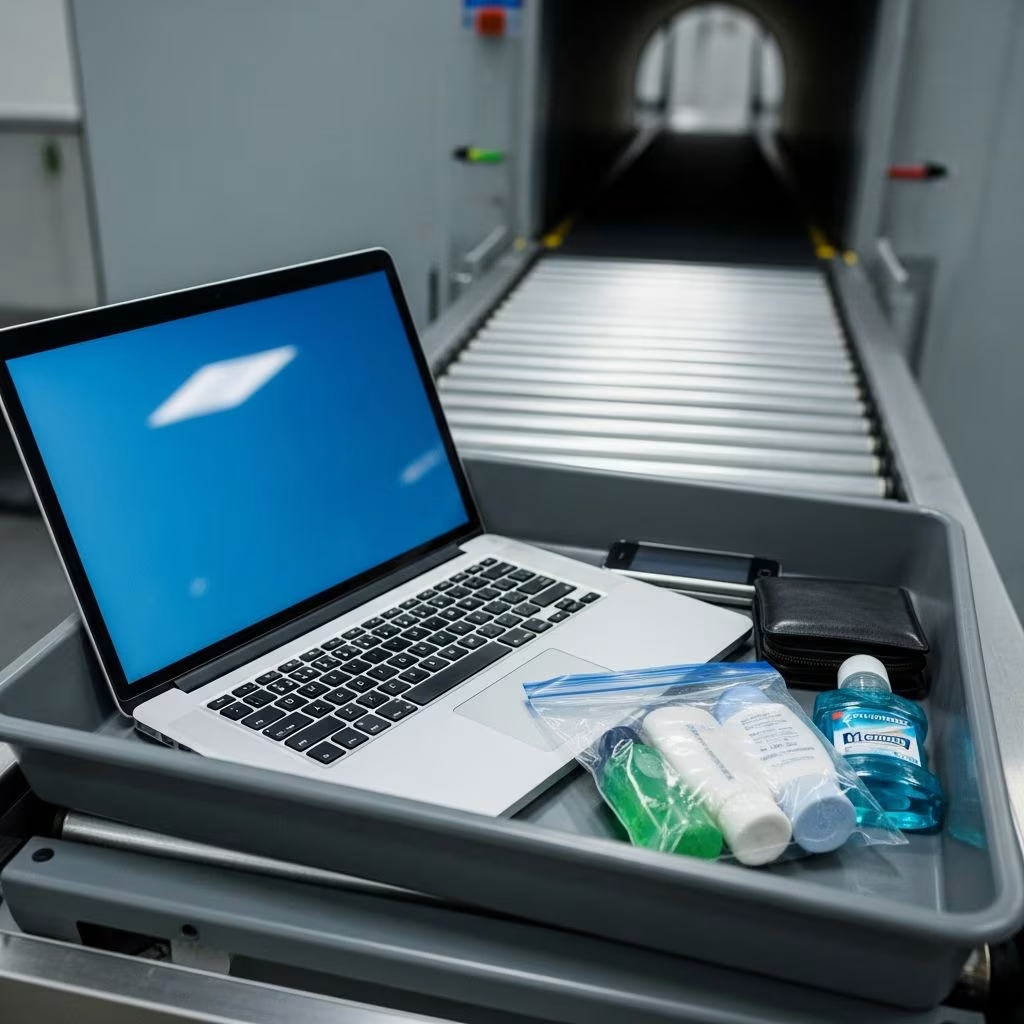
Melbourne Airport’s new CT scanners let you keep laptops and most liquids in your bag, speeding up screening while liquid limits still apply.
 Travel Essentials
Australia’s major airports, including Melbourne, have implemented groundbreaking changes to security screening procedures. Travelers can now pass through checkpoints without extracting laptops, tablets, or most liquid containers from their carry-on luggage, thanks to next-generation computed tomography (CT) scanners. This upgrade is part of a nationwide $2 billion investment aimed at enhancing security while drastically reducing wait times.
The Australian federal government has spearheaded a comprehensive airport security transformation, deploying advanced CT X-ray technology across key terminals. By late 2025, facilities in Brisbane, Melbourne, Adelaide, Perth, Canberra, and Hobart had fully integrated these systems, with Sydney and Darwin completing installations shortly after. Melbourne Airport’s Terminal 2 (international departures) leads the charge, featuring state-of-the-art equipment that detects threats more effectively without requiring passengers to unpack electronics or toiletries.
These CT scanners produce 3D images of bag contents, allowing security officers to identify potential risks with greater precision than traditional X-ray machines. The result? Passenger throughput has doubled in some locations, and average screening times have dropped by up to 30%, often under 10 minutes for most travelers.
These relaxations apply primarily to equipped lanes. Always follow on-site signage and officer instructions, as requirements can vary by terminal or during peak periods.
Melbourne Airport mandates body scanner screening for all passengers entering secure areas in Terminal 2. This non-intrusive technology uses millimeter-wave or backscatter methods to detect concealed items on the body, providing a clearer image than metal detectors alone.
The process is quick: stand in the scanner for a few seconds, follow prompts to raise arms, and step out. Privacy is protected—images are gender-specific, show only generic outlines, and are deleted immediately after review. No physical contact is involved unless a secondary pat-down is required.
If you cannot undergo body scanning due to medical conditions (e.g., pacemakers, implants, or pregnancy), present a doctor’s letter at the checkpoint. The letter must explicitly state why the specific scanner technology is unsuitable for you.
Without adequate documentation, alternative screening like hand-held wands or pat-downs may be offered, but refusing all options prevents access to boarding areas. Plan ahead and contact the airport in advance for accommodations.
While handling has simplified, volume restrictions persist. All liquids, aerosols, and gels must be in containers of 100ml (or grams) or less, fitting into a single 1-liter transparent, resealable plastic bag (approx. 20cm x 20cm). This aligns with international standards enforced by the Australian Border Force.
| Item Type | Allowed in Carry-On | Notes |
|---|---|---|
| Liquids (e.g., water, drinks) | 100ml max per container | All in one clear bag; powders over 350ml screened separately. |
| Aerosols (e.g., deodorant) | 100ml max per container | Valve-protected; no flammable types. |
| Gels (e.g., hair products) | 100ml max per container | Medications exempt with proof. |
| Baby Formula/Milk | Reasonable amounts | Declare at screening; taste test may apply. |
Pack non-compliant items in checked luggage to avoid confiscation. Duty-free purchases post-screening are permitted in secure bags with receipts.
For domestic Terminal 1,3, or 4, check specific signage—CT lanes are expanding but not universal yet.
The upgrades have transformed the airport experience. Frequent flyers report less stress from unpacking, especially families with children or business travelers with multiple devices. Sydney’s T1 now processes twice the passengers per lane, a model Melbourne emulates.
Environmentally, fewer trays mean less plastic waste. Security efficacy improves too—CT scanners spot explosives and organics invisible to older tech.
By April 2026, all major airports operate under these streamlined rules, but verify via official apps or websites for real-time updates.
Yes for T2 international, but it goes in a tray—no removal from main bag required in CT lanes.
No, place it in your carry-on or tray to avoid alarms.
Provide medical documentation for alternatives; otherwise, you can’t proceed.
Liquid meds over 100ml allowed with prescription/declaration.
Reduced by up to 30%, with many clearing in under 10 minutes.
These changes position Australian airports as global leaders in efficient, secure travel. Stay informed as tech evolves.
