

 Travel Essentials
 Travel Essentials

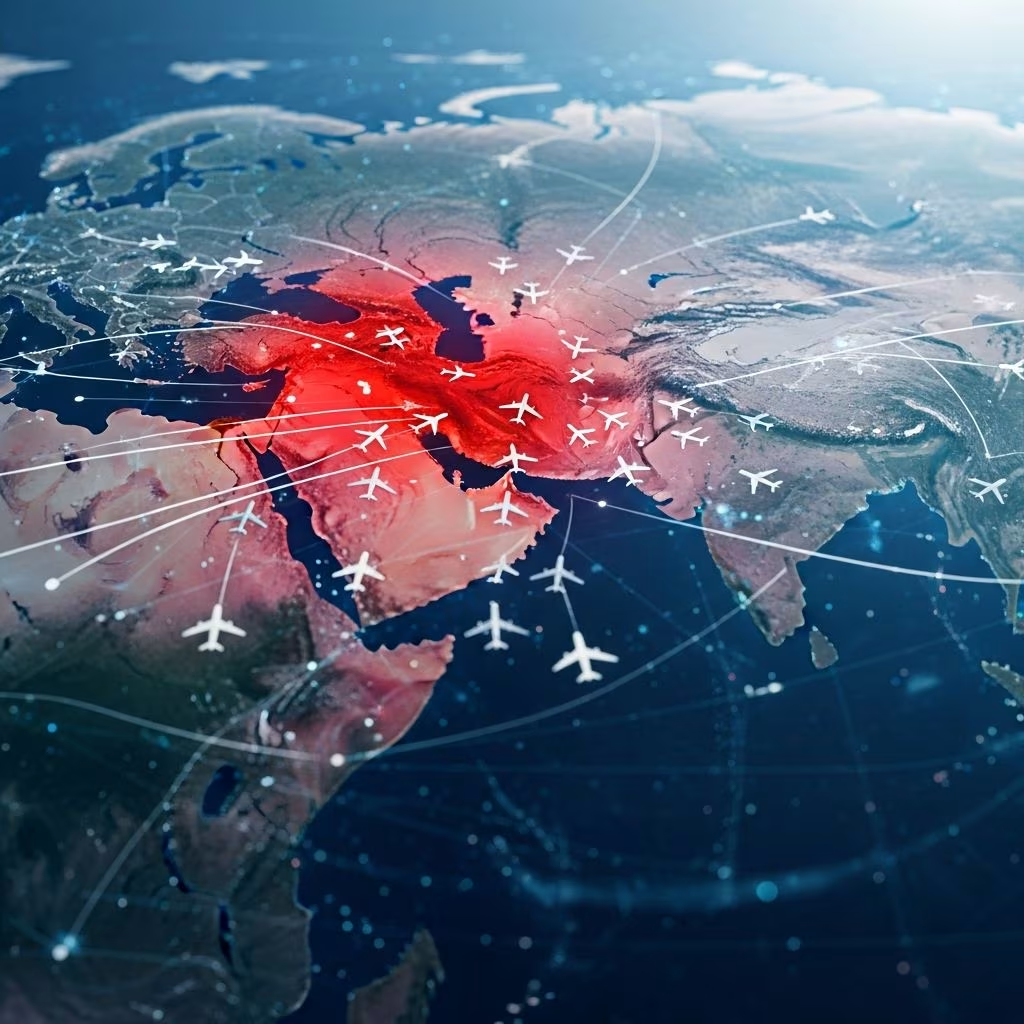
Military tensions have shut down key Middle East airspaces, forcing airlines to take longer routes, canceling thousands of flights, and disrupting global travel and supply chains.
 Travel Essentials
Escalating military conflicts in the Middle East have led to widespread airspace closures across multiple countries, fundamentally altering global aviation patterns. These restrictions, triggered by airstrikes and retaliatory actions involving Iran, the United States, Israel, and regional powers, have shuttered critical flight corridors, airports, and hubs, affecting over 5,000 flights and millions of passengers.
The crisis unfolded rapidly starting February 28, 2026, when coordinated airstrikes on Iran prompted immediate airspace shutdowns in Iran, Iraq, Israel, and Gulf states like Bahrain, Kuwait, and Qatar. By March 3, these closures expanded, with full restrictions on flight information regions (FIRs) such as OIIX (Iran), ORBB (Iraq), and LLLL (Israel). Security NOTAMs (Notices to Air Missions) further limited operations in the UAE, enforcing ESCAT protocols for wartime airspace management.
This isn’t isolated; it’s a cascading failure of a vital aerial bridge connecting Europe and Asia. Normally, over 500 aircraft traverse Iraqi airspace daily, but closures created a 500-mile-wide void, forcing airborne planes into emergency diversions to 73 alternate airports.
Key aviation gateways have suspended operations due to security threats and debris from missiles and drones. Dubai International (DXB), the world’s busiest international airport, halted all departures and arrivals indefinitely. Similarly, Abu Dhabi (AUH), Doha (DOH), Sharjah (SHJ), Kuwait (KWI), and Bahrain (BAH) remain closed or severely restricted.
On March 1, over 3,400 flights were canceled; March 2 added 2,000 more, per aviation trackers.
Major carriers have scrambled to adapt. Emirates suspended Dubai flights until at least March 3 (UAE time), with extensions likely. Etihad paused Abu Dhabi operations, Qatar Airways halted Doha services indefinitely, and European airlines like British Airways, Lufthansa, and KLM imposed partial bans through March 5-7. Indian carriers IndiGo and Akasa Air also suspended routes.
Business aviation faces ‘airspace compression,’ with constrained corridors via Saudi Arabia, Oman, Turkey, Egypt, or the Caspian region. This leads to longer flight times, higher fuel burn, and constant NOTAM validations—no stable routes exist.
| Airline | Status | Impact Duration |
|---|---|---|
| Emirates | Suspended (DXB) | Until March 3+, possible extension |
| Etihad | Paused (AUH) | Pending approval |
| Qatar Airways | Indefinite suspension (DOH) | Ongoing |
| BA, Lufthansa, KLM | Partial/full bans | Through March 5-7 |
| IndiGo, Akasa Air | Middle East routes halted | March 3-7 |
With central Gulf and Levant airspaces unusable, traffic has bifurcated into northern and southern alternatives, both plagued by congestion.
Flights detour via Turkey, the Caucasus, and Central Asia (e.g., OAKX/Kabul FIR seeing traffic spikes). This path offers viability but faces ATC delays, tactical reroutes, and geopolitical risks.
Routing through Egypt, Saudi Arabia, Oman, and the Arabian Sea absorbs heavy volume, causing flow management issues and extended paths with high fuel penalties.
Operators report 20%+ longer flights, crew duty limit breaches, payload reductions, and hub bank desynchronization—systemic ripples beyond simple detours.
Even if not flying to the Middle East, expect delays. Europe-Asia routes now add hours; U.S.-Asia connections via Pacific hubs face knock-on effects from reallocated aircraft. Over 870 of 3,400 scheduled flights canceled instantly, with 145 diversions.
Airfreight bears the brunt: reduced capacity on passenger flights tightens Europe-Asia-U.S. lanes, spiking rates akin to past crises. Logistics face delays, bottlenecks at alternates, and volatility—reinforcing needs for diversified routing.
Flight planning now demands real-time NOTAM monitoring. Constraints include FIR closures, limited alternates, and rapid changes (e.g., Azerbaijan/Syria openings offset by Iran/UAE extensions). Fuel burn rises, payloads drop, and networks lose predictability.
Sustained closures could reshape routes permanently, boosting southern maritime paths or northern bypasses. Airlines demonstrate resilience via adaptation, but vulnerability to geopolitics is stark—fleet utilization and connectivity optimized for stability now strain.
Ceasefires like Iran-U.S. Hormuz reopenings offer temporary relief but don’t eliminate risks; conditions shift hourly.
Yes, indirectly via reallocated aircraft and Europe-Asia delays impacting transatlantic connections.
Indefinitely; extensions tied to security clearances, potentially weeks.
Northern (Turkey-Caucasus) and southern (Egypt-Oman) corridors, but both congested—validate per flight.
Likely, from capacity shortages and fuel surcharges on longer routes.
No; faces same compression, requiring custom planning.
Use platforms like Safe Airspace for summaries, Universal Weather for ops updates, and WTO-MWW for cargo insights. Prioritize official sources like FAA or EASA advisories.
