

 Travel Essentials
 Travel Essentials

Escalating conflicts have closed Middle East airspace, causing mass flight cancellations, rerouting, and delays for global travelers. Learn how this affects routes, airlines, and what to do next.
 Travel Essentials
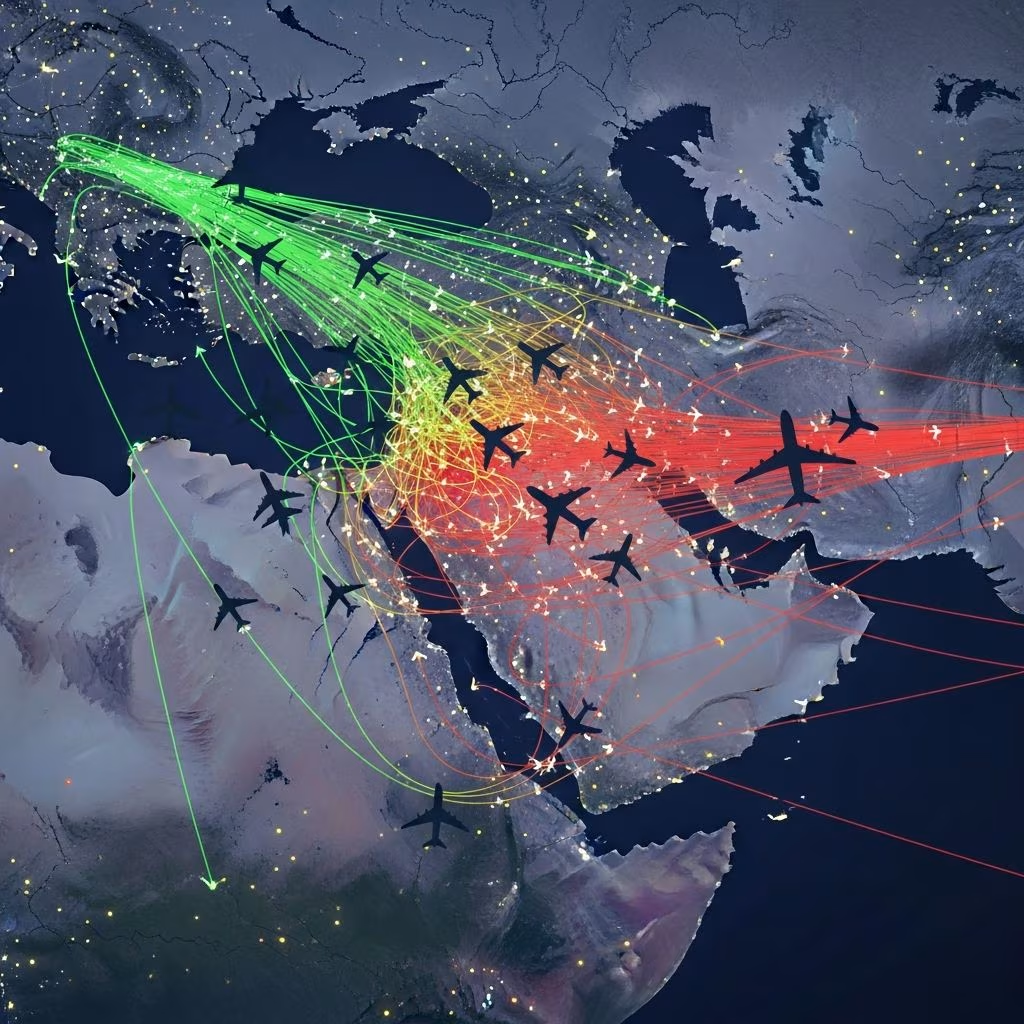
Geopolitical tensions in the Middle East, sparked by U.S. and Israeli strikes on Iranian targets starting February 28, 2026, have triggered extensive airspace closures across the region. These shutdowns have disrupted one of the world’s busiest aviation corridors, affecting flights between Europe, Asia, and beyond, leading to thousands of cancellations and rerouting that strands passengers and inflates costs.
The central Middle East airway, a vital superhighway for long-haul flights, is now largely inaccessible. Airspaces over Iran (OIIX/Tehran FIR), Iraq (ORBB/Baghdad FIR), Israel (LLLL/Tel Aviv FIR), Syria (OSTT/Damascus FIR), Bahrain, Kuwait, Jordan, Lebanon, Qatar, UAE, Oman, and parts of Saudi Arabia remain closed or heavily restricted at all altitudes. The European Union Aviation Safety Agency (EASA) has issued strong advisories urging operators to avoid these zones entirely through at least March 2026, with extensions expected.
These closures stem from missile exchanges, drone attacks, and retaliatory strikes. A notable incident involved a drone strike near Dubai International Airport’s Terminal 3 on March 7, 2026, halting operations briefly and amplifying global ripple effects. Over 12,300 flights were canceled at seven major airports, impacting more than 20,000 passengers in the UAE alone and leaving 8,000 stranded in Doha.
Major carriers have extended suspensions repeatedly, shifting from weeks to months-long halts. Here’s a breakdown of key airlines’ actions as of late March 2026:
Gulf carriers like Gulf Air have relocated operations to Dammam, Saudi Arabia, for limited routes to London, Frankfurt, Mumbai, Bangkok, and Nairobi through late March. This pattern indicates a ‘new normal’ where disruptions harden into prolonged changes.
With the primary corridor blocked, airlines must use detours. The northern route via Central Asia and the Caucasus (e.g., through OAKX/Kabul FIR) sees increased traffic but risks congestion and further geopolitical issues in Turkey or Azerbaijan. The southern path over the Arabian Sea and Indian Ocean adds significant distance—up to 10% more—without fully compensating for lost efficiency.
| Route Type | Key Path | Added Time/Distance | Risks |
|---|---|---|---|
| Northern Bypass | Central Asia/Caucasus | 1-2 hours; 5-10% | Congestion, instability |
| Southern Detour | Indian Ocean/Arabian Sea | 3-4 hours; 10-20% | Fuel costs, payload limits |
| Extreme South | Sub-Saharan Africa | 4+ hours | High operational strain |
Existing gaps from the Russia-Ukraine conflict and Israel-Gaza tensions compound the issue, fragmenting Eurasian skies further.
Rerouting imposes heavy burdens. A 5-10% distance increase spikes fuel consumption for widebody jets, often exceeding optimal burn rates. Aircraft face payload restrictions due to extra fuel needs, forcing cargo reductions or, rarely, fewer passengers. Crew duty limits are breached on extended flights, necessitating more stops or crew swaps.
Airport halts at hubs like Dubai (DXB) and Doha (DOH) create network-wide delays. Freighters and passenger ops alike suffer, as fleet planning assumes stable access. Fares rise globally, even for non-Middle East routes, due to capacity strains.
Hundreds of thousands are affected: rerouted mid-flight, turned back, or stuck refreshing apps. Transit passengers face indefinite waits, with 8,000 reported in Doha. Even indirect routes feel effects—Air India diverted a Tel Aviv flight amid tightening restrictions.
Historical precedents include Iran’s 2020 downing of Ukraine International Airlines Flight 752 and repeated 2024-2025 closures from Iran-Israel exchanges.
To navigate this crisis:
Closures persist into April 2026 and beyond, with no quick resolution anticipated. If Oman closes further or northern paths falter, only ultra-long southern routes remain viable, adding hours and costs. Safeairspace.net notes traffic shifts to Kabul FIR as northern bypasses intensify.
Limited operations resume between threats, but capacities are slashed; check for suspensions.
Europe-Asia routes add 1-4 hours depending on detour.
Yes, due to fuel, delays, and reduced capacity.
Verify coverage for ‘named storms’ or geopolitical risks; many policies adapt.
Industry expects months; monitor official sources.
This crisis underscores aviation’s vulnerability to regional instability, reshaping global connectivity for the foreseeable future.
