

 Travel Essentials
 Travel Essentials

Mission Garden in Tucson offers a unique journey through millennia of farming history with heirloom plants, educational plots, and community events in a stunning desert setting.
 Travel Essentials
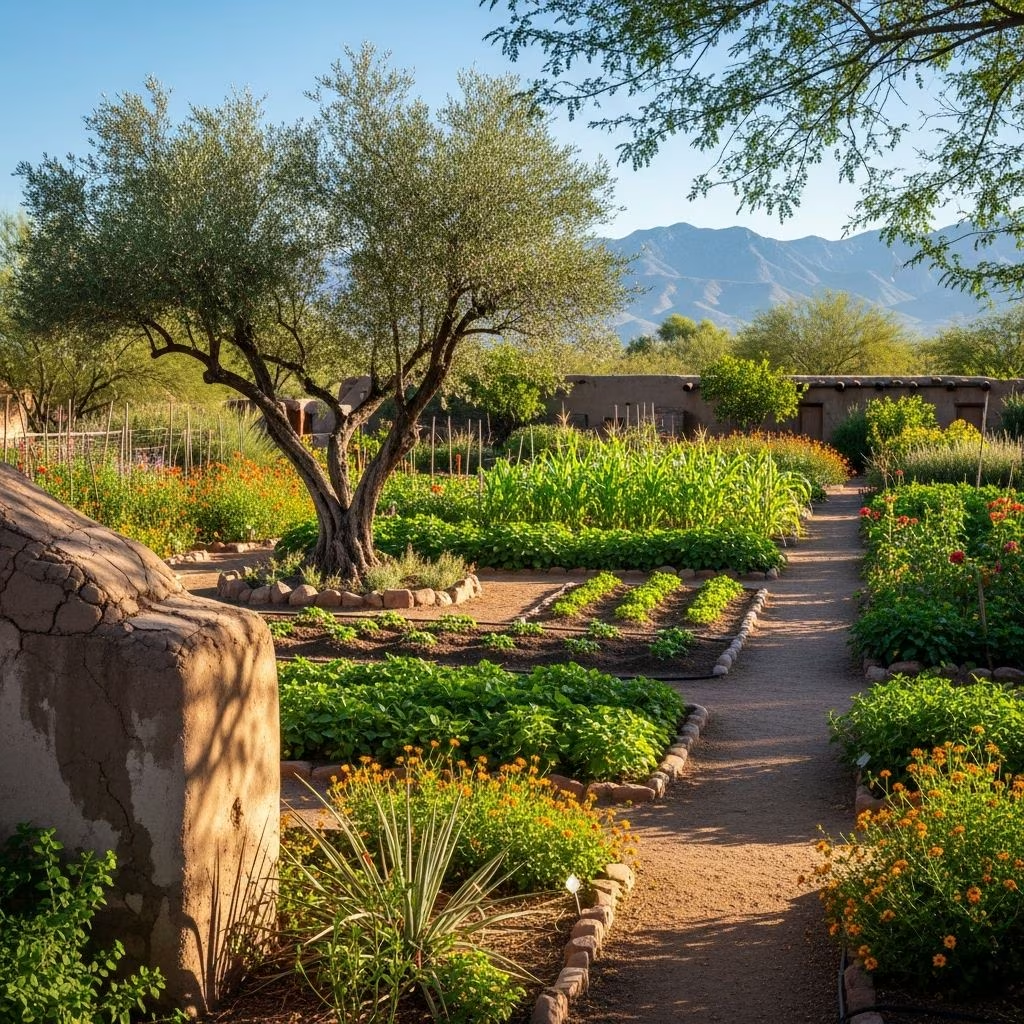
Mission Garden stands as a captivating testament to over 4,000 years of continuous agriculture in the Sonoran Desert, nestled at the base of Sentinel Peak in Tucson, Arizona. This four-acre living museum recreates the agricultural practices of diverse cultures that have shaped the region, from ancient indigenous peoples to modern innovators.
The site of Mission Garden has been farmed without interruption for millennia, beginning with the Hohokam people around AD 500-1300. Archaeological evidence reveals scattered Hohokam houses, hearths, and decorated pottery dating to AD 1140-1300, highlighting a vibrant prehistoric village known as Cuk Ṣon, sacred to the Tohono O’odham. The garden’s location in the Santa Cruz River watershed provided fertile ground for early farming, with agave-covered hillsides, roasting pits, and reconstructed pithouses offering visitors a tangible connection to this era.
Early agriculture here relied on desert-adapted crops like corn, beans, and agave, techniques that sustained communities through arid conditions. Today, these elements are preserved to educate on sustainable practices that blend ancestral wisdom with contemporary science.
Mission Garden organizes its plots chronologically and culturally, showcasing the evolution of farming in Tucson. Key areas include:
Developing sections like Grassland, Territorial, Statehood, and Tomorrow’s Gardens promise future expansions, alongside the Trail of Ndé (Apache) Plants, ensuring the narrative continues to grow.
Tucson earned its status as the first UNESCO City of Gastronomy in the US thanks to sites like Mission Garden, which honor the Sonoran Desert’s multi-cultural food production history. The garden grows exclusively heritage crops and heirloom trees, testing arid-adapted methods to address food security, resource depletion, and climate challenges.
Visitors can explore how these practices mitigate modern issues, with interactive exchanges of traditional knowledge from community elders and historical records. This aligns with Tucson’s gastronomic designation by celebrating local, sustainable agriculture.
| Garden Plot | Historical Period/Culture | Featured Plants/Crops |
|---|---|---|
| Native Plants | Prehistoric | Agave, desert edibles |
| Hohokam | AD 500-1300 | Corn, beans, squash |
| O’odham (Pre/Post Contact) | Indigenous | Traditional desert crops |
| Spanish/Mexican | 1775 onward | Heirloom fruits, citrus |
| Chinese/Yoeme/African | Immigrant eras | Specialty vegetables, grains |
Construction of the current garden began in 2008, with adobe walls enclosing the space in homage to Spanish Colonial designs. After a period of inactivity, the nonprofit Friends of Tucson’s Birthplace (FOTB), a 501(c)(3) organization, took over in 2011 under agreement with Pima County. Since then, enhancements like irrigation systems, a heritage fruit orchard, timeline gardens, a Tarahumara granary, chicken coop, education building, kitchen, and acequia have transformed it into a dynamic hub.
FOTB fosters multi-generational learning through hands-on activities, promoting the fusion of traditional techniques with scientific evaluation. Open primarily on Saturdays, the garden welcomes visitors to wander its paths, learn from docents, and participate in events.
Planning a trip to Mission Garden enhances the experience in Tucson’s sunny climate. Essential preparations include:
Free admission makes it accessible, though donations support ongoing development. Combine your visit with a hike up Sentinel Peak for panoramic views of the garden below.
Beyond passive observation, Mission Garden excels in interactive education. Programs engage youth through the Youth Garden, where kids plant and harvest heritage seeds. Workshops on medicinal plants and arid farming draw enthusiasts eager to learn practical skills.
Community events feature mural projects funded by grants, collaborations with local groups like the Boys & Girls Club, and tastings of garden produce. These initiatives preserve knowledge while inspiring resilient food systems for semi-arid regions.
In an era of water scarcity, Mission Garden demonstrates viable solutions. By prioritizing drought-tolerant heirlooms, it models low-water agriculture that reduces dependency on imported food. The acequia system revives ancient irrigation, promoting biodiversity and soil health.
Studies from the University of Arizona highlight the site’s role as an ancient agricultural hub, informing current food studies on sustainable desert farming.
For history aficionados, the layered timelines offer profound insights into Tucson’s pre-presidio roots, from Anza’s 1775 expedition to statehood eras. Food lovers appreciate the UNESCO tie-in, connecting garden plots to Sonoran’s culinary tapestry. Nature seekers find serenity amid heirloom orchards and native flora.
This nonprofit gem, free of religious affiliation, bridges past and future, making it a must-visit for authentic Tucson immersion.
A four-acre living agricultural museum interpreting 4,000 years of Sonoran Desert farming through themed plots and heirloom plants.
At the foot of Sentinel Peak, near the historic site of Cuk Ṣon village in Tucson, Arizona. Coordinates: 32°12′49″N 110°59′14″W.
Primarily on Saturdays; check the official site for events and tours.
Yes, with encouraged donations to support the nonprofit.
Its focus on heritage crops from diverse cultures, tied to Tucson’s UNESCO City of Gastronomy status.
