

 Travel Essentials
 Travel Essentials

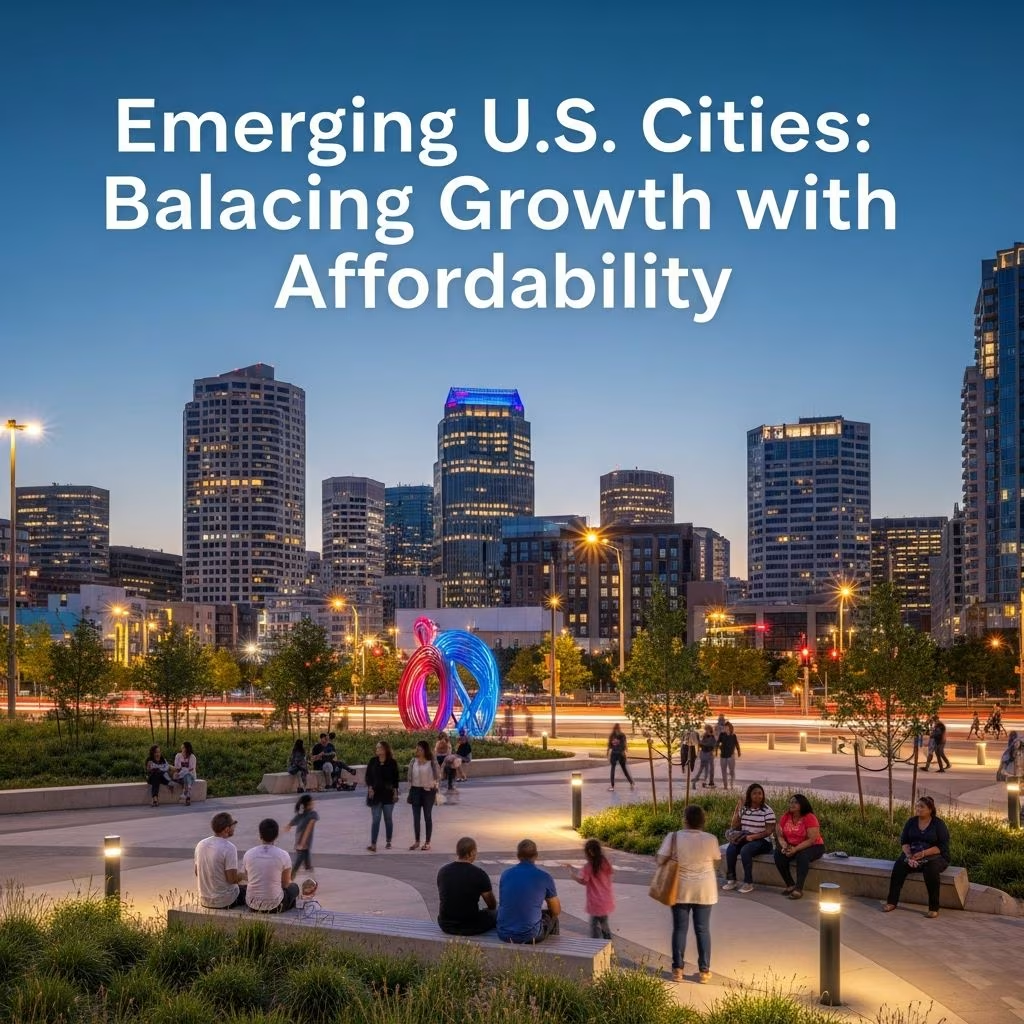
Explore rapidly developing U.S. cities offering affordable housing, strong job markets, and quality of life improvements for families and professionals.
 Travel Essentials
The American housing market continues to present significant challenges for prospective homebuyers and renters seeking stable, affordable communities. However, a new generation of secondary and tertiary cities is reshaping the relocation landscape by combining economic momentum with reasonable housing costs. These emerging metropolitan areas attract families, young professionals, and retirees who seek alternatives to expensive coastal megacities while maintaining access to quality employment, education, and recreational opportunities.
The most compelling opportunities for affordable living coupled with economic growth cluster heavily in specific geographic regions. Texas leads the nation in representation, with eleven cities identified as both affordable and rapidly expanding, demonstrating the state’s ability to accommodate population increases without proportional cost escalation. Frisco, ranking as the nation’s premier example, exemplifies this pattern with median home prices that allow dual-income households to retain over $83,000 in annual leftover savings. This financial cushion represents a fundamental shift from traditional cost-of-living mathematics, where home purchases consume increasing percentages of household budgets.
Florida closely follows Texas with seven municipalities meeting affordability and growth criteria, reflecting the Sunshine State’s ongoing appeal despite previous reputation for rapid price appreciation. North Carolina similarly positions itself as an attractive alternative with five ranked communities, while Arizona, Indiana, and Iowa each contribute multiple entries to the list of economically dynamic yet accessible cities.
The industrial Midwest continues demonstrating resilience through diversified economies and remarkably low housing costs. Des Moines, Iowa exemplifies this regional strength, where housing prices run 23% below the national average while median household incomes support comfortable lifestyles. The city’s broader economic foundation encompasses healthcare, education, and manufacturing sectors, creating employment stability across economic cycles.
Fort Wayne, Indiana maintains housing costs approximately 28% lower than national benchmarks while supporting workforce diversity through manufacturing, healthcare, and educational institutions. Similarly, Green Bay, Wisconsin prioritizes housing affordability, making residential acquisition feasible for families across income spectrums. The region’s lower cost structure extends beyond housing to utilities, transportation, and healthcare expenses, compounding long-term financial advantages for permanent residents.
Omaha, Nebraska distinguishes itself through family-oriented amenities combined with housing costs running 6% below national levels. The city’s education system, recreational infrastructure, and cultural institutions provide quality-of-life elements that justify residential consideration beyond purely financial metrics. Springfield, Missouri presents another Midwest alternative where overall cost of living runs 12% below national standards with housing costs reduced by 24%, enabling comfortable middle-class existence at substantially reduced expense.
The region spanning Texas through Arkansas and Oklahoma demonstrates distinct expansion patterns driven by business relocations and remote workforce attraction. Oklahoma City capitalizes on aggressive economic development initiatives, strong job market fundamentals, and family-friendly programming while maintaining housing costs 11% below national averages. This combination positions the city as attractive for families seeking stability and financial breathing room.
Fort Smith, Arkansas represents an underutilized opportunity for budget-conscious relocators, offering rental affordability where income devoted to housing represents approximately 19.35% of median earnings. Wichita, Kansas provides employment diversity alongside housing costs reduced by 22% relative to national standards, creating favorable conditions for first-time homebuyers and established families seeking geographic repositioning.
Historical coastal city affordability has evaporated across most American shorelines. However, select communities maintain beach proximity while preserving financial accessibility. Visalia, California emerges as the nation’s most affordable West Coast community, allowing homeowners to retain approximately $31,005 in annual savings after normal housing and living expenses. This breakthrough challenges assumptions that California residency necessarily demands six-figure household incomes.
Florida’s emerging coastal markets, particularly Cape Coral and Jacksonville, extend beachside living to broader economic demographics. These communities attract residents through combination of coastal amenities, developing employment bases, and pricing structures that differentiate from established resort destinations. Similarly, Vancouver, Washington provides Pacific Northwest coastal proximity with $23,784 in average annual homeowner savings, positioning the region as accessible for those seeking temperate climate without California pricing.
The urban South offers cultural richness alongside financial accessibility often absent from northern metropolitan areas. Memphis, Tennessee presents regional advantages through cost of living 5% below national standards combined with substantial cultural infrastructure encompassing music, art, and culinary traditions. The city attracts creative professionals, retirees, and families seeking urban experience without corresponding price escalation.
Cities balancing affordability with expansion typically demonstrate employment diversity preventing economic vulnerability to sector-specific downturns. Healthcare, education, manufacturing, and service industries provide employment platforms across skill and credential levels. This diversity maintains wage consistency, attracting talent while preventing speculative boom-and-bust cycles that historically destabilized single-industry communities.
Unemployment rates in leading affordable-growth cities typically range from 2% to 4.2%, substantially below historical national averages. This tight employment conditions translate into wage pressure benefiting workers while maintaining business competitiveness through operational efficiency rather than labor cost reduction.
Median home prices across premier affordable cities demonstrate remarkable variation reflecting regional economic structures and population density. Abilene, Texas features median purchase prices of $131,300 with corresponding monthly rents averaging $918, enabling renters to transition to ownership within reasonable timeframes. Akron, Ohio and Buffalo, New York maintain median home prices under $101,000, fundamentally altering home purchase mathematics for middle-income households.
This pricing structure creates natural affordability sustainability through limiting speculative investor activity that historically drives rapid appreciation. Owner-occupancy remains economically viable, discouraging institutional real estate investment that accelerates pricing cycles.
Comprehensive relocation decisions require assessment beyond financial metrics. Leading affordable-growth cities provide:
These amenities differentiate between financially accessible communities and those offering genuine quality-of-life improvements justifying permanent relocation rather than temporary cost reduction.
Affordable-growth cities appeal across demographic spectrums through different economic advantages. First-time homebuyers find entry-level prices enabling ownership before median ages reach 35. Families with children identify education systems and recreational infrastructure meeting contemporary parenting expectations. Retirees access cost-effective living allowing fixed incomes to extend through longer life expectancies. Remote professionals leverage affordable housing while maintaining high-income employment through digital connectivity.
Bismarck, North Dakota establishes national leadership for rental affordability, with median rent consuming only 15% of household income. Cedar Rapids, Iowa achieves similar results with 16.48% of income directed toward housing, fundamentally improving resident financial flexibility. These metrics contrast sharply with national patterns where rent increasingly consumes 25-35% of income in major metropolitan areas, creating systemic affordability crises.
Des Moines rental affordability metrics position the city as accessible across income spectrums, with rent representing 19.84% of median household income. This sustainability enables renters to build savings, invest in education, or plan family expansion without constant financial stress.
Median household incomes in emerging affordable cities typically range from $52,000 to $80,000 annually, reflecting regional economic structure and workforce composition. Rather than indicating low-skill employment, these figures reflect cost-of-living adjusted compensation. A $55,000 household income in Des Moines provides equivalent purchasing power to approximately $75,000-$85,000 in major coastal metropolitan areas when adjusted for housing, healthcare, and educational costs.
Six communities demonstrate exceptional homeowner financial advantage, with households retaining over $70,000 in annual savings after standard expenses. Frisco, Texas leads this category with $83,713 average annual residual income, followed by Carmel, Indiana ($80,872) and Fishers, Indiana ($77,328). This financial flexibility enables accelerated debt reduction, educational investment, retirement savings, and family emergencies without threatening residential stability.
Texas’s dominance in affordable-growth rankings reflects both population migration and business relocation toward lower-cost operational environments. The state’s regulatory environment, tax structure, and workforce availability create competitive advantages attracting corporate headquarters and regional operations centers. These employment concentrations drive housing demand while competitive development prevents price escalation exceeding income growth.
The Southeast’s increasing prominence reflects demographic migration toward warmer climates combined with lower regional costs relative to Northeastern and Western markets. North Carolina’s five ranked cities particularly reflect the state’s success attracting technology employment while maintaining housing affordability through strategic development.
Affordable-growth cities present distinct investment calculus compared to established metropolitan real estate markets. Price appreciation typically runs 2-4% annually, substantially below historical national averages, making these markets inappropriate for speculation-focused investors. However, owner-occupant investors benefit from appreciation combined with dramatically reduced carrying costs through lower mortgage amounts and taxes on significantly valued properties.
Cities combining rapid population expansion with housing costs and overall expenses remaining below or near national averages, typically supporting median household incomes through employment opportunities and cost structures enabling savings accumulation.
Leading affordable-growth cities maintain crime rates comparable to or below national averages, with strong community policing programs and neighborhood investment creating safe residential environments. Research specific neighborhoods within each city, as safety varies considerably geographically.
Healthcare, education, manufacturing, professional services, technology, and government agencies typically provide employment foundation in affordable-growth cities, creating workforce diversity preventing economic vulnerability.
Many affordable-growth cities maintain highly-rated education systems receiving state and national recognition. Research individual school districts, as performance varies significantly even within single cities.
Purchase decisions depend on personal circumstances. However, favorable pricing in many communities enables affordable homeownership compared to major metropolitan areas, providing wealth-building opportunities through equity accumulation.
The emergence of genuinely affordable communities experiencing economic expansion represents significant opportunity for American households seeking geographic repositioning toward financial sustainability and quality-of-life improvement. These cities offer alternatives to conventional patterns of coastal urban concentration while providing employment stability, cultural amenities, and recreational opportunities justifying long-term residential commitment.
