

 Travel Essentials
 Travel Essentials

Explore the most forested U.S. states like Maine, New Hampshire, and West Virginia, boasting over 75% tree coverage. Learn about their ecosystems, trails, and conservation.
 Travel Essentials
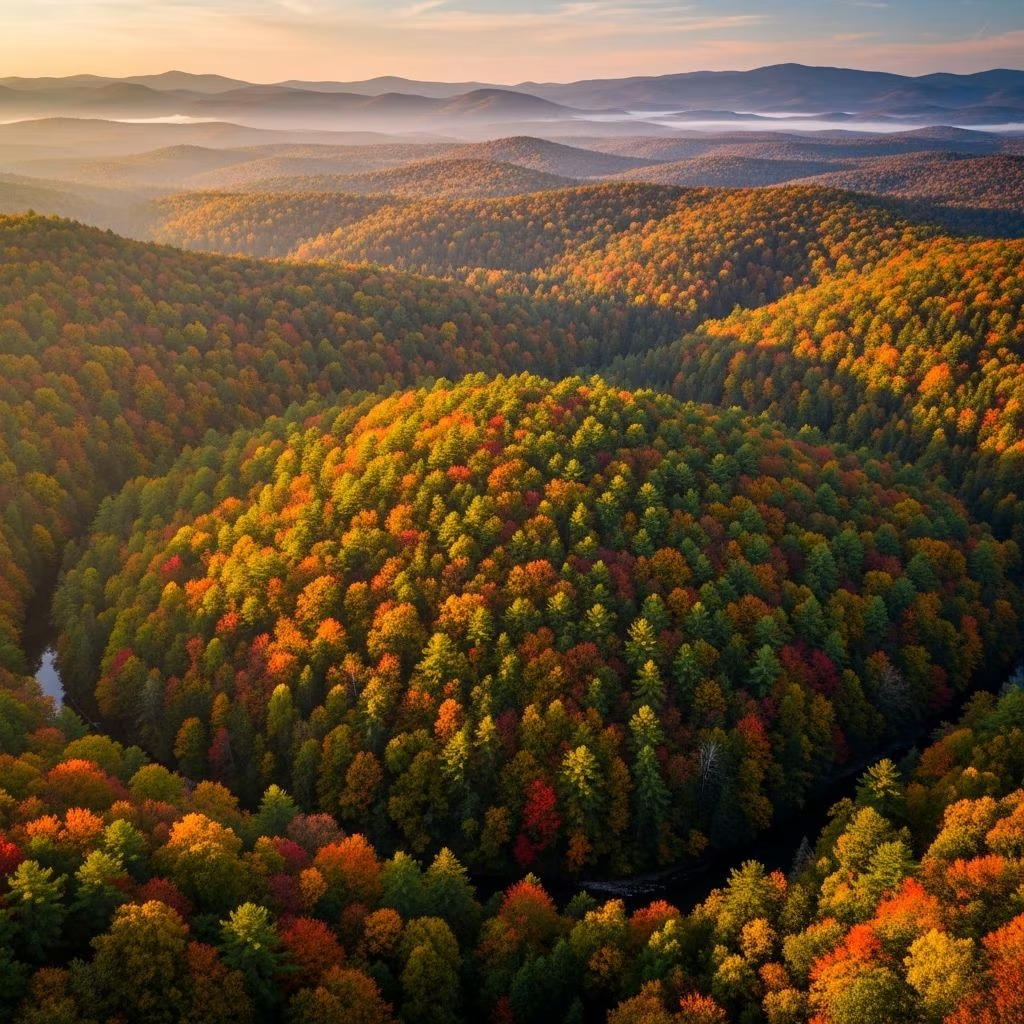
America’s landscapes burst with vitality where vast expanses of trees cloak entire regions, creating havens for recreation, wildlife, and ecological balance. These forested realms, particularly concentrated in the Northeast and South, represent some of the nation’s most pristine natural assets. Leading the pack, Maine stands out with approximately 89% of its land under forest cover, a testament to its enduring wilderness character. This article delves into the frontrunners, their unique attributes, outdoor pursuits, and the forces safeguarding these green expanses.
Forests cover about a third of the contiguous United States, playing pivotal roles in carbon sequestration, water purification, and biodiversity support. They provide habitats for diverse species, from black bears to songbirds, while offering humans spaces for reflection and adventure. Regional variations arise from climate, history, and land use: the Northeast’s deciduous stands contrast with southern pine-dominated woods. Data from recent assessments highlight how states like those in New England maintain high coverage despite population pressures, thanks to reforestation and protective policies.
Understanding forest density involves metrics like percentage of land forested and total acreage. For instance, while Alaska has immense boreal tracts, its percentage lags due to tundra expanses. Focus here centers on states exceeding 50% coverage, where woodlands define the terrain and lifestyle.
Recent compilations rank states by forest percentage, revealing a clear Northeast dominance. The table below summarizes the top 10 based on 2022-2026 data, including trees per capita for context on abundance relative to population.
| Rank | State | Forest Cover % (2022) | Trees per Capita (2025) |
|---|---|---|---|
| 1 | Maine | 89.06 | 3,292 |
| 2 | New Hampshire | 83.04 | 883 |
| 3 | West Virginia | 78.05 | 1,674 |
| 4 | Vermont | 76.47 | 1,803 |
| 5 | Alabama | 71.35 | 1,163 |
| 6 | South Carolina | 67.21 | 631 |
| 7 | Georgia | 66.93 | 584 |
| 8 | Mississippi | 64.53 | 1,663 |
| 9 | Virginia | 63.48 | 460 |
| 10 | New York | 62.62 | 243 |
This ranking underscores not just quantity but quality: Maine’s vast 17.7 million acres dwarf others in scale, while denser populations in states like New Hampshire amplify per-capita impact. Southern states contribute through expansive pine plantations vital for timber industries.
Nestled in the northeast, Maine embodies wilderness with nearly 90% forest saturation. Its 17.7 million acres encompass mixed woods of spruce, fir, maple, and birch, thriving in the cool, moist climate. This coverage supports a robust timber economy alongside tourism, drawing millions to its trails and coasts.
Adventure seekers revel in over 200 state parks and forests, including the famed Appalachian Trail segment. Baxter State Park alone spans 200,000 acres around Mount Katahdin, offering multiday hikes amid moose sightings. Kayaking through ancient cedar groves or foraging for wild blueberries adds layers to visits. Conservation via the Maine Forest Service ensures sustainable logging, preserving old-growth pockets.
Neighboring Maine, New Hampshire blankets 83% of its area in 4.8 million acres of forest, blending hardwoods and conifers. The White Mountain National Forest dominates, harboring black bears, moose, and bobcats amid Franconia Notch’s dramatic ridges.
Hiking the 160-mile state trail network peaks at Mount Washington, New England’s highest. Fall foliage transforms the landscape into a riot of reds and golds, boosting leaf-peeping tourism. Small towns like Lincoln serve as gateways, with zip lines and canopy tours enhancing access. State initiatives promote private woodland management, sustaining coverage amid development.
West Virginia’s 78% forest cover spans 12 million acres of rugged Appalachians, rich in oak-hickory forests. Six national forests, like Monongahela, feature waterfalls, rhododendron thickets, and the New River Gorge—now a national park.
The Appalachian Trail traverses 280 miles here, ideal for thru-hikers. Seneca Rocks offers world-class climbing, while rail-trails convert old railways into bike paths through tunnels and trestles. Biodiversity shines with over 100 tree species, supported by federal protections.
At 76% forested, Vermont’s 4.5 million acres glow with maples fueling its syrup industry. The Green Mountains host Long Trail, America’s oldest continuous footpath at 273 miles.
Autumn draws crowds to see peak foliage, tracked annually by state forecasts. Winter cross-country skiing weaves through snow-draped woods, while summer brings wildflower hikes in Tillotson State Forest. Low population density aids preservation, with land trusts acquiring thousands of acres yearly.
The Southeast rivals the Northeast with high coverage. Alabama’s 71% (over 21 million acres) features piney woods and bottomland hardwoods in Talladega National Forest. South Carolina (67%) and Georgia (67%) boast vast timberlands, with Chattahoochee-Oconee in Georgia offering trout streams.
Mississippi’s 65% includes Delta National Forest’s rare old-growth. These states balance industry and recreation via 20+ state parks each, with trails like the Natchez Trace Parkway linking history and nature.
These states excel in nature-based activities:
Accessibility improves with apps mapping trails and Leave No Trace principles guiding ethical use.
Sustaining these forests demands vigilance. Federal agencies like the U.S. Forest Service manage public lands, while states enforce logging regulations. Reforestation post-colonial clear-cutting rebuilt Northeast coverage from 20% to 80%+.
Challenges include invasive pests like emerald ash borer and climate shifts. Success stories: Maine’s Working Forest Credit Program incentivizes private stewardship. Community efforts, such as Vermont’s Current Use program, tax woodlands favorably.
| Region | Top States | Dominant Trees | Key Threats |
|---|---|---|---|
| Northeast | ME, NH, VT | Maple, Birch, Spruce | Development, Pests |
| Appalachia | WV, VA | Oak, Hickory | Mining, Acid Rain |
| South | AL, GA, MS | Pine, Cypress | Timber Harvest, Hurricanes |
Maine, at around 89%, leads consistently across datasets.
Yes, with extensive trails in national forests and state parks tailored for all levels.
Northeast coverage rebounded dramatically since the 19th century through natural regeneration.
Abundantly—dispersed sites, developed campgrounds, and backcountry options abound.
Bears, deer, raptors, and rare species like Carolina parakeets in southern woods.
