

 Travel Essentials
 Travel Essentials

Mount Everest tops Google searches among world's wonders, drawing millions with its towering height, climbing legacy, and cultural depth. Explore its allure, facts, and challenges.
 Travel Essentials
Mount Everest claims the title of the most Googled wonder of the world, with 1.4 million searches in January 2024 alone, dominating interest across nearly every U.S. state. This Himalayan giant, standing at 8,848 meters (29,032 feet), embodies human ambition and nature’s raw power, outpacing other iconic sites like the Aurora Borealis and ancient marvels.
Recent analyses of search data reveal Mount Everest’s unmatched popularity. A study by Rustic Pathways examined three years of Google trends for 14 natural and ancient wonders, crowning Everest as the clear leader. It topped searches in all but two states—Montana and Alaska, where the Northern Lights edged it out. This digital fascination mirrors Everest’s real-world draw, pulling climbers, trekkers, and dreamers from every corner.
Why the obsession? Everest represents the pinnacle of achievement. Its visibility in media, documentaries, and social shares amplifies its mystique, turning a remote peak into a household name. Searches spike around climbing seasons, anniversaries of historic ascents, and news of daring expeditions.
Straddling the Nepal-Tibet border in the Mahalangur Himal sub-range, Mount Everest rises as the highest point above sea level. Officially measured at 8,848.86 meters (29,031.7 feet) in 2020 by a joint China-Nepal survey, it edges out prior estimates.
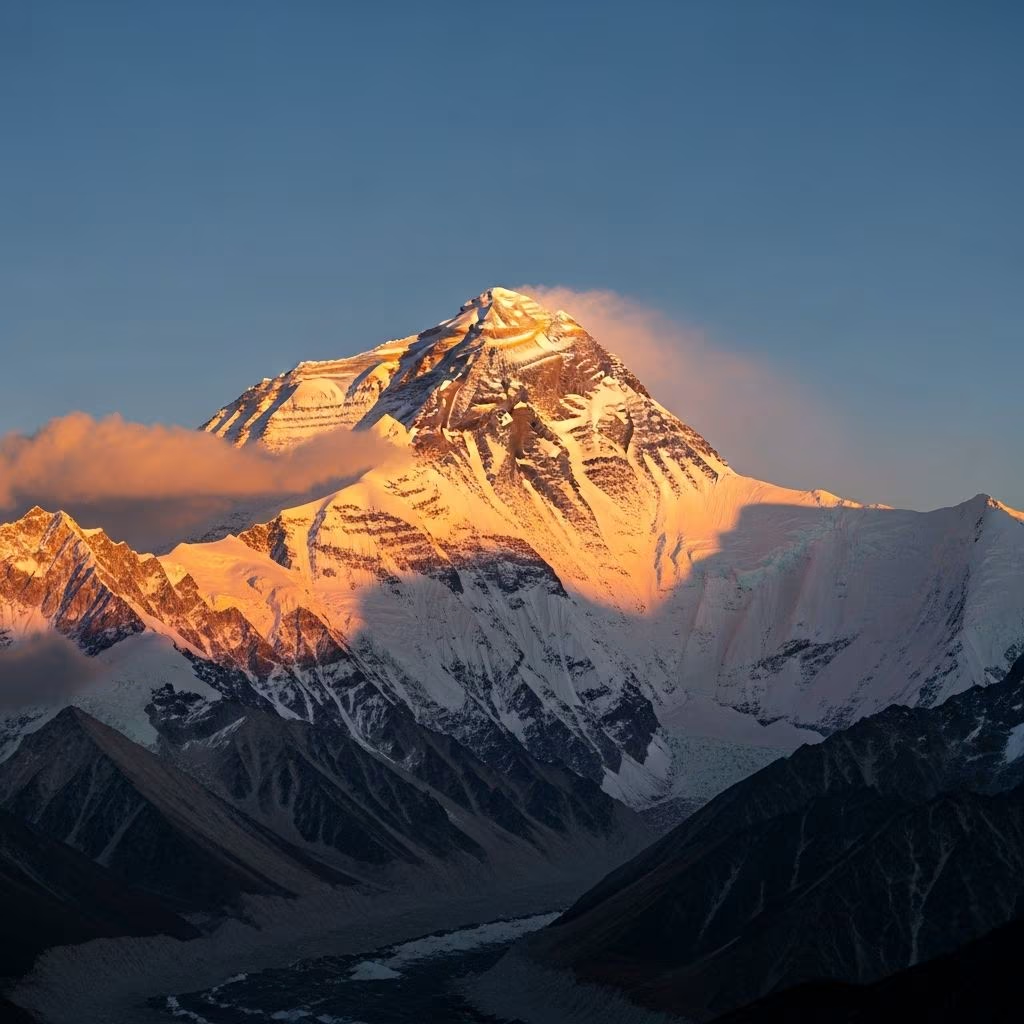
Formed by the Indian plate’s northward thrust under the Eurasian plate, Everest continues to grow about 4 mm annually due to tectonic forces. Its pyramid shape, flanked by Lhotse and Nuptse, creates dramatic profiles visible from afar, especially from Tibet’s Gawula Pass.
| Feature | Details |
|---|---|
| Height | 8,848 m (29,032 ft) |
| Location | Nepal-China border |
| Base Elevation | 4,200–5,200 m |
| Vertical Rise | 3,650–4,650 m |
| Annual Growth | ~4 mm |
Though not the tallest from base to summit—Mauna Kea holds that at over 10 km including its underwater portion—Everest’s above-sea supremacy is undisputed.
Beyond its Western moniker, Everest carries profound local names: Chomolungma (‘Goddess Mother of the World’) in Tibetan and Sagarmatha (‘Forehead in the Sky’) in Nepali. These reflect spiritual ties in Sherpa and Tibetan lore, where the mountain is a deity demanding respect.
Named in 1865 by the Royal Geographical Society after surveyor Sir George Everest, the peak honors colonial mapping efforts. Yet, indigenous names persist, underscoring cultural layers that enrich its story.
Sir Edmund Hillary and Tenzing Norgay’s 1953 summit marked the first verified ascent, igniting global mountaineering fever. Over 9,000 summits by more than 5,000 climbers have followed, aided by Sherpa expertise.
Deadly zones above 8,000 meters test limits, with oxygen scarcity and avalanches claiming lives. Crowding during peak seasons raises safety concerns, prompting permit limits.
Everest earns its wonder status through unparalleled traits:
As Asia’s ambassador for natural wonders, it symbolizes endurance.
Ascending Everest requires months of training: cardio endurance, strength, altitude acclimatization via lower peaks like Island Peak. Costs range $30,000–$100,000, covering guides, oxygen, permits.
Trekking to Base Camp (5,364 m) suits non-climbers, a 12-day journey revealing Everest’s base.
Tourism strains Everest: waste, melting ice from climate change, overcrowding. Initiatives include cleanup drives by climbers and Nepal’s ‘Everest Without Trash’ policy. Sagarmatha National Park enforces eco-rules, promoting leave-no-trace ethics.
Glaciers retreat, threatening water for millions downstream, urging sustainable practices.
Trek vs. Climb: Base Camp trek: moderate fitness, 2 weeks. Full summit: elite athletes, 2 months.
| Option | Duration | Difficulty | Cost |
|---|---|---|---|
| Base Camp Trek | 12-14 days | Moderate | $1,500–$3,000 |
| Summit Climb | 6-8 weeks | Extreme | $40,000+ |
| Flightseeing | 1 day | Easy | $200–$500 |
Best via Kathmandu, Lukla flights. Respect weather, altitude sickness risks.
8,848.86 meters (29,031.7 feet), per 2020 survey.
Edmund Hillary and Tenzing Norgay, May 29, 1953.
Yes, ~4 mm/year from plate tectonics.
Yes, from Tibet’s Gawula Pass or Nepal viewpoints.
High; ~1 in 10 summiteers face serious issues, death rate ~1%.
Nepal: $11,000 for groups; individual climbers restricted.
From digital searches to life-altering quests, Mount Everest stirs the soul. Its blend of peril, beauty, and legacy ensures it remains the world’s premier natural wonder, challenging us to reach higher.
