

 Travel Essentials
 Travel Essentials

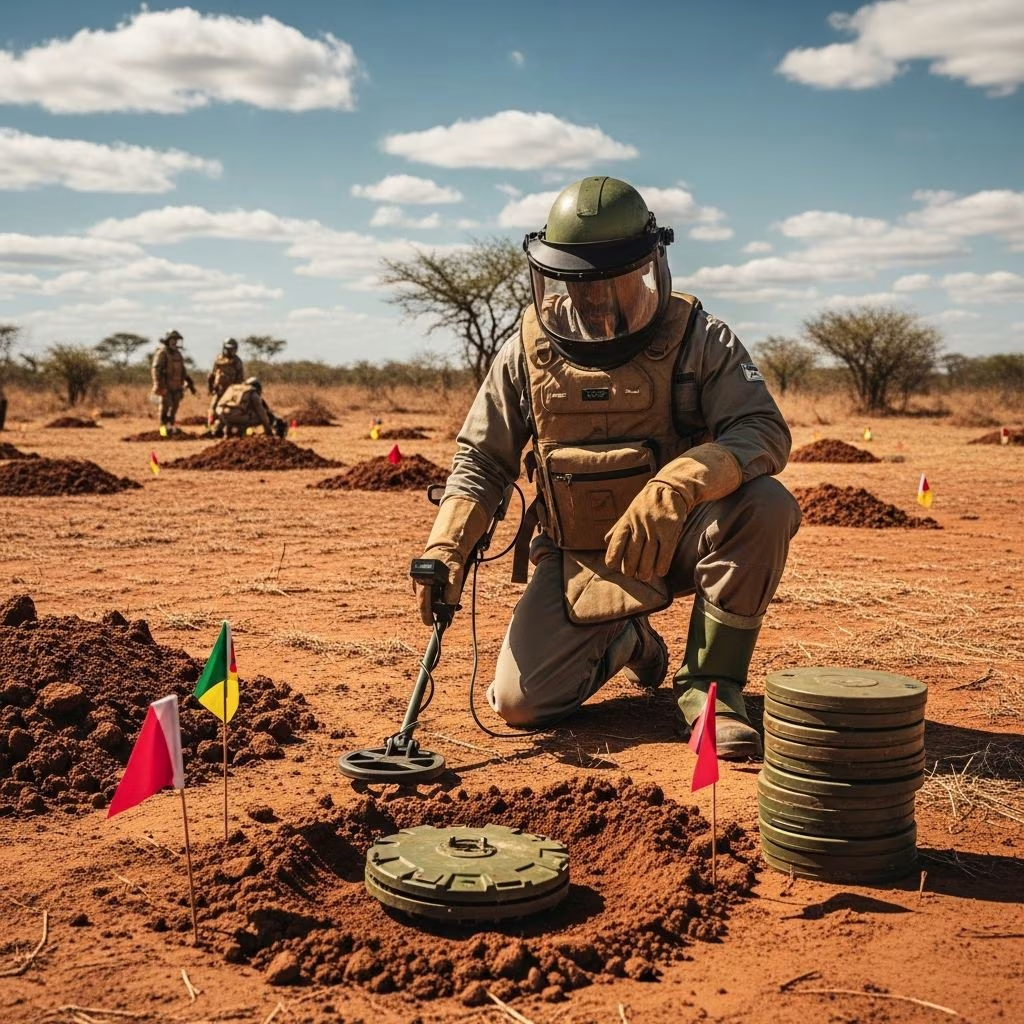
Mozambique was declared landmine-free in 2015 after two decades of intensive demining operations, marking a historic achievement in post-conflict recovery and enabling economic development.
 Travel Essentials
Mozambique’s declaration as a landmine-free nation represents one of Africa’s most significant humanitarian achievements in post-conflict reconstruction. In 2015, Foreign Minister Oldemiro Julio Marques Baloi announced at a public event in Maputo that Mozambique had successfully eliminated all known landmines from its territory. This milestone culminated 22 years of intensive demining operations and marked a transformative moment for a country devastated by decades of civil conflict.
Mozambique’s struggle with landmines stems from its prolonged civil war, which ended in 1992. During the conflict, both government forces and opposition groups deployed vast quantities of anti-personnel mines across the nation’s landscape. These weapons, indiscriminately placed in civilian areas, became a persistent threat long after the guns fell silent. By the time peace agreements were finalized, mines had already claimed over 10,000 victims and continued to cause casualties throughout the 1990s.
The geographic distribution of these mines created multiple challenges for demining operations. Mines were embedded in agricultural fields, along transportation corridors, near settlements, and in remote rural regions. Rural communities bore a disproportionate burden of casualties, as everyday activities like farming or traveling to markets exposed civilians to hidden ordnance. This reality shaped the subsequent approach to demining, emphasizing both infrastructure rehabilitation and protection of vulnerable populations.
Recognition of Mozambique’s mine problem prompted international intervention. In January 1993, the United Nations assumed responsibility for overseeing a national mine clearance plan. However, initial progress proved disappointing. The plan faced delays in gaining approval from both the Mozambique government and the opposition RENAMO party, with formal endorsement not occurring until November 24, 1993.
Early demining projects operated on a limited scale. By late 1993, only two significant mine clearance operations were underway: a pilot project clearing roads in central Mozambique launched in January 1993, and clearance efforts in Tete province that began in September 1993. These modest beginnings reflected the enormous scope of the challenge and the need to develop appropriate infrastructure and training systems.
International actors contributed specialized expertise to support Mozambique’s demining efforts. The New Zealand Defence Force deployed military mine clearance specialists to assist with operations. Between initial deployment in February 1995 and the conclusion of major clearance activities, 36 NZDF personnel rotated through Mozambique over 11 years, providing training and operational support. This international collaboration proved essential for transferring technical knowledge and accelerating clearance capabilities.
The HALO Trust, an international humanitarian demining organization, emerged as the principal entity driving Mozambique’s mine clearance from 1993 through 2015. This 22-year commitment demonstrated the patience and resources required for comprehensive landmine elimination. HALO’s operations encompassed vast territories across the nation, employing both manual and mechanical clearance methods adapted to Mozambique’s diverse terrain.
The scale of HALO’s achievements proved extraordinary. Throughout its operational period, the organization cleared approximately 17.6 million square meters of contaminated land, transforming dangerous territory into spaces safe for human habitation and economic activity. This immense undertaking required sustained funding, trained personnel, and sophisticated equipment deployed across the country’s varied ecosystems.
The human impact of cleared land extended far beyond mere statistics. HALO estimates that approximately 1.26 million local people directly benefited from the safe territory returned through demining operations. These individuals reclaimed access to agricultural land, grazing areas, transportation routes, and community spaces previously rendered unusable by mine threats. For rural populations particularly, this restoration of land access meant renewed economic opportunity and reduced daily risk.
Landmine clearance delivered substantial economic benefits to Mozambique. Research examining the relationship between demining and economic growth estimates that without demining efforts, Mozambique’s GDP per capita in 2015 would have been approximately 18-25% lower than its actual levels. This projection reveals the profound economic drag that mines imposed on development, constraining agricultural productivity, limiting infrastructure investment, and restricting population movement.
Specific infrastructure projects catalyzed by demining exemplified these economic gains. The Limpopo railway corridor, a vital economic artery connecting Mozambique to regional markets, required intensive demining operations to restore functionality. This strategic transportation route, once cleared of mines, enabled increased trade flows and commercial activity that supported broader national development. Such corridor clearance projects yielded multiplier effects throughout the economy by reopening supply chains and facilitating commerce.
Agricultural rehabilitation represented another critical economic dimension. Rural communities regained access to farming land that had been abandoned due to mine contamination. As cleared areas expanded, agricultural production increased, supporting both domestic food security and export-oriented crops that generated foreign exchange. The restoration of rural livelihoods through land access constituted perhaps the most direct and profound economic benefit for the majority of Mozambique’s population.
Mozambique’s demining journey encountered significant obstacles that complicated and prolonged the clearance process. The initial UN-designed clearance plan faced criticism from humanitarian organizations regarding its strategic priorities. Human Rights Watch assessment noted that the plan overemphasized clearing major roads while potentially underweighting rural areas that generated the greatest number of civilian mine casualties. This tension between clearing economically important infrastructure and addressing humanitarian needs in remote regions persisted throughout the demining campaign.
International coordination challenges also impeded progress. The requirement to obtain approval from both the government and opposition RENAMO party delayed plan implementation and subsequent operations. Political considerations sometimes influenced demining priorities in ways that reflected political rather than humanitarian logic. These coordination difficulties reflected Mozambique’s fragile post-conflict political environment and the need to maintain consensus among previously warring parties regarding national reconstruction efforts.
Human and material resource constraints further complicated operations. Early demining initiatives produced modest results, with substantial time required to recruit, train, and deploy adequate personnel. Building a demining workforce capable of operating sophisticated equipment across difficult terrain required sustained investment in training infrastructure and institutional development. These foundational activities, though essential, extended timelines before visible progress in actual mine clearance occurred.
Humanitarian organizations operating in Mozambique consistently characterized landmines as indiscriminate weapons that violated international norms. Human Rights Watch concluded that landmines deployed during Mozambique’s conflict were placed in flagrant disregard for the Protocol on Prohibitions or Restrictions on the Use of Mines, Booby-Traps and Other Devices, an international agreement intended to limit civilian harm. This observation highlighted how the Landmines Protocol proved inadequate in preventing mine use during internal conflicts.
The inadequacy of existing international restrictions prompted advocacy for comprehensive prohibition. Human Rights Watch called for a complete global ban on anti-personnel mine production, stockpiling, trading, and use as the only adequate response to the human suffering demonstrated by Mozambique’s experience. This advocacy contributed to broader international efforts that resulted in the Ottawa Treaty of 1997, which established a comprehensive ban on anti-personnel mines that many nations subsequently ratified.
Mozambique’s transition extended beyond simple mine removal. Following the 2015 declaration of landmine-free status, new security challenges emerged related to weapons and ammunition management. In 2022, HALO Trust returned to Mozambique to initiate projects addressing illicit weapons and ammunition stockpiles. This subsequent phase reflected recognition that post-conflict stability requires addressing the broader spectrum of weapons availability, not solely historical mines.
Mine clearance enabled ambitious infrastructure projects that transformed Mozambique’s development landscape. The rehabilitation of critical transportation networks, including roads and railways, depended upon demining operations that restored these corridors to functionality. Such infrastructure development expanded trade opportunities, facilitated internal migration and commerce, and integrated previously isolated regions into the national economy. These physical transformations expressed the tangible benefits of demining through improved connectivity and enhanced economic opportunity.
Mozambique was officially declared free of all known landmines on September 23, 2015, when Foreign Minister Oldemiro Julio Marques Baloi made the announcement in Maputo.
The primary demining campaign lasted 22 years, from 1993 to 2015, conducted largely under the leadership of HALO Trust.
Approximately 17.6 million square meters of contaminated land were cleared, benefiting roughly 1.26 million local people.
Research indicates that without demining, Mozambique’s GDP per capita in 2015 would have been 18-25% lower, demonstrating the substantial economic benefits of mine clearance.
Yes, the HALO Trust led primary operations, while New Zealand Defence Force personnel provided specialized training and expertise over an 11-year period.
Yes, HALO Trust returned to Mozambique in 2022 to address weapons and ammunition management challenges.
