

 Travel Essentials
 Travel Essentials

Explore Mumbai's diverse architectural heritage spanning from ancient Buddhist caves to contemporary skyscrapers, including its world-renowned Art Deco treasures.
 Travel Essentials
Mumbai stands as a living museum of architectural ambition, where centuries of human creativity have layered themselves upon the landscape to create a uniquely captivating urban environment. Unlike many cities that developed around a single architectural philosophy, Mumbai represents a palimpsest of design movements, each reflecting the aspirations and circumstances of its era. From the earliest meditation chambers carved into rock faces to the gleaming glass towers that pierce the contemporary skyline, the city’s buildings tell the story of transformation, cultural exchange, and India’s evolving place in the world.
Long before colonial powers established their trading posts, Mumbai—then known by various regional names—hosted communities whose architectural achievements reflected spiritual devotion and technical mastery. The earliest significant structures date to the first century BC, when Buddhist monks undertook the painstaking work of hollowing meditation caves into the rocky outcrops that characterize the region’s geology. These caves represent more than mere shelters; they embody a sophisticated understanding of acoustics, natural ventilation, and the relationship between built form and contemplative space.
These ancient Buddhist sanctuaries were followed by the construction of Hindu temples during the fifth century, which further enriched the city’s architectural vocabulary. These early religious structures established patterns of craftsmanship and spatial organization that would influence subsequent generations of builders. The temple builders of this period demonstrated remarkable engineering capabilities, creating structures that have endured for over fifteen centuries despite the challenging tropical climate and seismic activity that characterizes the region.
The arrival of Portuguese traders in the sixteenth century marked the beginning of sustained European influence on Mumbai’s physical form. However, it was the British establishment of a formal trading presence in 1661—when Bombay was granted to Britain as part of a Portuguese dowry—that fundamentally transformed the city’s architectural trajectory. What began as a modest commercial depot quickly evolved into a strategic military and administrative center, with the construction of Fort George serving as the original nucleus of colonial development.
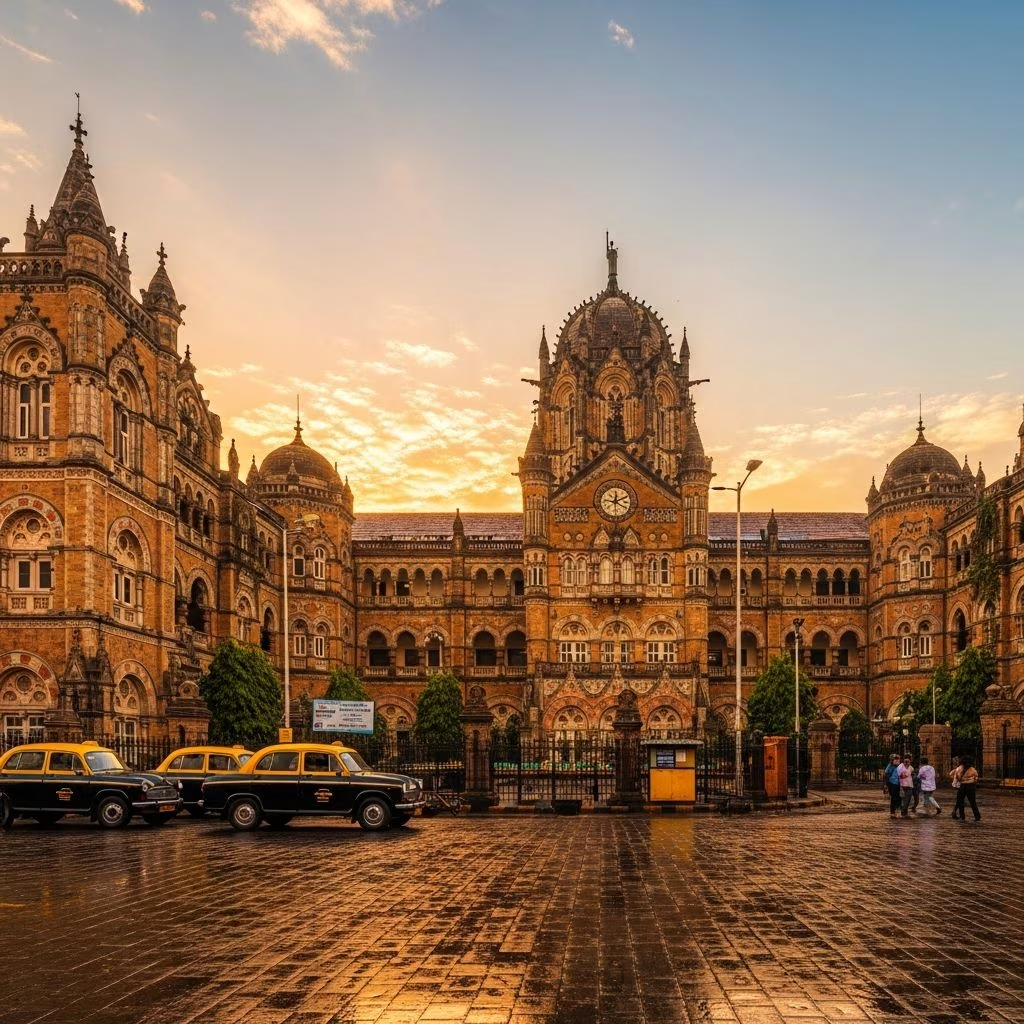
The architectural styles imported by British administrators initially drew from the Neoclassical vocabulary that dominated European design in the eighteenth century. However, as the nineteenth century progressed, Victorian Gothic emerged as the dominant aesthetic framework for civic and institutional buildings. This architectural movement, characterized by pointed arches, intricate stonework, and soaring vertical emphasis, found particular favor among colonial architects designing universities, government offices, and cultural institutions.
The Victorian Gothic style, as adapted to Mumbai’s tropical context, developed distinctive characteristics. Local architects and builders worked to integrate traditional Indian design elements with European formal languages, creating what observers have termed “Mumbai Gothic.” This hybrid approach reflected both practical considerations—such as the need for deep verandahs to provide shade—and the complex cultural negotiations inherent in colonial societies. Prominent examples of this period include the Chhatrapati Shivaji Maharaj Terminus, the Rajabai Tower, and the structures comprising the University of Mumbai’s Fort campus.
As colonial administration consolidated its control, architects and administrators sought aesthetic frameworks that could accommodate both European and Indian design traditions. The Indo-Saracenic style emerged during the latter half of the nineteenth century as a deliberate attempt to create architectural expressions that honored India’s Islamic and Hindu heritage while maintaining the formal monumentality valued by colonial authorities.
This distinctive style incorporated characteristic features including elaborate domes, extensive arched openings, decorative spires, stained glass windows, and detailed minarets. The exteriors showcased these traditionally Indian forms while interiors frequently displayed Victorian furnishings and organizational principles. The Gateway of India and the Chhatrapati Shivaji Maharaj Vastu Sangrahalaya represent the finest achievements of this approach, combining technical virtuosity with cultural synthesis.
The Indo-Saracenic movement represented a significant moment in architectural thinking, demonstrating that design could be a medium for negotiating cultural complexity rather than simply asserting dominance. These buildings acknowledged that impressive architecture could emerge from the integration of multiple traditions, though always within frameworks established by colonial authority.
The 1920s witnessed a dramatic shift in Mumbai’s architectural identity. Following the international success of the 1925 Exposition Internationale des Arts Décoratifs et Industriels Modernes in Paris, Art Deco rapidly became the style of choice for ambitious developers and forward-thinking citizens. Mumbai emerged as one of the world’s premier destinations for Art Deco architecture, developing a collection surpassed globally only by Miami.
This aesthetic revolution reflected profound transformations in Mumbai society. Wealthy industrialists and international merchants envisioned a modern India that would reclaim its historical position as a global center for innovation and commerce. The vast expansion of the city northward, built on reclaimed land and newly developed neighborhoods, provided space for experimental architectural ambitions. Developers and architects embraced Art Deco’s celebration of technology, progress, and modernity as the perfect expression of their aspirations.
The decorative vocabulary of Art Deco manifested throughout these buildings in remarkably comprehensive ways. Details extended far beyond surface ornamentation to encompass lighting fixtures, flooring materials, wooden wall treatments, elevator mechanisms, railings, glazed screens, weather shades, architectural trim, cornices, verandah structures, and metalwork. Etched glass windows, ornamental sculptures, and inscriptions rendered in monumental lettering created facades of remarkable visual sophistication. The stepped-back silhouettes characteristic of the style provided practical benefits in the tropical environment while creating striking visual impressions.
Among the most distinctive achievements of Mumbai’s Art Deco period were the spectacular cinema halls constructed during the 1920s and 1930s. These buildings represented far more than simple entertainment venues; they functioned as temples to the emerging Bollywood film industry and as gathering places for an increasingly cosmopolitan urban society. The grandeur of these structures reflected cinema’s cultural significance and the wealth flowing into the film industry.
Architects designing cinema halls drew inspiration from technological imagery and the science fiction narratives that captivated contemporary audiences. Publications such as Amazing Stories and Flash Gordon provided visual reference points, with their depictions of future cities and advanced technologies influencing decorative schemes and spatial organization. The cinema halls thus became physical manifestations of modernist imagination, spaces where audiences could experience both the technological marvels depicted on screen and the architectural modernity surrounding them.
The residential neighborhoods that expanded northward from Fort and Colaba transformed Mumbai into a city of distinctive apartment buildings, each competing for attention through innovative design. These structures housed the expanding class of merchants, professionals, and cultural figures who constituted Mumbai’s elite. The apartments became settings for the sophisticated social life of post-independence Mumbai, hosting gatherings that brought together film industry figures, politicians, financiers, writers, artists, and members of India’s royal families.
The Jehangir Art Gallery at Kala Ghoda, constructed in 1952 in the Art Deco style, exemplified the continued vitality of modernist architecture even after Indian independence. This institution and others like it reflected the confidence and ambition of a newly independent nation determined to establish itself as a center of artistic and intellectual activity.
Following independence in 1947, Mumbai’s architectural development continued to reflect the city’s aspirations and economic dynamism. While Art Deco gradually gave way to International Style modernism and later architectural movements, the city maintained its role as India’s laboratory for experimental urban design. Contemporary Mumbai showcases the world’s sixth-largest collection of skyscrapers, with gleaming glass and steel towers rising from neighborhoods such as Worli and Tardeo.
This contemporary development presents both opportunities and challenges. The modern structures represent economic advancement and technological capability, yet they often stand in stark contrast to the older neighborhoods and heritage buildings that remain from previous eras. The relationship between preservation and development has become increasingly complex as the city confronts questions about which structures merit conservation and how to accommodate continued urban growth while maintaining connection to architectural heritage.
| Architectural Period | Time Frame | Characteristic Features | Notable Examples |
|---|---|---|---|
| Buddhist & Hindu | 1st-5th centuries | Carved caves, temple structures, spiritual spaces | Ancient meditation chambers, early temples |
| Colonial Neoclassical | 18th century | Symmetrical forms, classical proportions | Early administrative buildings |
| Victorian Gothic | 19th century | Pointed arches, ornate stonework, vertical emphasis | Rajabai Tower, CST, University of Mumbai |
| Indo-Saracenic | Mid-late 19th century | Domes, arches, spires, hybrid design | Gateway of India, Vastu Sangrahalaya |
| Art Deco | 1920s-1940s | Geometric patterns, stepped forms, technology themes | Cinema halls, residential towers, Jehangir Gallery |
| International Modern | 1950s onwards | Glass and steel, functional design | Contemporary office towers, residential complexes |
Mumbai’s architectural legacy faces significant pressures from continued urban expansion, climate challenges, and the competing demands of preservation and development. The city’s older structures, particularly those from the colonial and Art Deco periods, require substantial investment in maintenance and restoration. Tropical climate conditions, including high humidity, salt air from proximity to the Arabian Sea, and intense monsoon rains, accelerate deterioration of building materials and decorative elements.
Professional conservators and heritage organizations work to document, protect, and restore significant structures. This work involves technical expertise in understanding original materials and construction techniques, as well as navigating complex regulatory environments and funding constraints. Successful preservation efforts require balancing the authenticity of restoration with the need for modern building systems and accessibility requirements.
Mumbai’s Art Deco prominence resulted from several convergent factors: the 1925 Paris Exposition’s international influence, the city’s rapid northward expansion on reclaimed land providing abundant development opportunities, substantial wealth from industrial and commercial enterprises seeking modern architectural expression, and the cultural momentum generated by the emerging film industry. The style’s emphasis on modernity and technological progress aligned perfectly with how Mumbai’s elite envisioned their city’s future.
Mumbai’s Victorian Gothic adapted European architectural traditions to tropical conditions and incorporated Indian design sensibilities. Deep verandahs, specialized ventilation strategies, and integrated decorative elements from traditional Indian architecture created a hybrid aesthetic. This approach acknowledged both the formal requirements of colonial administration and the practical wisdom of local building traditions.
Conservation efforts involve documentation, professional restoration, regulatory protection through heritage designations, and funding from government agencies and private foundations. Organizations dedicated to heritage preservation work with property owners, architects, and communities to maintain significant structures while allowing functional adaptation to contemporary needs.
The Victorian Gothic and Art Deco periods have most profoundly shaped Mumbai’s distinctive urban character. Victorian Gothic established the formal institutional and civic framework that remains visible throughout the city, while Art Deco created the extensive residential neighborhoods and commercial structures that comprise much of central Mumbai. Together, these periods define the architectural identity most visitors and residents associate with the city.
Mumbai’s architectural story remains incomplete, as the city continues to evolve and transform. Each new generation of builders and designers responds to contemporary needs, technological possibilities, and cultural aspirations. Understanding this ongoing evolution provides perspective on how cities function as dynamic expressions of human creativity and ambition, rather than static monuments to past achievements.
The layers of architectural history visible throughout Mumbai—from ancient Buddhist caves through colonial grandeur to modernist towers—create a uniquely complex urban environment. This complexity reflects the city’s role as a meeting point of cultures, a center of commerce and creativity, and a place where multiple visions of progress and modernity have found physical expression. For anyone seeking to understand contemporary India, Mumbai’s buildings provide an essential text, written in stone, steel, and glass.
