

 Travel Essentials
 Travel Essentials

Discover Paris's Resistance museums showcasing WWII history, underground bunkers, and the stories of those who fought Nazi occupation.
 Travel Essentials
The city of Paris holds within its walls profound repositories of memory, institutions dedicated to preserving the stories of ordinary citizens who became extraordinary defenders of freedom. These museums serve as temporal bridges, connecting contemporary visitors to one of Europe’s most turbulent chapters. Walking through their galleries, one encounters not merely objects behind glass, but the echoes of courage, sacrifice, and unwavering determination that shaped modern France.
Located at Place Denfert-Rochereau in the 14th arrondissement, a comprehensive museum complex honors three interconnected narratives: the leadership of General Philippe Leclerc, the symbolic legacy of Jean Moulin, and the triumphant moment when Paris regained its freedom. The institution that now occupies this prime location represents a convergence of historical scholarship, curatorial excellence, and architectural restoration worth approximately twenty million euros.
This museum evolved through careful reconsideration of how best to present such weighty historical material. Originally housed above the Montparnasse train station, the institution found new life when city planners recognized that historical narrative deserved equally historic surroundings. The 2019 relocation transformed visitor experience, positioning the museum within walking distance of monuments that themselves witnessed the events being chronicled.
The institution remains accessible to all visitors free of charge, opening Tuesday through Sunday from 10 am to 6 pm. This commitment to open access reflects a democratic principle fundamental to the Resistance movement itself—that such stories belong to everyone, not merely those with means to attend.
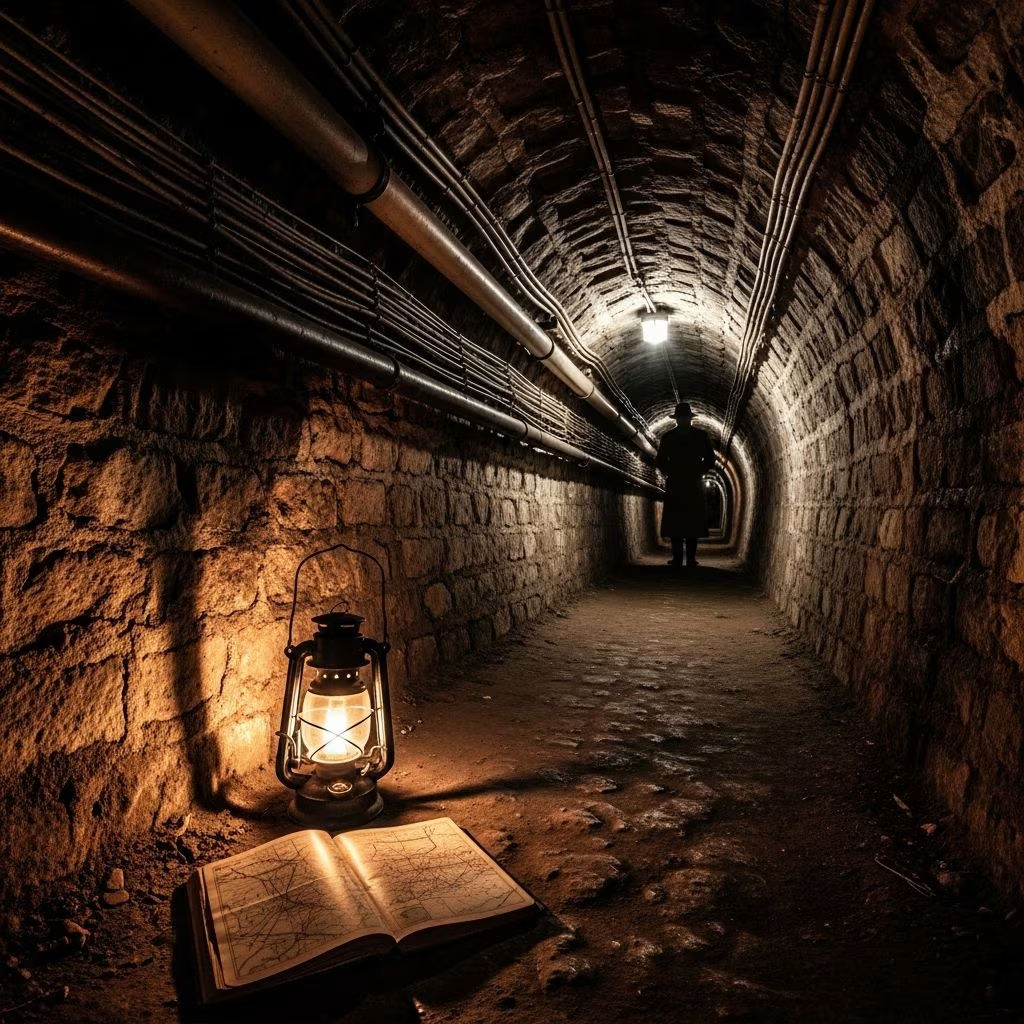
Perhaps the most extraordinary feature distinguishing this museum from conventional historical institutions is its preservation of an intact air raid shelter that served as the nerve center for Paris’s liberation during August 1944. This underground space operated as the command headquarters for Colonel Henri Rol-Tanguy, who directed the Forces Françaises de l’Intérieur—the umbrella organization encompassing various Resistance factions operating throughout the Paris region.
Visitors who descend more than one hundred steps reach rooms frozen in time, their walls bearing witness to frantic planning and critical decisions made while Nazi forces still occupied the city above. The shelter remains available for exploration at no additional charge, though its physical demands require visitors to consider accessibility limitations. Within this underground sanctuary, museum curators have implemented groundbreaking technology that allows visitors to experience mixed reality reconstructions of those final weeks preceding liberation, allowing immersive visualization of historical events within their original physical context.
The museum’s organizational structure guides visitors through a carefully sequenced historical progression. Beginning with establishing the broader context of World War II within European and global frameworks, the exhibition then traces the specific arc from June 1940—when German forces overwhelmed French defenses and established four years of occupation—through August 1944, when liberation finally arrived.
This chronological approach proves pedagogically sound, allowing visitors to understand how ordinary circumstances gradually transformed into extraordinary circumstances. The exhibition illuminates the choices confronting French leadership: the armistice negotiated by Marshal Pétain that led to collaboration, contrasted with Charles de Gaulle’s defiant declaration that France would continue fighting. Rather than presenting simplistic moral binaries, the museum examines how intelligent people made divergent decisions based on their assessments of survival, honor, and national interest.
Walking through the galleries reveals hundreds of artifacts accumulated through meticulous research and generous donations. Forged identification papers speak to the ingenuity required to maintain clandestine operations; weapons demonstrate the military dimensions of underground struggle; uniforms, posters, and newspapers capture the daily reality of occupation and resistance.
Yet perhaps most moving are the audiovisual testimonies of those who actually lived these experiences. Survivor videos allow visitors to hear direct accounts from Resistance fighters recounting their motivations, methods, dangers encountered, and the psychological toll of operating perpetually under threat of capture, deportation, and execution. These personal narratives transform historical abstractions into concrete human experience.
The museum’s dual dedication to Jean Moulin and General Philippe Leclerc reflects deliberate curatorial choices acknowledging different dimensions of French resistance. Jean Moulin emerged as the paramount symbol of internal Resistance networks—a figure whose name became synonymous with principled opposition to Nazi occupation despite lacking the military rank or resources available to external Free French forces. His assassination by Nazi-collaborating authorities transformed him into a martyr embodying intellectual and moral defiance.
Conversely, General Leclerc represented the military expression of French determination, commanding armored divisions that raced toward Paris during the final European campaign, ultimately arriving to liberate the capital on August 25, 1944. Together, these two figures encapsulate the museum’s central thesis: that French liberation emerged through combined efforts of underground civilian networks and external military organizations, each essential to ultimate victory.
The final exhibition rooms address the culminating moment when years of underground planning transformed into open insurrection. Beginning August 18, 1944, as Allied armies approached the capital, Parisian Resistance members occupied the police headquarters and the Hôtel de Ville, erecting barricades throughout the city’s streets. These exhibitions feature photographs, films, documents, and artifacts evoking the day-by-day intensity of this struggle, the Nazi retaliation against civilian combatants, and the moment when American and French armored divisions entered the city.
Documentary films, including newsreel footage from the 4th Infantry Division and 2nd Armored Division, provide visual record of those liberation days. These moving images capture the spontaneous joy of Parisian citizens greeting liberating forces, the transformation of a city from occupation to freedom, and the visible emotion etched upon faces no longer compelled to live under tyranny.
Paris maintains additional resources for those seeking comprehensive understanding of Resistance history. The Museum of the Order of the Liberation, located within the prestigious Hôtel National des Invalides military complex, tells the story of Free France from 1940 through 1945, documenting the Companions of the Liberation and the interior Resistance movements. This complementary institution provides historical depth while maintaining accessible admission through Musée de l’Armée tickets.
Beyond Paris proper, a network of eighteen museums across France extends from Champigny-sur-Marne to Nice, each preserving regional aspects of Resistance activity. The Musée de la Résistance Nationale in Champigny-sur-Marne houses extensive collections spanning one thousand square meters across three floors, including historical artifacts donated by former Resistance fighters, their families, and remembrance organizations, alongside an extensive photographic archive. Notably, this institution preserves the original manuscript of Paul Eluard’s poem “Liberté,” composed in 1942, which has become an enduring literary monument to Resistance ideals.
Prospective visitors should allocate minimum two hours for thorough exploration of the primary museum, though deeper investigation merits additional time. The institution provides comprehensive English-language explanations throughout, ensuring accessibility for international audiences. Elevators serve the main museum spaces, though the underground bunker requires navigating steps, presenting physical considerations for those with mobility constraints.
The museum’s commitment to free admission eliminates financial barriers to historical education, democratizing access to these vital narratives. Its convenient Paris location near major transportation hubs facilitates inclusion within broader sightseeing itineraries, though dedicated history enthusiasts will find sufficient depth for extended visits.
Q: What makes the underground bunker particularly significant?
A: The preserved air raid shelter functioned as the actual command headquarters where Colonel Rol-Tanguy coordinated Parisian liberation operations during August 1944. Visitors can experience this authentic historical space enhanced through mixed reality technology, creating immersive understanding of strategic decisions made within these walls.
Q: How does the museum balance military and civilian narratives?
A: Through its dual dedication to Jean Moulin (representing internal civilian Resistance networks) and General Leclerc (representing external military Free French forces), the museum acknowledges that liberation emerged through complementary military and underground efforts rather than singular heroic narratives.
Q: Are there accessibility accommodations for visitors with physical limitations?
A: The main museum includes elevators for vertical circulation. However, the underground bunker requires descending and ascending over one hundred steps, presenting constraints for those with mobility challenges.
Q: What languages are exhibitions presented in?
A: The museum provides comprehensive English-language explanations throughout exhibits, ensuring accessibility for international visitors.
Q: How long should visitors allocate for their museum experience?
A: A thorough visit merits minimum two hours; those particularly interested in World War II history should plan three to four hours for comprehensive engagement with all materials.
These museums transcend conventional historical presentation, functioning instead as temporal repositories preserving not merely objects but the values, struggles, and human dimensions of those who resisted tyranny. They remind contemporary visitors that freedom requires vigilance, that ordinary individuals possess capacity for extraordinary courage, and that historical understanding remains essential for comprehending modern Europe.
The decision to relocate the museum to historically significant surroundings, to preserve the underground bunker in its original state, and to integrate cutting-edge technology with traditional curatorial practices demonstrates commitment to honoring past experience while engaging contemporary audiences. These institutions transform Paris itself into a classroom where the city’s own walls bear witness to narratives being presented within.
