

 Travel Essentials
 Travel Essentials

Explore Nanjing's iconic City Wall, built by Emperor Hongwu, featuring unique design, 13 gates, and panoramic views. Learn its history, visit tips, and why it's China's best-preserved fortification.
 Travel Essentials
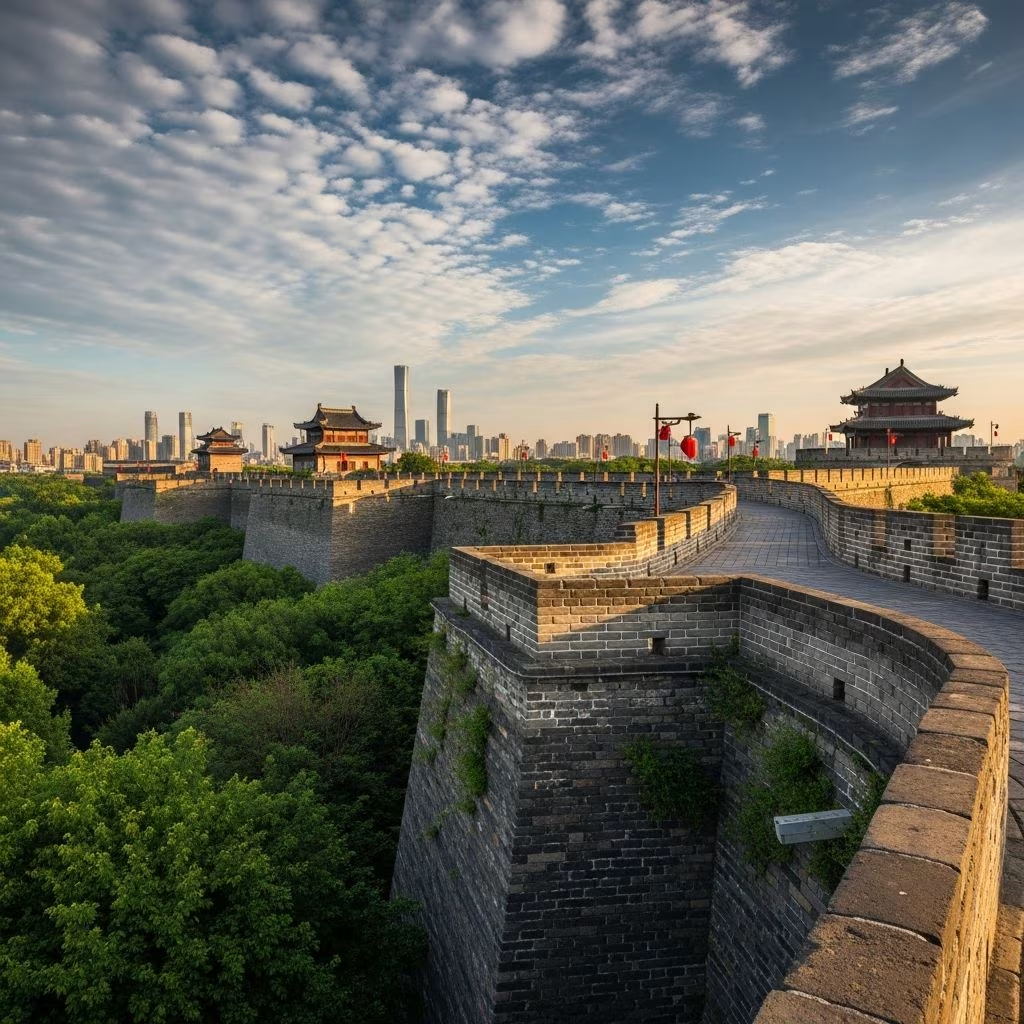
The Nanjing City Wall stands as one of China’s most impressive ancient fortifications, encircling the historic city with a perimeter originally spanning over 33 kilometers. Constructed primarily during the Ming Dynasty from 1366 to 1393, this monumental structure exemplifies advanced military engineering tailored to the local terrain of mountains, rivers, and plains.
In 1366, Zhu Yuanzhang, founder of the Ming Dynasty and later known as the Hongwu Emperor, initiated the construction of the Nanjing City Wall to secure his new capital. After declaring Nanjing the capital in 1368, he sought to protect against threats like coastal pirates and rival forces. Advisor Zhu Sheng recommended expanding existing defenses, incorporating strategic hills like Lion Hill, and building food reserves, which doubled the enclosed area.
The project mobilized resources from 118 counties across 20 states in five provinces, producing billions of specially marked bricks. Each brick bore inscriptions noting its origin, supervising official, and maker’s name, ensuring accountability—poor quality could mean execution for those responsible. This system created the largest collection of inscribed bricks in Chinese history.
Unlike the rigid, symmetrical layouts of Beijing or Xi’an walls, Nanjing’s followed the natural landscape: Purple Mountain to the east, Yangtze River to the north, and rivers like Qinhuai to the south. This irregular, flowing design maximized defensibility, turning geography into an ally.
Standing 12-14 meters high and 4-5 meters wide at the top, the wall used a mix of rammed earth, stone foundations, and glutinous rice mortar for bricks, enhancing durability in Nanjing’s humid climate. Foundations drew from earlier Six Dynasties walls (3rd-6th century), reusing ancient bricks near Xuanwu Lake.
The structure divided into layers: an outer city (now gone, once 180 km), inner city (main surviving portion), imperial city, and palace city. Gates numbered around 13-18, each with unique defenses. Total construction took 21-28 years, involving massive labor but innovative methods suited to terrain.
| Component | Length/Size | Key Features |
|---|---|---|
| Inner City Wall | 33.4 km | Main surviving section, 12-14m high |
| Outer City | 180 km (destroyed) | Diamond shape, 18 gates |
| Gates | 13 major | Hidden chambers, barbicans |
| Height/Width | 14-21m high / 4-5m top | Brick & stone, rice mortar |
This table summarizes the wall’s scale, highlighting its superiority over other Chinese fortifications.
The wall’s 13 main gates were engineering marvels, designed to thwart invaders. Zhonghua Gate (South) features a ‘eye-shaped’ layout with three courtyards, four archways, and 27 hidden chambers for 3,000 soldiers—perfect for ambushes.
These gates combined archways, watchtowers, and waterways, making breaches nearly impossible.
Though damaged over centuries—Taiping Rebellion (1853), Japanese occupation (1937), urban growth—about 25 km survives. In 2015, Jiangsu Province enacted the first dedicated law: Regulations on the Protection of Nanjing City Wall, covering walls, gates, moats, and ruins. This legalized protections reduced illegal demolitions.
Today, it’s a UNESCO tentative site candidate, with parks, museums, and bike paths atop sections. Bricks’ inscriptions aid archaeological study, revealing Ming labor details.
Visitors can bike 35 km trails, hike stairs to ramparts, or join night tours with lights. Key segments:
Bike rentals (~20 CNY/hour) from Xuanwu Gate; full loop takes 3-4 hours. Combine with Ming Xiaoling Mausoleum or Presidential Palace.
Spring (Mar-May): Cherry blossoms along walls, mild 15-25°C.
Summer (Jun-Aug): Lush greenery, but hot/humid; evening visits best.
Autumn (Sep-Nov): Golden foliage, comfortable weather.
Winter (Dec-Feb): Crisp air, fewer crowds, occasional snow.
Tickets: Free walks on most paths; gates/museums 30-50 CNY. Metro Lines 1-3 connect gates. Wear comfy shoes for stairs; bikes via apps like Mobike. English maps at visitor centers.
Nanjing, capital for six dynasties plus Ming early years, was world’s largest city ~1400 (pop. 487k). Wall symbolized imperial power, aiding defense through Qing era despite 1421 capital shift to Beijing.
Beyond military, it managed floods via river integration. Today, it hosts festivals, light shows, embodying Nanjing’s blend of history and modernity.
Originally 35 km for inner city; full system ~200 km including outer. 25 km preserved.
Hongwu Emperor (Zhu Yuanzhang), 1366-1393, with Liu Bowen design input.
Yes, on designated top paths; rentals available.
Zhonghua for architecture; Xuanwu for views.
Most sections 24/7; gates 8am-5pm, later in summer.
This UNESCO-recognized gem offers history, exercise, and vistas. Amid Nanjing’s skyscrapers, it recalls imperial glory, perfect for culture seekers.
