

 Travel Essentials
 Travel Essentials

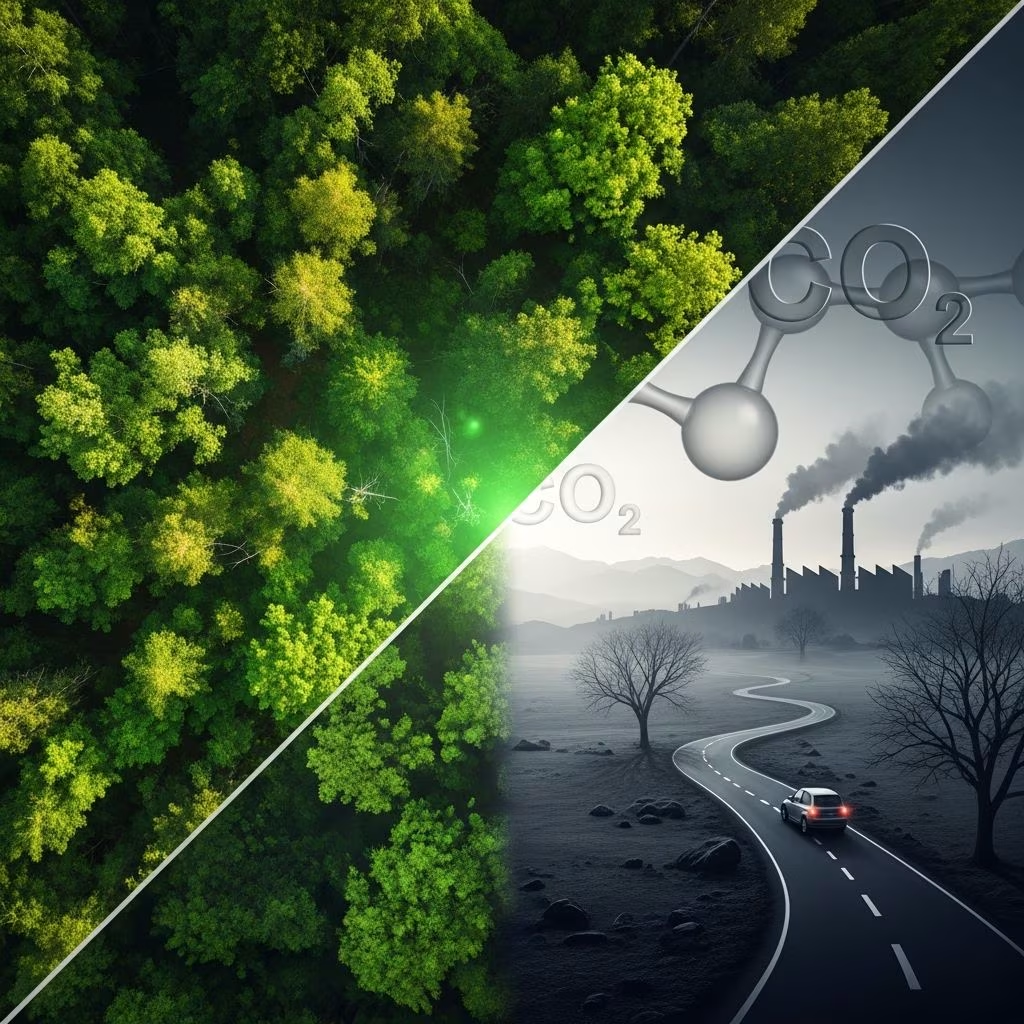
NASA studies show Earth's vegetated lands have greened significantly over decades, primarily due to CO2 fertilization and intensive agriculture in China and India, equivalent to twice the US land area.
 Travel Essentials
Over the past few decades, satellite observations have documented a remarkable transformation: Earth’s vegetated landscapes are expanding and becoming leafier. This global greening phenomenon, captured through advanced NASA instruments, points to a 70% contribution from carbon dioxide fertilization, alongside significant human interventions. What does this mean for our planet’s future?
NASA’s Moderate Resolution Imaging Spectroradiometer (MODIS) and the National Oceanic and Atmospheric Administration’s Advanced Very High Resolution Radiometer (AVHRR) have been pivotal in quantifying this change. From 1982 to 2015, a quarter to half of Earth’s vegetated lands exhibited significant greening, translating to an increase in leaf area index equivalent to two times the continental United States. This surge in foliage represents more than just aesthetic improvement; it alters carbon and water cycles fundamentally.
Lead researchers, including Zaichun Zhu from Peking University and Ranga Myneni from Boston University, analyzed data from 32 authors across 24 institutions. Their findings, published in Nature Climate Change, underscore that rising atmospheric CO2 levels enhance photosynthesis, directly boosting plant growth. Nitrogen deposition contributes 9%, while other factors like climate variations play smaller roles.
Higher CO2 concentrations act as a fertilizer for plants. By increasing the efficiency of photosynthesis, plants produce more sugars, leading to larger leaves and faster growth. Studies confirm that 70% of observed greening stems from this mechanism alone. In controlled experiments and field observations, elevated CO2 has consistently shown to spur biomass accumulation, particularly in forests and grasslands.
This effect is most pronounced in regions with adequate water and nutrients. However, it’s not uniform: arid areas may see limited benefits due to water constraints. The greening’s scale—millions of square kilometers—suggests a planetary-scale response to anthropogenic emissions, ironically countering some warming effects by enhancing carbon sinks.
While natural drivers like CO2 dominate, human activities have accelerated greening in unexpected places. A 2019 NASA study highlights China and India as primary contributors, accounting for one-third of the global increase despite occupying just 9% of vegetated land. In China, massive tree-planting initiatives, such as the Grain for Green Project, have restored forests on degraded lands. India’s intensive agriculture, with multiple cropping cycles, has expanded cropland foliage.
Over two decades, this human-driven greening equals the Amazon rainforest’s leaf area—over two million square miles added since the early 2000s, a 5% rise. Chi Chen, lead author from Boston University, notes that MODIS data at fine scales revealed these contributions, shifting perceptions from natural climate drivers to anthropogenic ones.
Greening patterns vary globally:
These shifts highlight how policy and technology intersect with environmental science.
More leaves mean greater photosynthesis, potentially sequestering more CO2. However, this greening’s net climate benefit is debated. Enhanced vegetation can cool local areas via transpiration but may reduce albedo in snowy regions, absorbing more heat. Lead author Zhu warns of changes to water and carbon cycling, which could amplify or mitigate warming.
NASA’s Orbiting Carbon Observatory missions track these dynamics from space, providing global CO2 concentration maps. Urban studies reveal nuances: decaying city greenery releases CO2 via respiration, complicating local emissions. Overall, greening absorbs an estimated 25-30% of human emissions, a temporary buffer.
Not all news is positive. Greening masks underlying issues like soil degradation and biodiversity loss. Intensive farming in Asia relies on fertilizers, risking nutrient runoff and water pollution. Moreover, as plants mature, their carbon uptake efficiency may decline—a phenomenon called saturation.
| Driver | Contribution (%) | Pros | Cons |
|---|---|---|---|
| CO2 Fertilization | 70 | Increased biomass | Potential water stress |
| Nitrogen | 9 | Boosted growth | Acid rain, eutrophication |
| Human Activity | ~25 (China/India) | Food security | Land overuse |
| Climate | Minor | Extended seasons | Drought risks |
This table summarizes key drivers based on NASA analyses. Balancing benefits requires sustainable practices.
NASA’s Earth Science Division monitors these changes alongside sea-level rise, ice melt, and extreme weather. Greening interacts with these: healthier vegetation stabilizes soils against erosion, but droughts could reverse gains. In urban settings, green spaces mitigate heat islands, yet decomposition adds to CO2.
Future projections hinge on emission trajectories. If CO2 continues rising, greening may persist, but tipping points like permafrost thaw could offset it.
China’s afforestation success—restoring 400,000 square kilometers—offers a model, though survival rates vary. India’s Green Revolution 2.0 emphasizes resilient crops. Globally, initiatives like the UN’s Decade on Ecosystem Restoration draw inspiration. Yet, experts urge integrating greening with conservation to avoid maladaptation.
Satellites like OCO-2 and OCO-3 provide unprecedented resolution, distinguishing fossil from biogenic CO2. Machine learning enhances leaf area mapping, revealing fine-scale human impacts. These tools empower policymakers with data-driven decisions.
Primarily CO2 fertilization (70%), plus human farming and tree planting.
It sequesters carbon but has trade-offs like altered hydrology and albedo.
Leaf area up 5% since 2000, equal to the Amazon.
China and India, via policy and agriculture.
Likely with rising CO2, but limited by water and nutrients.
Global greening underscores nature’s resilience amid change. NASA data calls for optimized land use: combine CO2 benefits with restoration, while curbing emissions. As we approach 2026, ongoing monitoring will clarify if this trend fortifies or strains our planet.
