

 Travel Essentials
 Travel Essentials

Discover the inspiring story of how Nina Simone's childhood home in North Carolina was rescued from demolition and restored to honor her enduring legacy.
 Travel Essentials
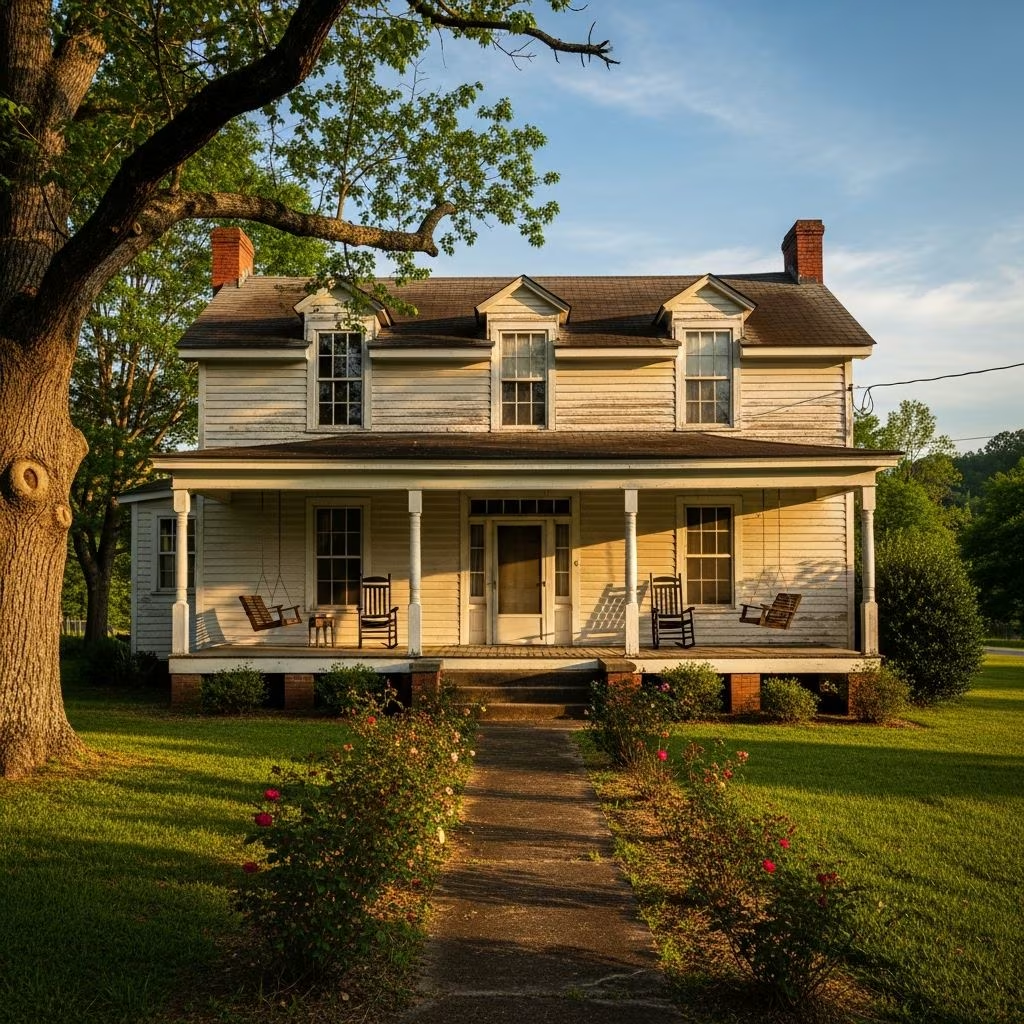
In the small town of Tryon, North Carolina, a humble three-room clapboard house holds extraordinary significance in American cultural history. This modest 650-square-foot dwelling, located at 30 East Livingston Street, is where Eunice Kathleen Waymon—better known to the world as Nina Simone—spent her formative years from 1933 to 1937. During this critical period of her childhood, the seeds of her remarkable musical talent and passionate activism were planted within these walls. Today, after facing near-certain demolition and weathering decades of neglect, this historic structure has been meticulously restored and permanently protected as a testament to one of America’s most influential musical and political voices.
Like many historic structures associated with African American cultural heritage, Nina Simone’s childhood home faced a precarious future. Following Simone’s family’s departure in 1937, the property changed hands repeatedly over the decades. Successive owners made alterations that gradually stripped away the home’s historical authenticity, adding haphazard structural modifications and materials inconsistent with its original 1930s design. By the early 1990s, the house had fallen into severe disrepair, the accumulation of years of insufficient maintenance and evolving property uses leaving it structurally compromised and aesthetically diminished.
Throughout the early 2000s, multiple rehabilitation efforts were initiated but remained stalled and incomplete. These incomplete projects, while well-intentioned, left the structure in a frustrating state of limbo—neither fully restored nor entirely lost. The removal of later additions and non-historical materials, necessary steps in returning the home to its authentic appearance, consumed resources without achieving lasting results. As the years progressed, the threat of demolition loomed larger, with the property becoming increasingly vulnerable to developers or property owners who might view a deteriorating structure as an obstacle rather than a cultural treasure.
The turning point came in 2017 when four prominent African American visual artists made an extraordinary decision that would change the trajectory of this historic property. Adam Pendleton, Rashid Johnson, Ellen Gallagher, and Julie Mehretu collectively purchased the neglected house for $95,000, acting with quiet determination and clear purpose to prevent its demolition. This acquisition represented more than a real estate transaction; it was a conscious act of cultural stewardship and a recognition that some structures transcend their physical form to embody historical significance that belongs to the broader public.
The timing of their intervention proved fortuitous in ways that extended far beyond their initial purchase. That same year in 2017, the National Trust for Historic Preservation launched a comprehensive campaign specifically dedicated to identifying, protecting, and preserving African American historical sites across the United States. This national initiative reflected a growing recognition that many landmarks associated with Black history and culture had been systematically overlooked in preservation efforts, leaving significant gaps in how America’s historical narrative was documented and protected.
Building on the foundation established by the artists’ purchase, the preservation landscape shifted dramatically in 2018 when Nina Simone’s childhood home was designated as a National Treasure by the National Trust for Historic Preservation. This official recognition provided immediate legal protection against demolition while opening pathways to dedicated funding and expert resources. The National Treasure designation signified that this structure met rigorous criteria for historical significance and warranted comprehensive protection efforts.
In 2020, the preservation strategy achieved another critical milestone with the establishment of a permanent preservation easement. This legal mechanism represents a voluntary agreement between property owners and the National Trust in which owners commit to permanently protecting a historic building’s authentic character. Under the terms of this easement, future property owners are bound by its stipulations: the house may be renovated and improved, but demolition is permanently prohibited. This arrangement ensures that regardless of ownership changes or evolving economic pressures, the structure cannot be destroyed.
The preservation easement also represented the culmination of a three-year intensive campaign to secure the property’s future. This extended effort required coordination among multiple stakeholders, sustained fundraising initiatives, and persistent community engagement. The African American Cultural Heritage Action Fund emerged as a central player in this collaborative work, partnering directly with the four artists who had purchased the home to develop comprehensive rehabilitation strategies.
The actual physical restoration of Nina Simone’s childhood home demanded meticulous historical research, specialized craftsmanship, and unwavering commitment to authenticity. The African American Cultural Heritage Action Fund completed full rehabilitation using historically accurate materials and methods that honored the home’s original character. Restoration specialists carefully researched and replicated the original paint colors, stain finishes, and material selections that would have been present during the Waymon family’s residence in the mid-1930s.
Rather than replacing deteriorated elements with modern substitutes, preservationists prioritized the retention and restoration of original materials wherever possible. Where replacement was necessary, new materials were selected and finished to match historical specifications precisely. This approach required extensive archival research, consultation with architectural historians, and careful examination of surviving original elements to determine accurate colors, textures, and construction methods.
Beyond cosmetic restoration, the rehabilitation addressed structural integrity issues that had developed during decades of neglect and previous incomplete efforts. Previous owners’ additions and inappropriate modifications were carefully removed to restore the home to its original 1930s footprint. This restoration work did not simply halt deterioration—it fundamentally transformed the property from a symbol of historical neglect into a meticulously preserved artifact of American cultural heritage.
The location of Nina Simone’s childhood home within Tryon’s historically African American East Side neighborhood carried profound significance beyond the single structure itself. The house stood just up the street from St. Luke’s CME Church, where Simone’s mother, Mary Kate Waymon, served as a preacher and where young Eunice Kathleen first began her piano studies. This proximity connected the home to the broader cultural and spiritual infrastructure of the Black community that nurtured Simone’s artistic development.
The East Side neighborhood represented a distinct African American community with its own institutions, social networks, and cultural life. By preserving Simone’s childhood home within this context, preservation efforts acknowledged that individual historic structures cannot be fully understood in isolation—they belong to larger communities and historical narratives. The home’s preservation thus became an opportunity to recognize and celebrate the entire neighborhood’s contributions to American culture.
A significant aspect of this preservation project involved rethinking how to honor Nina Simone’s legacy while acknowledging the home’s modest scale and historical authenticity. Rather than transforming the structure into a traditional house museum filled with period furnishings or personal artifacts, the Action Fund developed a more innovative approach. The restoration emphasizes the materiality and historical integrity of the space itself—the walls, floors, and architectural elements that survived Simone’s childhood years.
Instead, the next phase of the project focuses on designing and implementing dynamic public programs that will activate the space with meaning while respecting its historical character. This approach recognizes that the home’s true significance lies not in displaying objects but in creating opportunities for visitors to contemplate Simone’s journey and connect with her legacy in thoughtful, interpretive ways. Preservation partners, Tryon community members, and family representatives work collaboratively to develop programming that authentically honors Simone’s memory while remaining grounded in historical and cultural accuracy.
The successful preservation of Nina Simone’s childhood home demonstrates the power of institutional coordination and diverse stakeholder collaboration. The African American Cultural Heritage Action Fund, the National Trust for Historic Preservation, Preservation North Carolina, and the World Monuments Fund all contributed specialized expertise and resources. The four visual artists who initiated the purchase provided financial resources and demonstrated deep commitment to Black cultural preservation.
Equally important were voices from within Simone’s own family, particularly her brother, award-winning composer Dr. Samuel Waymon, who contributed invaluable family history and cultural perspective to the restoration process. Local Tryon community members provided historical knowledge, cultural context, and ongoing support for the project. This collaborative approach ensured that the preservation effort reflected multiple viewpoints and honored various forms of expertise—from technical restoration knowledge to family memory to community understanding.
The financial resources necessary for comprehensive rehabilitation came through dedicated fundraising initiatives that demonstrated widespread public enthusiasm for preserving African American cultural heritage. The National Trust and the African American Cultural Heritage Action Fund launched a coordinated campaign that successfully raised over 140 percent of their initial $25,000 goal within just a few months. This exceptional fundraising response reflected genuine public interest in supporting the preservation of significant Black historical sites.
Beyond the initial fundraising campaign, additional resources were secured through various partnerships and funding mechanisms. The involvement of the World Monuments Fund, an international preservation organization, demonstrated how local preservation efforts could attract global attention and resources. These varied funding streams enabled comprehensive rehabilitation work while ensuring that financial considerations did not compromise the quality or historical accuracy of restoration efforts.
The completion of Nina Simone’s childhood home restoration represents not an ending point but rather a transition to a new chapter in the structure’s history. Preservation professionals and community partners continue developing interpretive strategies that will help future visitors understand Simone’s early life and recognize how her childhood experiences shaped her artistic genius and activist commitment. These interpretive efforts will balance scholarly accuracy with accessible storytelling, creating meaningful connections between Simone’s biographical journey and broader historical contexts.
The home’s future activation will honor the discipline and joy that characterized Simone’s discovery of her musical talents within these walls, as reflected in the words of her family members involved in the preservation process. By creating dynamic public programming rather than static museum displays, the restoration project acknowledges that cultural heritage remains living and evolving, constantly reinterpreted by new generations engaging with historical narratives.
The successful preservation of Nina Simone’s childhood home carries significance that extends far beyond Tryon, North Carolina. This project exemplifies how coordinated efforts among artists, preservation institutions, government agencies, and communities can rescue historically significant structures from neglect and demolition. The outcome demonstrates that African American cultural heritage sites merit the same careful stewardship and resource commitment as other nationally important historical properties.
Furthermore, this preservation effort contributes to a larger movement of #TellTheFullStory of American history, as the National Trust framed its African American Cultural Heritage Action Fund initiative. By protecting sites associated with Black artists, activists, and communities, preservation efforts help ensure that American historical narratives include the contributions and experiences of African Americans who have shaped the nation’s cultural, political, and social development.
