

 Travel Essentials
 Travel Essentials

A rare geomagnetic storm is pushing the aurora borealis south, visible from northern states to the Midwest. Learn viewing tips, science behind it, and best spots for this cosmic show.
 Travel Essentials
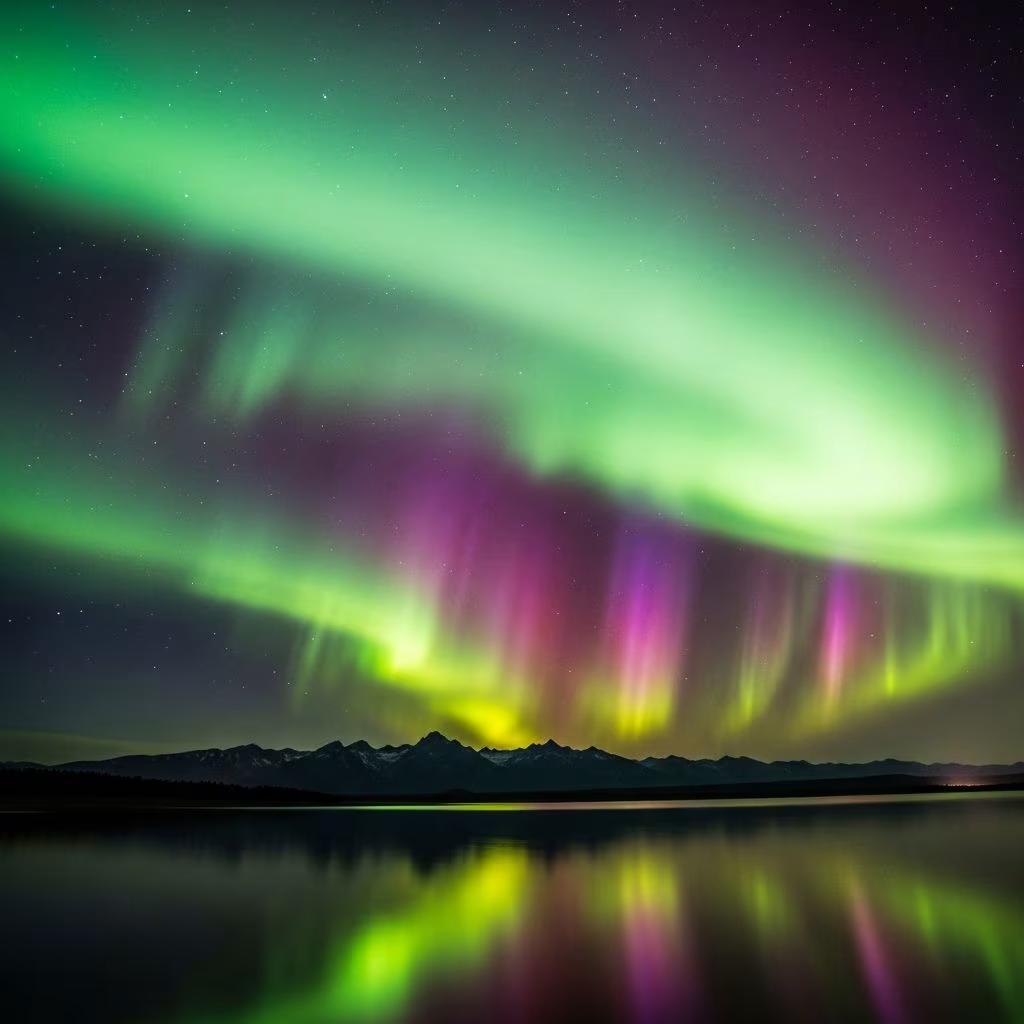
The mesmerizing dance of the **Northern Lights**, or aurora borealis, is set to captivate skywatchers across a vast swath of the United States this weekend. Triggered by a moderate geomagnetic storm, this celestial event offers a rare opportunity for people far beyond traditional polar regions to witness vibrant greens, purples, and reds illuminating the night sky.
At its core, the aurora results from interactions between charged particles from the Sun and Earth’s atmosphere. Solar wind—streams of plasma ejected from the Sun’s corona—carries these particles toward our planet. Earth’s magnetic field directs them toward the poles, where they collide with oxygen and nitrogen molecules high in the atmosphere.
Oxygen at altitudes around 100-200 km produces green hues, while higher-altitude nitrogen creates reds and purples. During heightened solar activity, like the current event from a coronal hole, high-speed solar wind streams (up to 800 km/s) intensify geomagnetic disturbances, expanding the auroral oval southward.
This phenomenon is not new, but its reach is exceptional. The magnetosphere, Earth’s protective bubble, funnels these particles, creating the glowing curtains and arcs we admire. Under normal conditions, displays are confined to high latitudes; storms like this G2-level event push visibility to mid-latitudes.
According to the Space Weather Prediction Center (SWPC), a G2 moderate geomagnetic storm watch is active, courtesy of solar wind from a coronal hole. Expect peak activity Friday and Saturday nights, with auroras potentially visible as far south as the Upper Midwest, northern New York, and Idaho.
The Geophysical Institute at the University of Alaska provides detailed forecasts: low to moderate activity means overhead displays from Utqiaġvik to Fairbanks, with horizon views possible lower south. Clear skies are crucial—partially cloudy conditions can obscure fainter displays.
| Region | Visibility Level | Best Viewing Hours |
|---|---|---|
| Alaska (Fairbanks north) | Overhead, high intensity | 10 PM – 2 AM local |
| Northern Midwest (MN, WI) | Northern horizon, moderate | 10 PM – 2 AM local |
| Northern Plains (ND, MT) | Strong horizon glow | 10 PM – 2 AM local |
| New England/NY | Faint horizon, if clear | Midnight – 3 AM local |
Optimal viewing windows are between 10 p.m. and 2 a.m. local time, when darkness is deepest and activity peaks. Geomagnetic storms can fluctuate, so check real-time updates from SWPC’s aurora viewline tool.
Travelers should prioritize sites with Bortle Scale 1-3 skies (pristine dark). Apps like Dark Sky Finder or Light Pollution Map help scout locations. Shoulder seasons post-April or pre-August offer twilight glimpses, but full darkness from late August to April is ideal.
Smartphone cameras struggle with low light, but modern ones with night modes (e.g., iPhone 14+ or Pixel 7+) can yield stunning shots. Use a tripod for DSLRs/mirrorless: wide-angle lenses (14-24mm), ISO 1600-6400, f/2.8 aperture, 10-30 second exposures.
Forego filters; they block light. Stack multiple exposures in software like Sequator for noise reduction. Time-lapses capture motion—set 5-15 second intervals. Patience is key: auroras pulse in substorms lasting 20-60 minutes.
G2 storms pose minor risks: brief high-latitude blackouts, GPS glitches, or satellite drag. Power grids may see induced currents, but operators are alerted by NOAA. Radio enthusiasts might note HF propagation boosts.
No direct health threats to humans on the ground, as the magnetosphere shields us. However, avoid flying private aircraft during peaks due to compass deviations. Airlines monitor for radiation spikes on polar routes.
This storm’s intensity mirrors rare events pushing auroras to Florida or Texas in past cycles. Internationally, similar latitudes like Scotland or Tasmania see displays during strong activity. The auroral oval expands symmetrically in the south as australis.
We’re nearing the peak of Solar Cycle 25 (predicted max 2024-2025), when sunspots and coronal holes proliferate. This boosts auroral frequency—expect more shows through 2026. Historical G5 storms (e.g., 2003) lit skies to the equator; G2s like this democratize viewing.
Book dark-sky lodges or tours in Alaska/Churchill equivalents stateside. Pack layers—nights drop below freezing even in May. Apps: Aurora Alerts, My Aurora Forecast for push notifications. Join communities like Aurora Chasers for live cams.
Sustainable viewing: stick to trails, minimize lights. This event underscores nature’s grandeur, blending science and wanderlust.
Solar particles excite atmospheric gases along Earth’s magnetic field lines, emitting light.
Unlikely due to light pollution; head 50+ miles north of urban areas.
This one: through the weekend; effects wane as solar wind subsides.
Yes for ground observers; minor tech disruptions possible.
ISO 3200, f/2.8, 15s shutter on tripod.
Peak now-ish; activity high until 2026.
