

 Travel Essentials
 Travel Essentials

Explore the origins, colors, best times and places to see the Northern Lights, plus cultural lore and viewing tips for an unforgettable celestial adventure.
 Travel Essentials
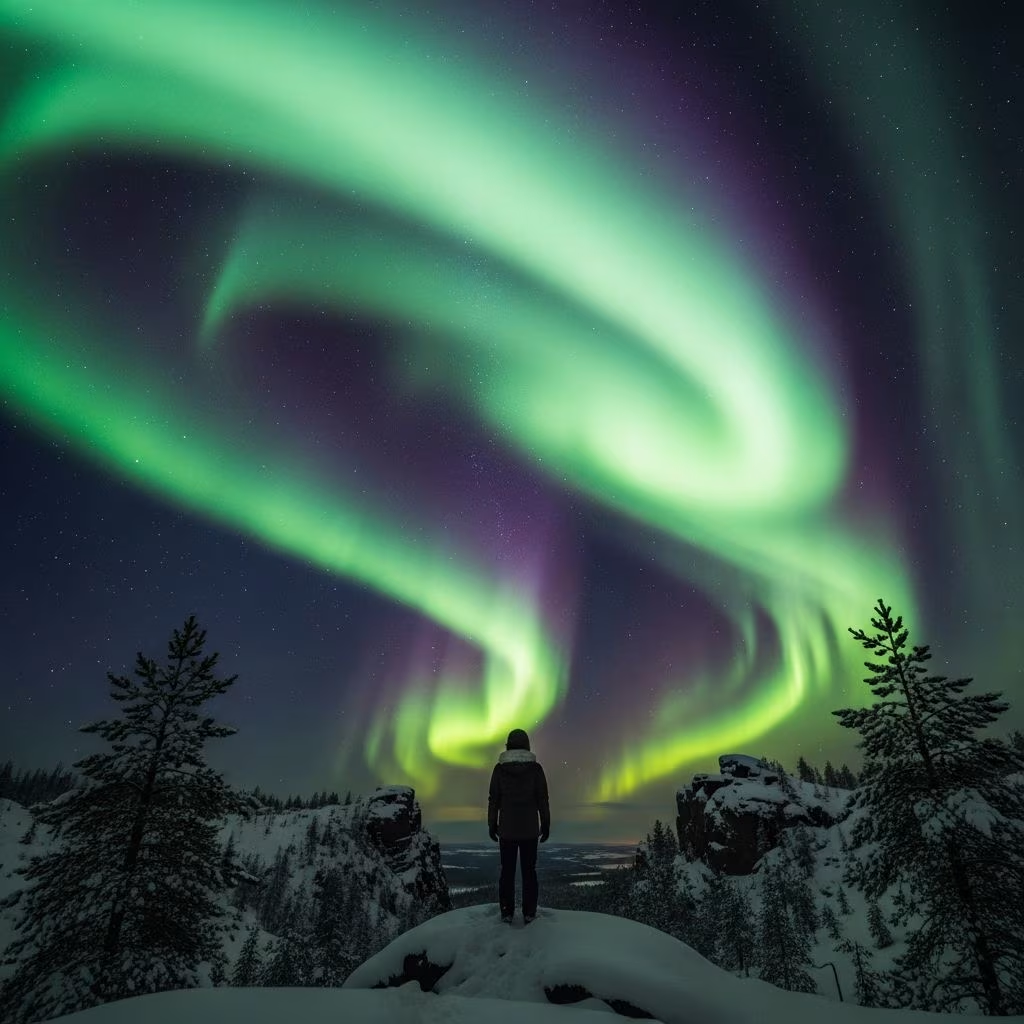
The Northern Lights, or Aurora Borealis, represent one of nature’s most breathtaking spectacles, where vibrant curtains of light drape across polar skies. This phenomenon arises from solar particles interacting with Earth’s magnetic field and atmosphere, producing a symphony of colors visible primarily in high-latitude regions.
At the heart of the Northern Lights lies intense solar activity. The Sun constantly ejects streams of charged particles known as solar wind, which accelerate through space at speeds up to a million miles per hour. During periods of heightened activity, such as solar flares or coronal mass ejections, these ejections intensify, sending massive plasma clouds toward Earth.
Upon reaching our planet, these particles encounter Earth’s magnetosphere—a protective shield generated by the planet’s molten core. The magnetosphere funnels the incoming particles toward the magnetic poles, concentrating the energy in the polar regions. Here, the particles plunge into the upper atmosphere, colliding with oxygen and nitrogen atoms at altitudes between 60 and 250 miles.
These collisions excite the atmospheric gases, causing electrons to jump to higher energy states. As the atoms return to their ground state, they release photons—packets of light—at specific wavelengths, manifesting as the glowing auroras. This process mirrors the glow of neon signs, where energized gases emit light upon de-excitation.
The Northern Lights’ signature colors stem from the types of gases involved and collision altitudes. Green dominates most displays, produced by oxygen molecules at altitudes of 60 to 115 miles. This hue arises from oxygen atoms emitting light at a wavelength of 557.7 nanometers.
Dynamic shapes like arcs, curtains, and spirals emerge from interactions with Earth’s magnetic field lines, which guide particles and shape the light patterns. Wave-like formations occur as plasma waves propagate through the magnetosphere.
Auroral activity peaks during the equinoxes in September and March, when Earth’s magnetic field aligns optimally with the solar wind. The 11-year solar cycle also plays a crucial role; the current cycle, Solar Cycle 25, approaches its maximum around 2025, promising more frequent and vivid displays.
| Season | Why Optimal? | Expected Intensity |
|---|---|---|
| September-March | Long dark nights; equinox alignment | High |
| Winter Solstice | Maximum darkness away from poles | Medium-High |
| Summer | Midnight sun hinders visibility | Low |
Clear, moonless nights with minimal light pollution enhance sightings. Geomagnetic storms, rated by the Kp index (0-9), boost auroras; a Kp of 5 or higher often extends visibility equatorward.
Seek latitudes between 60° and 75° N for reliable sightings. Remote locations minimize light pollution and maximize dark-sky time.
Southern Lights (Aurora Australis) mirror this in Antarctica, visible from Tasmania or New Zealand during southern winter.
Preparation elevates your chances. Monitor aurora forecasts via apps like Aurora Alerts or NOAA’s Space Weather Prediction Center, tracking solar wind speed and Kp index.
Photography tips: Wide-angle lenses capture expansive curtains; raw format preserves colors. Ethical viewing respects local ecosystems and indigenous lands.
Indigenous Arctic peoples have revered auroras for millennia. Inuit viewed them as spirits of ancestors playing soccer with a walrus skull. Scandinavian sagas depicted Valkyries weaving battle fates in the lights. Finnish lore saw them as foxes sweeping fire across skies.
In Japan, historical records from the 19th century describe red auroras during the Carrington Event of 1859, linking them to omens. Today, auroras inspire art, music, and eco-tourism, bridging science and spirituality.
Modern science builds on Galileo, who coined “Aurora Borealis” in 1619, honoring dawn goddess Aurora and north wind Boreas.
Climate change and light pollution threaten visibility. Rising tourism strains remote sites, urging sustainable practices. Space weather research, via satellites like NASA’s THEMIS, refines predictions.
Solar Cycle 25’s peak through 2026 offers prime opportunities. Advances in forecasting could extend accessibility, even to mid-latitudes during superstorms.
Solar wind particles collide with atmospheric gases near the poles, exciting them to emit light.
September to March, during solar maximum, on clear nights with high Kp index.
Norway, Iceland, Canada, Alaska, Finland—at 60-75°N latitudes.
No, activity varies; prime spots see them 100-200 nights yearly under ideal conditions.
No, they pose no risk to humans; they’re high-altitude light emissions.
Displays range from minutes to hours, intensifying during geomagnetic storms.
Chasing the Northern Lights blends science, adventure, and wonder, inviting skywatchers to witness Earth’s magnetic ballet under starlit polar vaults.
