

 Travel Essentials
 Travel Essentials

Explore Notre-Dame's 800-year journey: construction innovations, historic restorations, the devastating 2019 fire, and triumphant 2024 reopening as a symbol of resilience.
 Travel Essentials
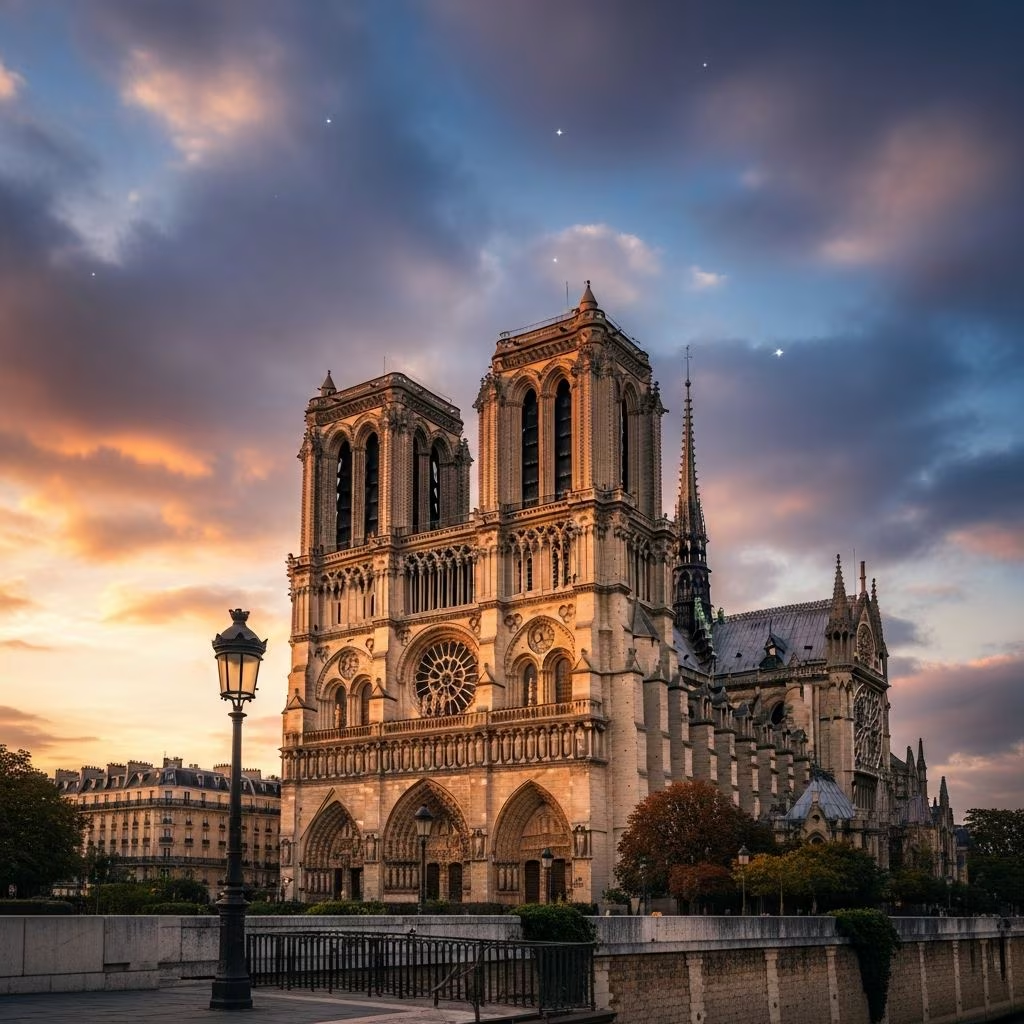
Notre-Dame Cathedral stands as one of Paris’s most enduring symbols, embodying centuries of architectural brilliance, spiritual devotion, and human perseverance. Constructed starting in 1163, this Gothic masterpiece has witnessed revolutions, restorations, and a near-catastrophic fire, only to emerge renewed in 2024.
The story of Notre-Dame begins in the mid-12th century amid a transformative era in European architecture. Bishop Maurice de Sully envisioned a grand cathedral to rival the era’s growing urban ambitions, laying the first stone in 1163. What followed was over two centuries of construction, blending innovation with faith.
Early builders introduced revolutionary techniques like flying buttresses—external supports that allowed for soaring vaults and vast windows flooding interiors with light. These elements defined the Gothic style, pushing structural boundaries and inspiring cathedrals across Europe. By 1345, the main structure was complete, though modifications continued.
This phase established Notre-Dame as a beacon of medieval ingenuity, drawing pilgrims and kings alike.
From the 18th century onward, Notre-Dame faced decay and upheaval. Weather erosion and the French Revolution brought vandalism—statues were beheaded as symbols of royalty, and the building fell into disrepair.
By the early 1800s, the cathedral teetered on collapse, its grandeur obscured by grime and neglect. Victor Hugo’s 1831 novel The Hunchback of Notre-Dame sparked public fervor, highlighting its plight and urging preservation.
| Era | Challenges | Impact |
|---|---|---|
| 18th Century | Structural mods, Revolution damage | Loss of spire, desecration |
| Early 19th Century | Neglect, threat of demolition | Cultural revival via literature |
These trials tested the cathedral’s resilience, setting the stage for revival.
In 1844, architects Eugène Viollet-le-Duc and Jean-Baptiste Lassus launched a 25-year restoration, blending authenticity with creative flair. They rebuilt the spire (removed in 1786), crafted new gargoyles for rainwater management, and restored stained-glass windows.
Viollet-le-Duc’s additions, like the chimera statues, captured the Gothic spirit while incorporating 19th-century interpretations. Facades were cleaned, revealing intricate carvings of biblical narratives and mythical beasts. This effort not only saved the structure but elevated it to national treasure status.
By 1864, Notre-Dame gleamed anew, hosting coronations and masses.
The 20th century brought systematic maintenance. From 1963, soot from pollution was meticulously removed from the façade, unveiling original stone hues. A deeper project from 1991 to 2000 addressed interiors, ensuring UNESCO World Heritage listing in 1991.
These efforts prepared Notre-Dame for millions of annual visitors, solidifying its role as France’s most-visited monument by 2018.
On April 15, 2019, tragedy struck as flames erupted in the attic, devouring the oak roof frame—”the forest,” built from 13th-century trees—and toppling the 19th-century spire. Firefighters battled for nine hours, saving the stone vaults, rose windows, and towers amid global shock.
Though the cause remains unclear (possibly electrical), the blaze symbolized fragility. President Emmanuel Macron pledged a five-year rebuild, amassing nearly $1 billion in donations worldwide.

Restoration began in 2021, mobilizing 2,000 workers. Pre-fire laser scans by Andrew Tallon provided a digital twin, enabling precise reconstruction via 3D modeling and augmented reality.
Key feats included:
The €739 million project integrated modern tech while honoring medieval methods, culminating in a December 8, 2024, reopening ceremony attended by global leaders.
Post-restoration, Notre-Dame’s details shine:
| Feature | Description | Significance |
|---|---|---|
| Rose Windows | 13th-century stained glass, 13m diameter | Illuminate biblical stories with spectral light |
| Flying Buttresses | External arches supporting vaults | Enable thin walls, tall interiors |
| Gargoyles & Chimeras | Water-spouting figures | Drainage plus Gothic whimsy |
| Bell Towers | House Emmanuel bell (13 tons) | Peal across Paris |
Recent cleanings exposed fossil imprints in limestone, offering fresh insights into medieval quarrying.
Beyond stone, Notre-Dame pulses with history: site of royal weddings, Napoleon’s self-coronation, and Liberation masses in 1944. It remains a Christian worship center, drawing 13 million visitors pre-fire.
The reopening affirmed its role in French identity, timed near the 2024 Olympics.
Notre-Dame’s saga underscores debates on heritage: faithful replication versus adaptation? Its survival highlights global unity in safeguarding shared legacies.
Future challenges include climate impacts, but digital archives ensure longevity.
Construction started in 1163 under Bishop Maurice de Sully and took nearly 200 years to complete the main structure.
The exact cause is undetermined but likely electrical; it destroyed the roof and spire.
Five years, from 2019 to 2024, reopening on December 8.
Yes, it welcomed worshippers and tourists starting December 2024.
3D laser scans, augmented reality, and digital modeling for precision.
