

 Travel Essentials
 Travel Essentials

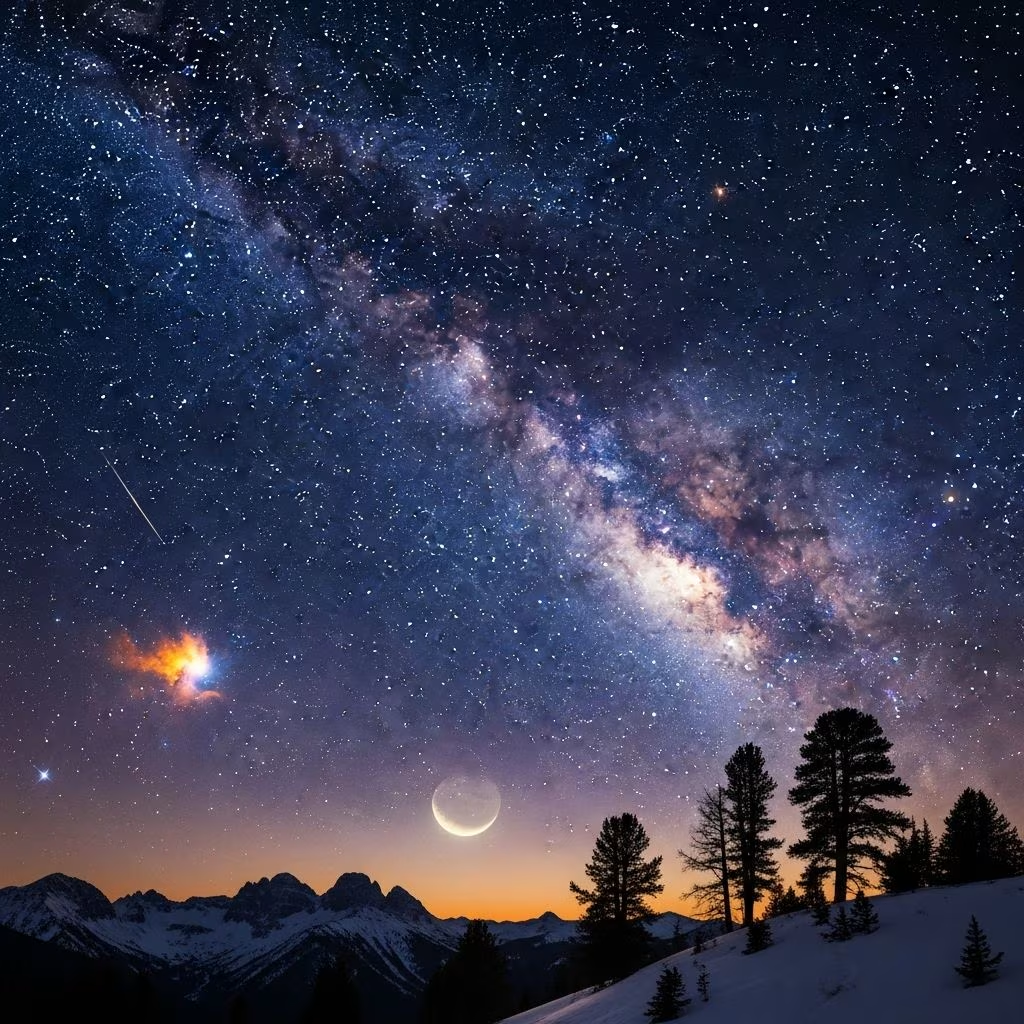
Discover what to watch in November's night sky, including the Full Beaver Supermoon, Taurid and Leonid meteor showers, and Saturn's rare ring alignment.
 Travel Essentials
November presents one of the most dynamic months for amateur and professional astronomers alike, with a succession of remarkable celestial events that will transform the night sky into a stage for cosmic drama. From the luminous presence of an oversized full moon to the dramatic streaks of multiple meteor showers, the month offers unprecedented opportunities for observers across North America and beyond. Whether you’re an experienced stargazer or someone simply seeking a moment of wonder beneath the stars, November 2025 delivers astronomical experiences that occur only once every several years or longer.
One of November’s most anticipated events centers on an astronomical occurrence that captures public imagination and floods social media feeds: the appearance of an exceptionally large and bright full moon. This phenomenon, occurring on November 5, reaches its peak brightness at 8:20 a.m. UTC, meaning observers in North America should position themselves for optimal viewing on the evening of November 4 or the night of November 5.
The science behind this dramatic celestial display involves the geometry of lunar mechanics. The Moon’s orbit around Earth follows an elliptical path rather than a perfect circle, creating two critical points in its orbital cycle. The closest point to our planet, termed perigee, brings the Moon approximately 30,000 kilometers closer than its farthest point, called apogee. When the full moon phase coincides precisely with perigee, the result is a visually striking event that professional astronomers and casual observers alike find remarkable.
According to NASA classifications, a supermoon specifically refers to a full moon occurring within at least 90% of its closest approach to Earth. This technical definition helps distinguish genuine supermoons from ordinary full moons and sets clear parameters for astronomical record-keeping. The November iteration earns the traditional name “Full Beaver Moon,” referencing indigenous and colonial harvest traditions associated with autumn beaver trapping season.
Meteor showers result from Earth’s passage through debris trails left by comets or asteroid fragments. November hosts not one but two distinct Taurid meteor showers, each originating from different celestial sources and exhibiting unique characteristics that make them worthy of separate attention.
The Southern Taurids peak during November 4-5, coinciding with the supermoon event. These meteors originate from debris shed by Comet 2P/Encke, creating slow-moving projectiles famous throughout the astronomical community for their exceptional brightness. Observers can expect approximately 7 meteors per hour at peak activity, though the concurrent full moon may substantially reduce visibility by washing out fainter streaks with its intense illumination.
The distinctive characteristic of Southern Taurids lies in their production of fireballs—exceptionally bright meteors that can illuminate the landscape as effectively as lightning. These slow-moving, low-velocity meteors provide extended viewing windows as they traverse the atmosphere, sometimes leaving luminous trails that persist for several seconds after the meteor itself has burned away.
The Northern Taurids peak approximately one week later, on November 11-12, offering substantially better viewing conditions than their southern cousins. Unlike the Southern Taurids, which originate from a comet trail, the Northern Taurids derive from debris released by asteroid 2004 TG10, yet they share similar visual characteristics despite different sources.
During peak activity, the Northern shower produces up to 5 meteors per hour, with occasional bright fireballs punctuating the display. The radiant point—the area of sky from which meteors appear to originate—lies just to the right of the constellation Taurus. For optimal viewing, observers should position themselves after midnight when Taurus reaches its highest point in the sky.
Mid-to-late November features the appearance of the Leonids, a meteor shower distinguished by remarkable velocity and historical significance. This shower peaks during November 16-18, and potentially extends through November 19, with dramatically improved viewing conditions compared to earlier November events.
Leonid meteors hold a unique distinction in astronomical records: they achieve speeds exceeding hundreds of thousands of miles per hour, earning recognition in the Guinness Book of World Records as the fastest meteor shower. This extraordinary velocity produces distinctively bright, fast-moving streaks across the sky that differ markedly from the leisurely fireballs of the Taurids. During peak activity, observers may witness 10-20 meteors per hour under ideal conditions, though this represents typical year performance rather than the exceptional rates associated with certain rare events.
The Leonid peak occurs approximately two weeks after the November 5 full moon, resulting in a waning crescent moon that produces minimal light pollution. This favorable lunar phase dramatically enhances visibility compared to November’s earlier meteor showers, creating what astronomers describe as nearly perfect dark-sky conditions. The shower’s radiant point lies within the constellation Leo, specifically in the region between the stars Algieba and Rasalas, and optimal viewing occurs during the hours between midnight and sunrise on November 17.
The Leonid meteor shower possesses a dramatic history marked by occasional extraordinary outbursts. Approximately every 33 years, the Leonids produce a true meteor storm with rates exceeding 1,000 meteors per hour. However, observers should note that the next predicted meteor storm of this magnitude will not occur until 2099, making the current period one of relative calm in the Leonid cycle.
Although the Orionid meteor shower peaked in late October, its activity continues through early November, specifically through November 7. These meteors, which derive from Halley’s Comet debris, occasionally produce fireballs and remain visible for observers seeking extended meteor-watching opportunities before concentrating on November’s primary events.
Beyond meteor showers and supermoons, November features an extraordinary astronomical event occurring only once every 15 years: Saturn’s rings will appear to disappear from view, visible without their distinctive ring structure around November 23. This phenomenon results from Earth’s position relative to Saturn’s orbital plane, creating an alignment where the rings edge directly toward our planet, rendering them essentially invisible from terrestrial observation points. This rare alignment offers a unique perspective on the gas giant and its complex ring system.
Most meteor showers display peak activity between midnight and dawn, when your geographic location faces directly into the debris stream. Viewing conditions improve progressively from evening into early morning hours. For the supermoon, evening observations work well, as the moon rises before sunset and remains visible throughout the night. However, moonrise times vary by geographic location, making consultation of local astronomical calendars essential for precise timing.
A supermoon reaches its full phase while positioned near perigee, Earth’s closest point to the Moon. This proximity creates apparent size increase of approximately 7-14 percent and brightness elevation of roughly 30 percent compared to typical full moons. While these differences are measurable, they become apparent only through direct comparison or photographic documentation; casual observation often fails to reveal dramatic distinctions.
Meteor shower observation requires no telescopes, binoculars, or specialized equipment. In fact, such devices limit the field of view, reducing rather than enhancing the experience. The naked eye provides the optimal viewing method, allowing observation of the entire sky dome. Wide-field binoculars may enhance observation of faint meteors, but they remain optional rather than essential.
Absolutely. Light pollution, atmospheric conditions, moon phase, and cloud cover all substantially impact observations. The November 5 supermoon creates significant challenges for observing the Southern Taurids simultaneously, as the bright moon overwhelms fainter meteors. Later November events benefit from darker skies as the moon wanes toward new phase. Weather conditions remain entirely beyond our control, making clear skies the critical factor in successful observations.
Predictions derive from orbital mechanics calculations, debris stream modeling, and historical observation patterns. Professional astronomical organizations track debris trails and predict peak activity timing and intensity based on Earth’s position relative to these trails. However, actual activity can vary from predictions due to unpredictable debris distribution variations and unexpected cometary behavior.
November’s exceptional celestial lineup invites all observers, regardless of experience level, to participate in the wonder of the night sky. The month offers something for every preference: the steady glow of the supermoon for casual observers, the active displays of meteor showers for enthusiasts, and the rare ring alignment of Saturn for deep-sky observers.
Plan your observations strategically, selecting specific events that align with your schedule and location. Group viewing with friends, family, or local astronomy clubs enhances the experience through shared wonder and collective observation. Bring a journal to record impressions, sketch meteor trails, or document the supermoon’s appearance at different times during the night. Photography enthusiasts will find substantial opportunities to capture these phenomena, though equipment ranges from simple smartphone cameras to sophisticated astronomical imaging systems.
November’s night sky transforms Earth into a cosmic observation platform, offering reminders of our position within a dynamic, active universe. Whether you dedicate entire nights to dedicated observation or simply glance skyward during evening walks, November provides celestial moments worthy of attention and memory.
