

 Travel Essentials
 Travel Essentials

Explore the rich history, architectural innovations, and lesser-known facts about the Palace of Versailles, from hunting lodge to seat of power.
 Travel Essentials
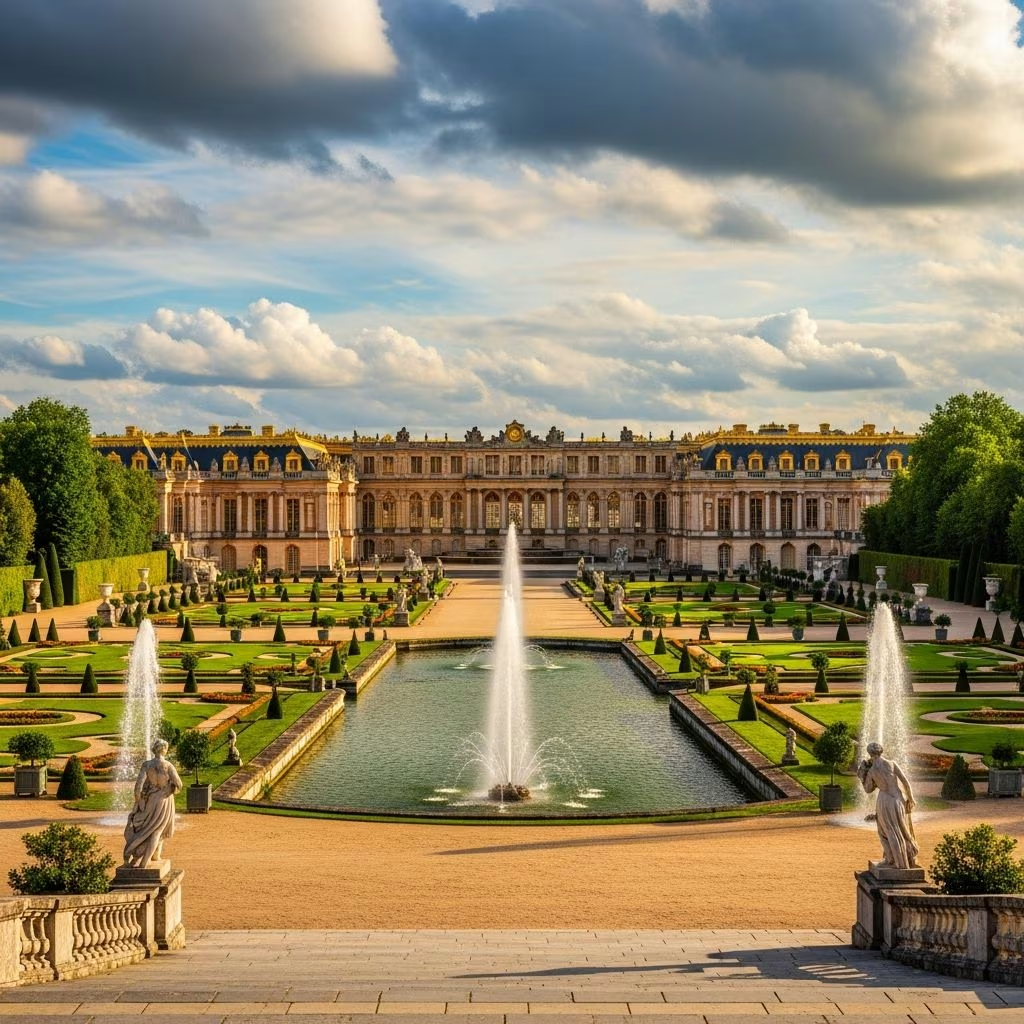
The Palace of Versailles stands as one of the most magnificent testaments to human ambition and artistic achievement in European history. Located just 20 kilometers from Paris, this sprawling complex has served multiple roles throughout its existence, from a modest hunting retreat to the epicenter of French political power and cultural influence. Today, it attracts over 7.7 million visitors annually and remains a UNESCO World Heritage Site, drawing people from around the globe who seek to understand the grandeur and complexity of French history.
The origins of Versailles trace back to 1623, when Louis XIII constructed a simple hunting lodge on the estate. The king, who enjoyed the abundant game in the surrounding forests, built this modest structure as a convenient retreat. According to historical accounts, the original building was so unimpressive that contemporaries noted a mere gentleman would not have taken pride in its construction. What began as a pragmatic solution to a hunting enthusiast’s needs would eventually transform into the most powerful symbol of French monarchy.
Between 1631 and 1634, Louis XIII undertook significant renovations, directing architect Philibert Le Roy to replace the original lodge with a more substantial château. These early improvements established the foundational structure upon which future generations would build. The king even purchased additional portions of the Versailles fiefdom in 1632, expanding the royal holdings and preparing the groundwork for future development.
The transformation of Versailles from a secondary residence into France’s primary seat of power occurred under Louis XIV, one of history’s most ambitious monarchs. The king harbored competitive instincts shaped partly by his desire to surpass the Vaux-le-Vicomte estate, which had been built for Nicolas Fouquet, an influential financial minister. Recognizing the potential of Versailles, Louis XIV conceived a bold plan to relocate the entire French court and government apparatus from Paris to this countryside location.
Beginning in 1661, Louis XIV commissioned legendary landscape architect André Le Nôtre to design and execute the intricate gardens surrounding the palace. This monumental project consumed four decades of continuous labor, creating one of the most sophisticated horticultural achievements of the era. The gardens themselves became expressions of royal power, representing humanity’s ability to reshape and control nature according to aesthetic and political principles.
Construction proceeded in phases from 1661 to 1715, with each stage adding new dimensions to the palace’s magnificence. Louis XIV personally involved himself in the architectural decisions, effectively serving as his own visionary architect while professional builders executed his grand designs. By 1682, he formally established Versailles as the official residence of the French court and the administrative center of government.
The Palace of Versailles represented unprecedented technological and artistic achievement for its time. The construction utilized exclusively French materials and craftsmanship, with artisans representing the finest traditions of French artistry and engineering. This deliberate choice reflected the king’s commitment to developing French cultural supremacy and reducing dependence on foreign expertise.
One of the most celebrated features emerged as the Hall of Mirrors, constructed beginning in 1678 under architect Jules Hardouin Mansart. This spectacular chamber contains 357 mirrors, each representing an extraordinary expense at the time. Mirrors were among the most precious commodities in the seventeenth century, with Venice maintaining a virtual monopoly on their manufacture. To overcome this constraint, France employed a bold strategy: luring Venetian mirror makers away from their homeland with promises of wealth and opportunity. The Venetian Republic, alarmed by this industrial espionage, reportedly ordered the assassination of the defected craftsmen—a testament to how fiercely nations guarded their technological advantages.
The luxury extended to virtually every element of palace life. Even utilitarian objects reflected royal opulence; chamber pots were fashioned from silver rather than conventional materials. This pervasive extravagance served political purposes, demonstrating the monarch’s absolute command over resources and his ability to transform even mundane objects into expressions of artistic refinement.
Versailles transcended its role as a residential palace to become a machine for concentrating and projecting royal power. Louis XIV strategically moved not merely the court but the entire administrative apparatus of French government to Versailles, effectively transforming a countryside estate into the de facto capital of France. This relocation centralized decision-making authority and allowed the monarch to maintain closer supervision over the aristocracy and bureaucratic elite.
The palace hosted watershed moments in European history. The declaration of the German Empire, proclaimed following France’s military defeat by Prussia, was signed at Versailles in 1871. The most momentous diplomatic event occurred following World War I, when the Treaty of Versailles was signed within the Hall of Mirrors in 1919, establishing terms that would reshape European geopolitics. Additionally, in 1783, the palace witnessed the signing of treaties concluding the American Revolutionary War, with British and American delegates, led by Benjamin Franklin, formalizing the independence of the United States.
Beyond its political functions, Versailles became a nexus for cultural and intellectual life during the seventeenth and eighteenth centuries. The palace served as a venue for artistic performances and intellectual exchange that established aesthetic and philosophical standards throughout Europe. As a child prodigy, the young Wolfgang Amadeus Mozart performed within its walls, his talents exhibited before European nobility.
The palace hosted elaborate entertainment spectacles designed to showcase royal magnificence. Grand fêtes held in 1664, 1668, and 1674 were orchestrated on a scale designed to impress and intimidate, with accounts of these celebrations disseminated throughout Europe via prints and engravings. These carefully managed displays of luxury and control served propaganda functions, enhancing the mystique and authority of French monarchy across the continent.
Beyond its famous hall of mirrors, Versailles incorporated several innovative features that demonstrated advanced thinking about architectural and aesthetic design:
The French Revolution abruptly terminated Versailles’ role as a royal residence. On 14 July 1789, King Louis XVI and Queen Marie Antoinette learned of the storming of the Bastille while at the palace. Their isolation increased as revolutionary fervor spread through Paris. The Women’s March on Versailles on 5 October 1789 brought thousands of protesters to the palace gates, demanding bread and confronting the monarch directly. This dramatic encounter marked the beginning of the end for Versailles as a seat of royal power.
In 1789, revolutionary forces compelled Louis XVI to abandon Versailles permanently and relocate to Paris. The palace, stripped of its political function, entered a new phase of existence. It would never again serve as a royal residence, fundamentally altering its purpose and significance.
Following the Revolution, Versailles faced an uncertain future until King Louis-Philippe, who ascended to the throne in 1830, conceived a novel vision for the complex. In 1837, he established the Palace of Versailles as the Museum of the History of France. This transformation saved the structure from deterioration while giving it renewed cultural relevance.
The museum collections focused on housing paintings and sculptures depicting great figures and momentous events from French history. Curators continuously expanded these collections throughout the nineteenth century and into the early twentieth century. Under the direction of the palace’s most influential curator, Pierre de Nolhac, the institution underwent significant changes. Recognizing the historical importance of preserving Versailles’ authentic appearance as a royal residence, Nolhac orchestrated a comprehensive restoration of the central portions of the palace, returning key areas to their original configuration during the Ancien Régime period.
The Palace of Versailles achieved international recognition when UNESCO designated it as a World Heritage Site in 1979, acknowledging its significance as a center of power, art, and science in France during the seventeenth and eighteenth centuries. The French Ministry of Culture has designated the palace, gardens, and subsidiary structures as culturally significant monuments requiring protection and stewardship.
Today, the palace operates as a major international tourist destination and functioning museum. The annual visitation exceeds 7.7 million visitors, making it one of the most visited cultural heritage sites globally. Tourists, historians, and art enthusiasts travel from across the world to witness the architectural splendor, examine historical artifacts, and walk through spaces where momentous decisions shaped European history.
The Palace of Versailles functions as a visual chronicle of French architectural evolution spanning from the 1630s to the 1780s. The structure demonstrates the progression of styles, techniques, and aesthetic principles across more than a century of development. Successive generations of builders and designers added their contributions, creating a complex whole that reflects changing tastes while maintaining overall coherence and magnificence.
Every architectural and decorative element communicated political messages about royal authority, cultural sophistication, and national pride. The deliberate employment of exclusively French materials and artisans transformed the palace into a statement about French capability and independence. The sheer scale of expenditure on luxurious details conveyed the unlimited resources at the monarchy’s disposal.
The Palace of Versailles ultimately represents far more than an exceptional building. It embodies the ambitions, achievements, and eventual decline of absolute monarchy in Europe. From a simple hunting lodge transformed into an architectural wonder, Versailles witnessed the height of royal power and the dramatic events that dismantled it. Today, it stands as a tangible connection to a pivotal era in European history, offering visitors and scholars profound insights into the aesthetics, politics, and culture of ancien régime France.
