

 Travel Essentials
 Travel Essentials

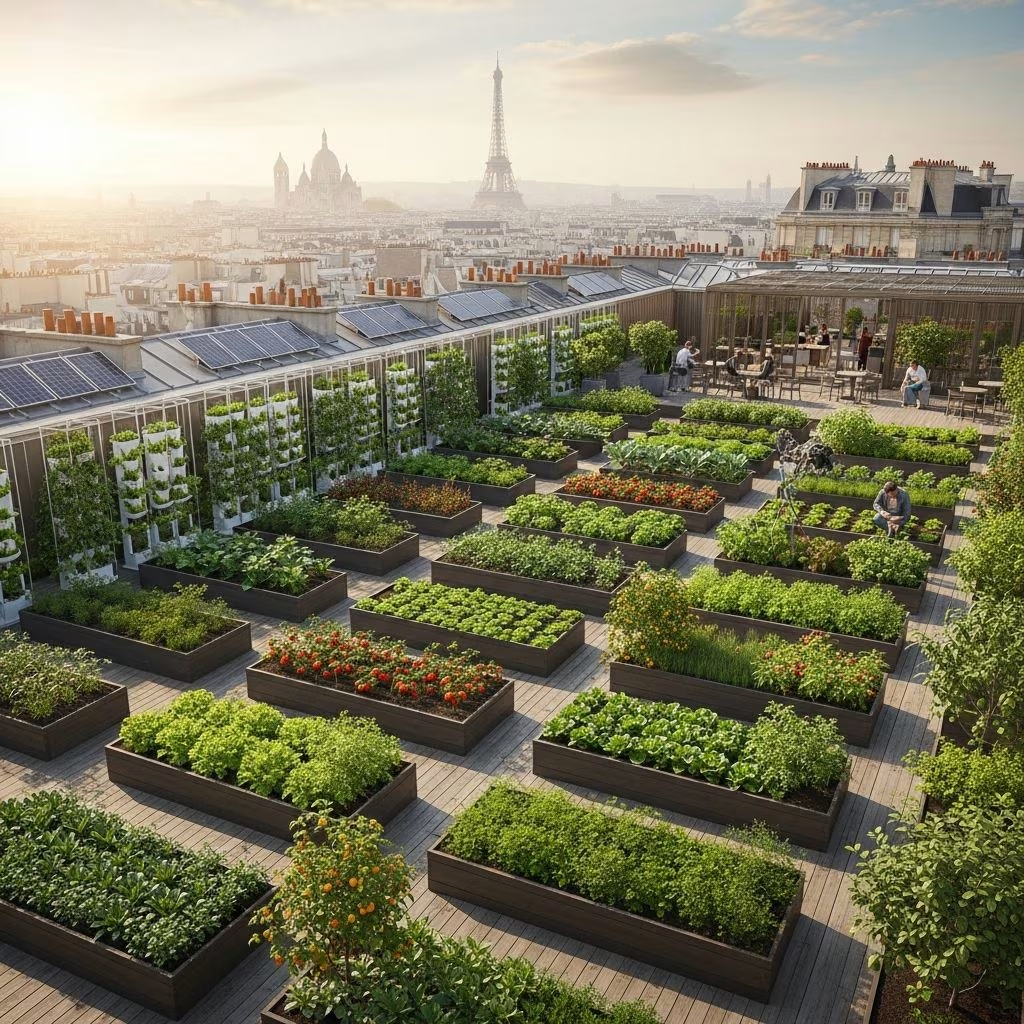
Paris turns a rooftop into a high-yield, pesticide-free farm using aeroponics, producing fresh local food, jobs, and community plots.
 Travel Essentials
Modern cities face unprecedented challenges in feeding their expanding populations while maintaining environmental sustainability. Paris has emerged as a pioneer in addressing this complex problem through an innovative approach: transforming underutilized rooftop spaces into productive agricultural zones. Located at the Paris Expo Porte de Versailles in the 15th arrondissement, just 15 minutes from the Eiffel Tower, a transformative agricultural facility demonstrates how metropolitan areas can cultivate significant portions of their own food supply.
This agricultural innovation represents far more than a simple garden expansion. It embodies a comprehensive reimagining of how densely populated urban centers can achieve greater food independence while simultaneously enhancing environmental quality and community engagement. The project operates on multiple levels—literally and conceptually—addressing food security, ecological responsibility, and social cohesion through integrated design.
Traditional agriculture relies on soil as the medium through which plants receive water and nutrients. However, modern urban farming employs entirely different systems. Aeroponics represents a revolutionary cultivation method where plants receive nourishment through nutrient-rich mist rather than traditional soil substrates. This soil-free approach fundamentally transforms what becomes possible in metropolitan environments with limited horizontal space.
The aeroponic system operates with remarkable efficiency compared to conventional farming methods. By delivering nutrients directly as a fine mist to plant root systems, this technology requires only 10% of the water consumed by traditional agricultural practices. This dramatic reduction in water consumption becomes increasingly critical as urban centers worldwide confront water scarcity challenges. Additionally, the system eliminates the need for pesticides entirely, creating produce that reflects environmental responsibility and consumer health priorities.
The vertical arrangement of growing structures maximizes productive capacity within the constrained footprint of urban rooftops. Rather than spreading crops horizontally across vast acreage, modern vertical farming systems stack cultivation layers upward, dramatically increasing output per square meter. This vertical orientation permits significant agricultural production within spaces previously considered unusable for food cultivation.
The Paris rooftop agricultural facility occupies an expansive footprint covering approximately 14,000 square meters—equivalent to about two full football pitches of growing space. Despite occupying a rooftop environment with inherent spatial constraints, the facility generates substantial quantities of fresh produce. Operating at full capacity during peak seasons, the installation produces more than 2,000 pounds of fruits and vegetables daily. This output derives from approximately 20 market garden areas cultivating roughly 30 different plant varieties.
The facility employs twenty trained gardeners who maintain these growing operations year-round. These agricultural professionals manage sophisticated hydroponic and aeroponic systems, monitor plant health, optimize nutrient delivery, and ensure consistent production across the diverse crop portfolio. The combination of technological systems and human expertise creates an agriculture model that balances automation with the nuanced understanding that experienced growers provide.
Beyond serving as a commercial agricultural operation, the rooftop farm functions as a genuine community resource. Approximately 140 individual garden plots have been allocated to local residents, enabling neighborhood participants to cultivate their own vegetables despite living in an urban context where traditional gardening space remains prohibitively limited. This participatory dimension transforms the facility from merely a production center into a shared community asset.
The community garden component serves multiple social functions simultaneously. It reconnects urban dwellers with fundamental agricultural processes, fostering awareness about seasonal growing cycles and the labor involved in food production. For residents who have spent their entire lives in metropolitan environments, hands-on cultivation experience provides educational value alongside the practical benefit of fresh homegrown produce. This interaction between communities and their food sources strengthens social bonds and builds collective environmental consciousness.
The facility extends beyond pure agricultural function through integration with Paris’s renowned culinary scene. A rooftop restaurant and bar operated by Le Perchoir, Paris’s established chain of elevated dining venues, occupies the panoramic terrace overlooking the growing operations. This restaurant implements a farm-to-fork dining philosophy, incorporating produce harvested directly from the rooftop gardens into seasonal menus.
The gastronomic partnership creates multiple benefits flowing in both directions. The restaurant gains access to exceptionally fresh, locally-grown vegetables at peak nutritional value—impossible to achieve with produce shipped from distant agricultural regions. Simultaneously, the rooftop farm gains a high-profile venue that showcases the quality and versatility of aeroponic vegetables to discriminating diners. This culinary collaboration transforms agricultural output into cultural experience, demonstrating that sustainably-produced vegetables merit celebration through thoughtful gastronomy.
The Paris rooftop agricultural facility emerged through collaboration between multiple institutional partners, each bringing distinct expertise. Viparis, the organization managing the Paris Expo Porte de Versailles venue, provided the essential rooftop infrastructure and regulatory framework. Agripolis, an enterprise specializing in urban agricultural technology design and installation, contributed technical expertise and operational systems for the growing infrastructure. Cultures en Ville, another organization focused on urban agriculture advancement, manages community services, educational programming, and event coordination.
This multi-organizational approach reflects contemporary project management principles emphasizing complementary capabilities and specialized knowledge. Rather than attempting to develop all necessary expertise internally, the collaborative structure allows each partner to focus on domain-specific excellence. This distribution of responsibilities enhances overall project effectiveness while maintaining clear accountability for distinct operational components.
The rooftop farm’s production enters the local food system through multiple pathways. Primary distribution channels include the on-site restaurant, direct retail sales to visitors, vegetable box subscription schemes, neighborhood retail shops, corporate canteen facilities, and local hotel kitchens. This diversified distribution approach ensures that produce reaches consumers through various purchasing preferences and lifestyle patterns.
By supplying neighborhoods in southern Paris and adjacent municipalities with fresh local produce, the operation reduces transportation distances—and consequently carbon emissions—associated with food distribution. Conventional food systems frequently transport vegetables across continental distances, accumulating environmental costs through fuel consumption, refrigeration requirements, and packaging materials. Hyperlocal production inherently minimizes these transportation impacts while delivering nutritional benefits associated with recently harvested vegetables.
Beyond production and retail functions, the facility operates as an educational resource through organized tours and specialized programming. Educational tours guide visitors through growing systems, explain aeroponic technology, discuss sustainability principles underlying the operation, and connect urban dwellers with agricultural fundamentals. These educational experiences provide particular value for urban residents and students with limited exposure to food production realities.
The facility also hosts team-building workshops for corporate participants, leveraging agricultural settings to foster collaborative work experiences beyond traditional office environments. Companies increasingly recognize that employees benefit from activities connecting them to environmental stewardship and food security challenges. These corporate engagement programs generate revenue while simultaneously raising awareness about sustainable agriculture among influential organizational leaders.
The Paris rooftop farm functions as a flagship installation within a comprehensive municipal sustainability initiative. Paris Mayor Anne Hidalgo established an ambitious goal to eventually cover at least 100 hectares of rooftops, walls, and facades with vegetation—including 30 hectares dedicated to fruit and vegetable production. The Les Parisculteurs program actively invites community organizations to propose suitable urban agriculture projects for potential municipal support, creating an expanding portfolio of agricultural installations across the metropolitan landscape.
This systematic approach to agricultural expansion reflects recognition that single installations, however impressive in scale, represent only initial steps toward comprehensive urban food system transformation. By cultivating multiple sites throughout the city, Paris creates redundancy in food production systems while distributing benefits across diverse neighborhoods and communities. This distributed model proves more resilient to localized disruptions and ensures that sustainability benefits extend throughout the metropolitan area rather than concentrating in single privileged locations.
The rooftop agricultural facility directly addresses interconnected environmental and economic vulnerabilities inherent to contemporary metropolitan food systems. By producing substantial quantities of fresh vegetables within the city, the operation reduces dependence on distant agricultural regions subject to weather disruptions, transportation challenges, and supply chain volatility. This localized production capacity enhances food security, particularly important for densely populated urban centers vulnerable to supply interruptions.
The project also generates economic activity through employment, retail operations, restaurant services, educational programming, and tourism attraction. Unlike extractive economic models that export wealth from communities, localized food production systems retain economic value within the metropolitan region while building employment in agriculture-related fields.
Agripolis, the technology company operating the growing infrastructure, develops specialized equipment and monitoring systems designed specifically for large-scale urban farm operations. These proprietary systems optimize nutrient delivery, monitor plant health indicators, manage environmental conditions like temperature and humidity, and forecast production patterns. The standardization and modularity of equipment enables efficient installation, maintenance, and eventual expansion or relocation of agricultural infrastructure.
Continuous technological refinement enhances operational efficiency and production reliability. As data accumulates from growing season to growing season, operators identify optimization opportunities, troubleshoot challenges, and incrementally improve yields while reducing resource consumption. This iterative improvement approach transforms early installations into increasingly efficient production systems over time.
The Paris rooftop farm represents a proof-of-concept demonstrating feasibility of large-scale urban agriculture. Success at this location creates momentum and template models for additional installations throughout Paris and potentially exportable to other metropolitan centers worldwide. Urban planners and municipal leaders in other cities increasingly recognize rooftop agriculture potential as they confront similar challenges of feeding growing populations while minimizing environmental impacts.
The founding vision articulated by Agripolis leadership emphasizes transforming how cities utilize their built environment. Rather than restricting rooftops and abandoned surfaces to mechanical systems or unused space, the vision reimagines these areas as productive landscapes covered with advanced growing systems contributing directly to metropolitan food security. As technological systems mature and operational knowledge accumulates, increasingly ambitious agricultural installations become conceivable in urban contexts previously considered unsuitable for food production.
Aeroponic systems deliver nutrients through mist rather than soil, requiring 90% less water than conventional agriculture while eliminating pesticide requirements entirely. Plants grow vertically in stacked configurations, maximizing production within limited space.
Yes, approximately 140 garden plots are available for local residents to rent, enabling urban dwellers without traditional garden space to cultivate their own vegetables.
The farm cultivates approximately 30 different plant varieties, with specific crops rotating seasonally. Production exceeds 2,000 pounds daily during peak growing seasons.
Le Perchoir restaurant operates on the facility’s panoramic terrace, incorporating freshly-harvested vegetables into farm-to-fork seasonal menus.
The facility occupies the rooftop of Paris Expo Porte de Versailles, a cultural complex in the 15th arrondissement located approximately 15 minutes from the Eiffel Tower.
| Metric | Value |
|---|---|
| Total Growing Area | 14,000 square meters (approximately two football pitches) |
| Daily Production Capacity | More than 2,000 pounds of fruits and vegetables |
| Plant Varieties Cultivated | Approximately 30 different varieties |
| Market Garden Sections | More than 20 distinct growing areas |
| Employed Gardeners | 20 trained agricultural professionals |
| Community Garden Plots | Approximately 140 plots for local residents |
| Water Usage Reduction | 90% less water compared to traditional agriculture |
| Pesticide Requirements | None—completely pesticide-free production |
